An Incomplete Directory of Open Standards
Through this open world I’m about to ramble,
Through ice and snows, sleet and rain,
I’m about to ride that mornin’ railroad,
P’raps I’ll die on that train.
- MAN OF CONSTANT SORROW
During the panel discussion at the recent British Computer Society Open Source event, there was discussion (and confusion) about Open Source versus Open Standards. I was asked “So, can you give us some examples of Open Standards”. I rattled off a few, but I thought I’d add a few more here. There is a lot more to be said on the topic, but a good place to start is to list the standards that I think are important.
If I get the time, I plan to turn this into a nice diagram that is much more easily digestible. If there are important standards that I’ve forgotten about that anyone interested in web sites should know about, please let me know in the comments. I’d avoided worrying about file formats (e.g. PNG, MPEG, PDF). And REST isn’t a standard – it is an architectural style that was developed in parallel with the HTTP/1.1 protocol. I’m sure there are many many important ones I’ve left out though.
This is a long and boring post with a record-breaking number of acronyms. So maybe you should stop reading now.
The Internet Plumbing
These standards are the plumbing of the Internet. Like the sewers under a big city, they are impossible to change and will be there forever. They’re infrastructure. Some people are saying Twitter has already become infrastructure, but I’m not convinced about that yet. These standards are split into layers – the link layer is about physical connection to a network and include standards such as Ethernet. The Internet layer routes packets of information across one or more network using the Internet protocol (IP). The Transport Layer is responsible for the reliable delivery of messages, and uses standards such as TCP or UDP. Finally, the Application Layer provides higher level application specific protocols such as DNS, HTTP (and WebDAV) for web servers, FTP, SMTP for mail servers, NTP for time servers, LDAP for user directories and so on. But I’m not here to talk about any of these. I want to talk about the standards that sit on top of these, specifically for web pages.
Making Web Pages

First 10 Years of the W3C - Click for large version
Let’s start with the standards we know and love that make up web pages. Of course we have HTML 4, XHTML and the eagerly awaited HTML 5. We make our HTML pretty using Cascading Style Sheets (CSS) and we interact with the page using the Document Object Model (DOM), which has a large number of associated standards. Note AJAX is not a standard, despite what you might hear. The XMLHttpRequest DOM API (which can be used to implement AJAX) is currently a last call working draft and may be a W3C standard soon. Another client side standard, Scalable Vector Graphics (SVG) never really took off and probably never will.
So we have standards to make interactive web pages that may or may not be semantically rich. But the world would be a better place if these pages can be accessed by as many people as possible. So we have accessibility standards as part of the Web Accessibility Initiative (WAI). These include Web Content Accessibility Guidelines (WCAG) for your web page and the imminent Accessible Rich Internet Applications (WAI-ARIA).
Excellent! Our HTML is neat, we’ve styled it, and all humans can interact with it. But what about the machines? They don’t understand our badly structured markup. If we want machines to be able to understand the content, we need to engage with the semantic web standards and Resource Description Framework (RDF). The UK public sector is keen on HTML+RDFa although this is not a W3C standard yet. You can query your RDF data set using SPARQL and define your ontology (formal representation of concepts and relations between them) using the Web Ontology Language (OWL, not WOL). While we’re at it, a related and very succesful standard which touches my world is the Dublin Core Metadata Standard, which is an ISO standard. I like this good introduction to Semantic Web standards if you want to read more.
The Biggest Standard of the Naughties
Extensible Markup Language (XML) is a hugely successful standard. If you judge the success of a standard by its adoption (which I do), it was the Hit of the Decade. XML Schema (XSD) has replaced the ill-thought-out DTD standard for defining XML structures. Other child standards include the node selection language XPath and query language XQuery. XSL Transformations (XSLT) is my favourite templating language. XML Inclusions (XInclude) joins XML documents together. They’ve also given us XForms to collect data – sadly it hasn’t taken off as I’d have liked.
Also XML related, the Web Services Standards have given us a wonderful way to make remote services play together. The Holy Trinity behind Web Services are SOAP (previously Simple Object Access Protocol) to define the message formats, Web Services Description Language (WSDL) to give service descriptions and Universal Description, Discovery and Integration (UDDI) to find the services. UDDI is actually an OASIS specification, not W3C, but it fits better here.
OASIS standards
OASIS (Organization for the Advancement of Structured Information Standards), in their own words, “drives the development, convergence and adoption of open standards for the global information society”. The OASIS standards that touch my world include, in no particular order:
- Content Management Interoperability Services (CMIS) – Okay, so this isn’t actually a standard yet, but it is well on the way. It will allow for interoperability between Content Repositories
- Web Services for Remote Portlets (WSRP) – Allows portals to include remote portlets. This is probably going to lose to the newer, simpler portlet/widget ideas.
-
Universal Description, Discovery and Integration (UDDI) – mentioned earlier. The third pillar of Web Services
- Security Assertion Markup Language (SAML) – Used for exchanging authentication and authorization data between security domains. I think this will also lose to newer protocols.
-
Darwin Information Typing Architecture (DITA) – A presentation neutral component-oriented XML content standard, which competes with another OASIS standard, DocBook, which I know very little about.
-
eXtensible Resource Descriptor Sequence (XRDS) – An XML format for discovery of metadata about a resource. Actually part of another standard, but that’s just details.

Authentication and Private Data Portability
-
OpenSocial (Google) – for building social applications (widgets) and share data across networks
-
Friend of a Friend (FOAF) – defines an open technology for connecting social Web sites and the people in them. It uses RDF and OWL.
-
Portable Contents – for moving your social graph around the internet with you
Content Repository Access, and Java Community Standards
-
JSR 170 and 283 for the Java Content Repository
-
JSR 168 and 286 for Java Portlet Specification
- JSR 53, 152 and 245 for various versions of Java Servlet and JavaServer Pages (JSP)
-
JSR 314 for JavaServer Faces (JSF)
-
JSR 255 for Java Management Extensions (JMX)
Syndication
Things that start with Open
I thought I’d end with some things I like that aren’t actually standards, but use the word Open in their title.
- OpenSearch – A set of formats designed to make sharing search results easier
- OpenStreetMap – Creates and provides free geographic data such as street maps to anyone who wants them. This is more about Open Data than Open Standards, but anyway.
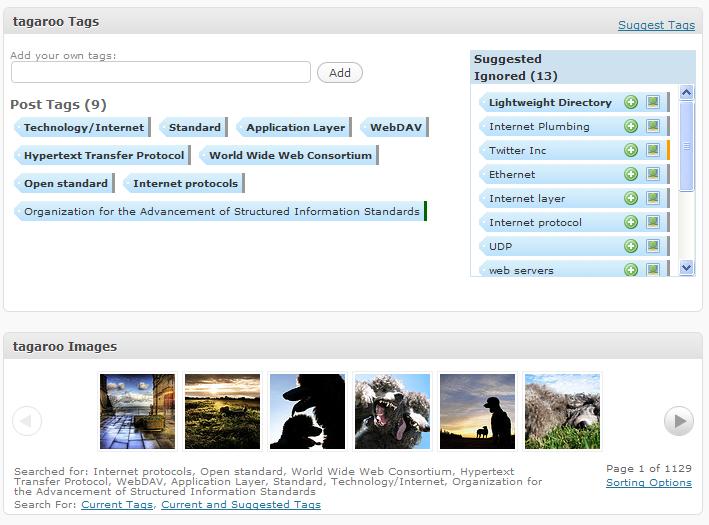
- OpenCalais- A service that semantically parses your content and identifies people, events, places and more. I used the WordPress plugin Tagaroo on this blog for fun. Only basic use is free, though. Probably doesn’t really belong here. However, below is a screenshot that shows Tagaroo suggesting tags and images for this blog post. The power of semantic analysis.

 RSS Feed
 Follow Me
Hey, Microsoft just applied to join the SVG working group so there is hope yet!
The only real filesystem standards are in POSIX which starts to get a little bit tangential perhaps. Plus NFS, which is IETF. CIFS is not standardized by any external body.
There are not a huge number of standards specifically related to content management, I think a diagram could work here… will work on something.
Looking forward to seeing it. I don’t think they need to be directly related to the Content Management side. Content Delivery / PMS side standards should get on there too.
So many standards, so much confusion.
It seems to me that in general proprietary vendors does just a good job of standards compliance compared to open source vendors. I know that Microsoft has not been great historically, but IBM and Oracle seems to do well with most if not all of the above.
Yes there are a lot of standards…. but in my opinion few of them actually help you in delivering an actual CMS project. Most of them are to do with getting data in and out of a system (SQL, CMIS), or the way in which the data is presented to the end user (HTML, XML, CSS).
If you need to implement a specific piece of functionality that your proprietary CMS system does not support then you can yell ‘Open Standards’ until you are blue in the face. If there isn’t an API that allows you to do what you want to do, or the vendor does not support (or want to support) what it is you want to do then you are out of luck. Simple as that.
So, yes I agree that Open Standards are a must, and are IMHO a *minimum* needed, but I don’t think they can encompass the whole benefit in terms of flexibility, transparency, and balance of power between vendor and client you get from Open Source.
-Matt
Just to add to this, my response and take on this is now up:
http://www.netsight.co.uk/blog/2010/1/11/open-source:-does-it-matter
-Matt
On the subject of SVG, I think there’s still a good chance that it’ll take off given that Microsoft is now showing an interest.
I just realised Justin already pointed that out. Ignore me.
Tom Tague from OpenCalais here.
First – thanks for mentioning Tagaroo – and a brief clarification on usage. You can use it as much as you want – for commercial or non-commercial blogs – up to 50,000 times per day (that’s a lot of posts). It works on top of the OpenCalais service which has the same usage rules.
For those 50,000 transactions you get the full OpenCalais capability – not some dumbed down version. Above 50,000 per day and we’d like to have a discussion on some flavor of value exchange.
Thanks for the article!
Regards
Can believe I forgot OSGi. Justin – make sure that’s in your uber-diagram
Here is the first version. No OSGI yet… and not enough standards bodies mentioned
http://blog.technologyofcontent.com/2010/01/standards-diagram/
Prezi is fun! Havent worked it all out yet though…
What! No mention of ECMAScript, the world’s most-installed programming language?
I’d also like to see some mention of Microformats such as hCard, vCard and hCalendar, which seem to have been in RFC since 1998 and are as close to a de facto open standard as you can get.
Note to self. There is now an Apache Project (Shindig – http://incubator.apache.org/shindig/) providing an OpenSocial reference. I didn’t know this. Very exciting.
An Incomplete Directory of Open Standards | Jon On Tech
nike blazers http://www.1sthour.com/
An Incomplete Directory of Open Standards | Jon On Tech
women ugg boots for cheap http://www.cascatafarm.com/
An Incomplete Directory of Open Standards | Jon On Tech
輝きのUGG http://www.rent-a-locker.com/ugg-japan/輝きのUGG.html
[MARKED AS SPAM BY ANTISPAM BEE | CSS Hack]Undeniably believe that which you stetad. Your favorite reason seemed to be on the net the simplest thing to be aware of. I say to you, I certainly get irked while people consider worries that they just don’t know about. You managed to hit the nail upon the top and also defined out the whole thing without having side-effects , people could take a signal. Will likely be back to get a lot more. Thanks
An Incomplete Directory of Open Standards | Jon On Tech
nike blazers low women http://www.prbf.org/2013blazers/nike-blazers-low-women.html
An Incomplete Directory of Open Standards | Jon On Tech
nikeblazersmid http://www.mdc-ltd.co.uk/images/nike-blazers/nike-blazers-mid.html
An Incomplete Directory of Open Standards | Jon On Tech Anna Sui【アナスイ】バッグ ショルダーバッグ ワーク 新作 レディース ブランド ピンククリアランスセール http://www.gnbadditions.com/anna-sui【アナスイ】バッグ-ショルダーバッグ-ワーク-新作-レディース-ブランド-ピンククリアランスセール-p-49.html
An Incomplete Directory of Open Standards | Jon On Tech ポールスミス財布二つ折り財布アイボリーメンズ紳士 http://www.tyrephoto.com/paul-smith【ポールスミス】財布二つ折り財布-paul-smith-アイボリー-psk86463-メンズ-紳士-b-p-183.html
An Incomplete Directory of Open Standards | Jon On Tech
ブーツ メンズ コーデ http://www.penmanshipmusic.com/ugg/ブーツ-メンズ-コーデ.html
855 I don’t have a 70 inch moose rack over the wall, but I think about my lesser moose as trophies nevertheless. But I discovered out right this moment that it’s the Louis Vuitton watches developing further diamonds and becoming more high-class.
louis vuitton backpack replica http://www.crowehill.org/replicalouisvuitton.htm
855 I don’t have a 70 inch moose rack over the wall, but I take into consideration my smaller moose as trophies however. But I found out these days that it is the Louis Vuitton watches acquiring a good deal more diamonds and to be increased lavish.
cheap kids uggs http://www.epilationservices.co.uk/cheapuggs.html
An Incomplete Directory of Open Standards | Jon On Tech
mini bailey button uggs http://www.rebattu.com/uggs-outlet/mini-bailey-button-uggs.html
En términos generales, aún más grande, una mejor calidad y las aves más maduras, pelusa, por así decir pelusa ganso será mejor. Pero el proceso de producción de ganso y el pato es el mismo, tanto en términos de calidad, mullido, caliente la diferencia no era mucho. La razón más importante caro que el ganso pato, creo que es mucho menor que el rendimiento del edredón de pluma de ganso – temporada de ganso produce tan sólo un año, el pato puede producir hasta tres cuartas partes del año.
What is better still is that as an alternative
to having to buy countless watches for various occasions,
this watch can fulfil many fashion roles, from smart,
to stylish and in many cases casual. Apart in
the wide variety of case and wrist band colours, the G Shock 6900 also includes
a wide selection of face colours and types. Each G-shock is different,
however, and several will offer even a lot more than the four basic features, like solar power, tide
graphs, moon age data, and temperature resistance.
They are also the entry through which very many people enter their homes at the end of long days.
Steel garage doors cost about $600 for the most basic
variety and there are many more styles which are priced accordingly.
These tend to be the noisiest of doors so bear this in mind if you
have a bedroom above and need to use the door when people may be sleeping.
Today, while I was at work, my cousin stole my iPad and tested
to see if it can survive a 40 foot drop, just so she can be a youtube sensation.
My iPad is now broken and she has 83 views. I know this is completely off topic but I had to share it with
someone!
I do not even understand how I finished up here, but I thought this post was once good. I don’t understand who you’re but definitely you’re going to a well-known blogger should you are not already. Cheers!
I’m not sure exactly why but this weblog is loading extremely slow for me.
Is anyone else having this issue or is it a issue on my end?
I’ll check back later and see if the problem still exists.
Hello my friend! I want to say that this post is awesome, great written and include almost all significant infos.
I’d like to see more posts like this .
Review my page; Low Cost Removals
[MARKED AS SPAM BY ANTISPAM BEE | CSS Hack]I would like to express my reecspt for your generosity giving support to folks who have the want for assist with this theme. Your special commitment to obtaining the remedy across was extraordinarily informative and has all the time helped some individuals considerably like me to realize their ambitions. The warm and friendly helpful info denotes a lot to me and a whole lot more to my office workers. Very best wishes; from everyone of us.
[MARKED AS SPAM BY ANTISPAM BEE | CSS Hack]His or her shape of unrealistic tats were ililianty threatening. Lindsay utilized gun 1st basic, whereas this girl snuck outside by printer ink dog pen. I used absolutely positive the all truly on the shade, with the tattoo can be taken from the body shape. make an own temporary tattoo
Excellent article. Keep posting such kind of information on your page.
Im really impressed by your blog.
Hi there, You’ve performed a fantastic job.
I will definitely digg it and for my part suggest to my friends.
I am confident they will be benefited from this website.
Feel free to surf to my blog … Google
Thank you for some other informative web site. The place else may just
I am getting that type of information written in such an ideal method?
I’ve a mission that I am just now working on, and I’ve been on the glance out for such information.
Hello, yes this post is actually pleasant and I have learned lot of things from it about
blogging. thanks.
Physiotherapists highly recommend bodybuilders to don a wristband during weightlifting sessions in the gym or during contests.
For televised information, the viewers needed to watch Dordarshan and some worldwide information channels like BBC or CNN.
Online surveys are actually a reliable half time job
and a approach to herald some extra cash from
throughout the residence.
CENTURY 21′in faaliyette olduğu tüm ülkelerdeki
ofislerle ortak çalışma yapabilir, yönlendirme yaparak satış kiralama işlemlerine aracılık edebilirsiniz.
it just merely puts you in a position where you
can comfortably BE. Due to purely herbal composition these can be used by person of any age and gender without any medical prescription. It is organically grown,
without herbicides, pesticides or insecticides.
Every weekend i used to go to see this web page, because
i want enjoyment, for the reason that this this site conations
truly fastidious funny data too.
Wonderful items from you, man. I’ve be mindful your stuff previous
to and you are just extremely excellent. I actually like what you’ve bought here,
certainly like what you’re stating and the way in which
wherein you are saying it. You make it entertaining
and you still care for to stay it smart. I cant wait to learn far
more from you. That is actually a great site.
After 23+ years with USAA, no homeowners claims until 3 years
ago, not one late cost, they dropped our homeowners insurance.
Hello there, You have done a great job. I’ll definitely digg
it and personally suggest to my friends. I’m confident they’ll be benefited from this web site.
I don’t know if it’s just me or if everybody else experiencing issues with your site.
It seems like some of the written text on your content
are running off the screen. Can somebody else please provide feedback and let me know if this is happening to them too?
This may be a issue with my internet browser because I’ve had this happen before.
Cheers
Quality articles or reviews is the crucial to invite the viewers to pay
a visit the website, that’s what this site is providing.
Magnificent web site. Lots of helpful info here. I’m sending it to several buddies ans additionally sharing in delicious.
And obviously, thank you for your effort!
Since responsive design is evolving, there are quite a few software packages which can be also evolving on the similar time.
Completa los logros que te piden en el juego.
Coming into into an electrician apprenticeship program is actually a satisfying career.
For example, the Golden Occasions Group, Inc.
For a while in the design industry we have been informed to maintain as much above
the fold as we can, or at the least the necessary stuff.
L’ecole du Dimanche or Sunday faculty may be plenty of fun with the suitable choice
of songs.
The Nashville Sound characterised the country music of
the period.
Each of them are helpful and a common decisions to buy,
but a combo bar that has spot and flood functions may assist you cope with
the issue to decide on. It can work by dividing flood and spot reflectors along the bar’s length or by splitting the capabilities between rows.
Interesting how it’s the fathers and/or the new girlfriends & wives of the fathers who have to pay child
help which have enormous problems with this topic.
I all the time see my son and it is silly to just take
a look at a persons’ wage and say that is how a lot you will
pay.
The great information is that you can replenish this Vitamin C simply.
The Vitamin C Serum will soak up instantly into your skin, and deal with age
spots, wrinkles and tremendous strains. Vitamin C
aids in the manufacturing of Collagen, which as we
all know that once you age your collagen production declines, and
you get wrinkles.
On this recording venture, is equipped also other artists who lately have shared quite a bit with the group, such because
the Ligurian Stefano Valla, the most vital player of the
Four Provinces Fife, French Grégory Jolivet to the hurdy gurdy,
singer Sabrina Pallini and Paolo Bonfanti to the electrical guitar.
They are barely costlier than a junkyard part may be, nevertheless they will still value lower than a model new part.
Moreover, many of these re manufactured elements will also embody a limited
guarantee, which is a definite advantage when you could substitute an element in your automobile.
Another key benefit to purchasing used auto elements is that it
is a superb way to assist the environment.
You can provide the auto elements that they do not.
Thanks for the marvelous posting! I certainly enjoyed reading it, you can be a great author.I will
ensure that I bookmark your blog and will come back down the road.
I want to encourage that you continue your great work, have a nice afternoon!
As mentioned, France is a popular vacationer destination.
A number of days ago our heater went out.
The Cave will supply the gaming community the flexibility to spend their time gaming
with other like-minded people in a friendly social atmosphere with all the comforts of gaming at house, all at a aggressive worth.
InterMapper’s built-in probes and SNMP services keep him in contact with customary network units
and broadcast specific tools including the Chook BPME series wattmeters, Audimat
RDS encoders and all the transmitter remote management gear.
Weitere Informationen über Referenzsound Mastering findet ihr auf Es würde mich freuen eure Tracks zu hören und mit euch zu finalisieren.
The T5 carries over a similar 9-level AF system with
one central cross-kind AF point, and a 3fps continuous capturing burst performance spec.
It is just not a secret already for many individuals that it is attainable to watch many matches
of soccer on-line by way of Internet, but it is not completely so, it’s attainable to look at much more
than on TV through Internet If you for instance are fond of rates on sports our website
will even provide help to very a lot as we have results of all matches of various kinds of sports, and live streams, together with footballonline.
The video games offers plenty of content to keep
players busy and, mixed with the excessive level cap, it
provides many hours of potential gameplay.
I benefit from looking through your website. Regards!
NBA http://jz.360shangjia.com/comment/html/index.php?page=1&id=134428
I enjoy this site – its so usefull and helpfull
CSGO http://classifieds.thecommunityuae.com/author/wmymargarit/
The final focus for HubPages continues to be the same: to create the very best place for people to put in writing online.
Great looking website. Presume you did a great deal of your ownyour very own html coding
COUNTERSTRIKE http://tjsnty.com/comment/html/index.php?page=1&id=181945
People working at BLS appeared extremely organized contrary to what I heard about them in online boards.
Some companies use small cameras which can be exhausting to detect as a result of they can be
put in in a ceiling vent or inside a wall clock.
I think everything posted was actually very reasonable.
However, what about this? what if you added a little information? I am not saying your content is not solid, however
what if you added a post title that makes people desire more?
I mean An Incomplete Directory of Open Standards
| Jon On Tech is kinda plain. You could peek at Yahoo’s
front page and note how they create post titles to get people
to open the links. You might try adding a video or a pic or
two to grab people excited about everything’ve written. Just my opinion, it
would make your blog a little livelier.
Oaks additionally provided shelter for fire fighters in the blaze, whereas different tree species exploded.
Once water went you will need to cope with the carpets or another flooring.
Flood barriers are one of the most effective ways of preventing
flood waters from entering your house. If the river damage within your basement comes
from a minor spill, you’ll be able to likely take care of it on your
own own.
There is noticeably a lot to know about this. I believe you made certain nice points in features also.
victoria’s secret st patricks day shirts http://buff.ly/2mJhIdQ
Skype has opened its internet-centered client beta towards the world, soon after launching it extensively in the Usa and You.K.
previously this month. Skype for Online also now supports Chromebook and Linux for immediate text messaging conversation (no voice and video yet, all those
require a plug-in set up).
The increase from the beta adds assistance for a longer set
of dialects to help you bolster that international usability
An Incomplete Directory of Open Standards | Jon On Tech
Qué recomiendan acerca de adquirir una empresa en cesión? Por un motivo lo
están traspasando.
Excelllent suggestions for water saving while gardening.
Hallo, Ordentlich Post. Es gibt ein Problem mitt Ihrem Website in Web explorer, Maai prüfen das?
IE noch dennoch ist der Marklt Marktführer und eine große Komponente andere Menschen werden weglassern Ihhre ausgezeichnete
schriftlich durch dieses Problem.
I am actually glad to glance at this weblog posts which includes tons of useful facts,
thanks for providing these data.
6iWa3E Very good post! We are linking to this particularly great content on our site. Keep up the good writing.
If a Swiss army knife is anything, then it’s bulky.
gode lommeknive https://www.schweizerknive.dk/10-ting-man-kan-med-en-lommekniv/
This blog is obviously entertaining and factual. I have picked up many useful tips out of it. I ad love to visit it again soon. Cheers!
P.S. аА аАТаА аЂааА бТТаАабТТ, аА аБТаАааАТаАабТТаА аЂааАабТТаА аБТ, аАааБТ аА аАТаА аЂааАааАТ аА аБТаАааАТаА аБТаА аБТаА аБТаА аЂааАааАТаА аАТ аА аБТ аАааАТаА аАТаА аЂааАааАТаАааАТаАабТТаА аЂааА аАТ
Hi, I found your website by the utilisation of Google even as hunting down a comparable subject, your site came up, it seems very good. I’ve bookmarked it in my google bookmarks.
Efficiently composed post and there is also interesting content. It will be important to anyone who utilizes it, including myself. Keep doing awesome hold up to peruse more.
I’m really impressed with your services as well as with the layout on your blog. The overall look of your website is magnificent, as well as the content. I can not wait to read far more from you.
You are not probably to achieve virtually just about everywhere if you definitely really don at brush for that
You made some OK factors there. I looked on the web for the issue and found a great many people will connect with together with your site.
I enjoy you because of all of your effort on this website.All of us hear all relating to the medium you give simple tips on your web blog.
I got this web site from my pal who shared with me concerning this site and at the moment this time I am browsing this web site and reading very informative articles at this time.
click here. https://www.goodreads.com/topic/show/19983165-prons-and-cons-to-2019-chevrolet-silverado-1500-work-truck?tab=author
Cash for gold is one of the best way to convert your scrap and old jewelry into cash without any problem. If you want to get more cash so you have to sell your gold, silver and diamond jewelry to us because we are Gold buyer who gives maximum cash for your gold items. Feel free to call us on +91-9999821702, +91-9999195468 or visit here: http://www.cashforgoldindelhincr.com/
Everything consists of five basic elements – fire, water, earth, space, and air. The balance that is observed in nature is easily noticeable in all moving bodies, but unfortunately we cannot perceive this balance in static bodies. Get more Vastu tips by a Vastu Consultant. Call +91-9999256700 now or Visit: – http://vastu-india.com/
Thanks For sharing this the informative information . keep doing this as usual do. if you want to integrate your all social data then Data Channel is the best service provider.
I do not know whether it’s just me or if perhaps everybody else encountering issues with your site. It looks like some of the written text within your content are running off the screen. Can someone else please comment and let me know if this is happening to them too? This may be a issue with my browser because I’ve had this happen before. Thank you
click here https://diigo.com/0i1jam
Usually I do not read post on blogs, but I would like to say that this write-up very forced me to take a look at and do it! Your writing style has been surprised me. Thanks, very great article.
Click here. https://www.fanfiction.net/u/13916769/
What’s up, its pleasant article about media print, we all know media is a great source of facts.
click here https://brady80bird.webgarden.cz/rubriky/brady80bird-s-blog/why-are-led-lights-better-2
Awesome! Its truly amazing article, I have got much clear idea regarding from this post.
click here https://malone26warren.webgarden.cz/rubriky/malone26warren-s-blog/why-led-bulbs-brighter-than
This is my first time pay a visit at here and i am actually happy to read all at alone place.
I’m extremely impressed with your writing skills and also with the layout on your blog. Is this a paid theme or did you customize it yourself? Anyway keep up the nice quality writing, it is rare to see a nice blog like this one nowadays..
Hey, I think your site might be having browser compatibility issues. When I look at your blog in Firefox, it looks fine but when opening in Internet Explorer, it has some overlapping. I just wanted to give you a quick heads up! Other then that, great blog!
At this time it looks like Movable Type is the preferred blogging platform out there right now. (from what I’ve read) Is that what you are using on your blog?
whoah this blog is excellent i love reading your articles. Keep up the great work! You know, many people are searching around for this info, you can help them greatly.
Awsome article and straight to the point. I don’t know if this is truly the best place to ask but do you guys have any ideea where to employ some professional writers? Thx
I would like to thank you for the efforts you have put in writing this web site. I’m hoping the same high-grade website post from you in the upcoming as well. In fact your creative writing abilities has encouraged me to get my own site now. Actually the blogging is spreading its wings rapidly. Your write up is a great example of it.
As I web site possessor I believe the content matter here is rattling magnificent , appreciate it for your hard work. You should keep it up forever! Good Luck.
You really make it seem so easy with your presentation but I find this topic to be really something that I think I would never understand. It seems too complicated and very broad for me. I am looking forward for your next post, I will try to get the hang of it!
Hey there, You have done a fantastic job. I will certainly digg it and for my part recommend to my friends. I’m confident they’ll be benefited from this web site.
WONDERFUL Post.thanks for share..extra wait .. …
Hello, i think that i saw you visited my website thus i came to “go back the desire”.I’m trying to to find issues to improve my site!I assume its ok to use some of your ideas!!
After 2 weeks: You’ll expertise wholesome drops in blood stress if you’ve been diagnosed with hypertension.
Pretty section of content. I just stumbled upon your blog and in accession capital to say that I acquire in fact enjoyed account your weblog posts. Any way I’ll be subscribing to your augment or even I achievement you get entry to persistently fast.
Attractive section of content. I just stumbled upon your blog and in accession capital to assert that I acquire actually enjoyed account your blog posts. Any way I’ll be subscribing to your feeds and even I achievement you access consistently quickly.
hello there and thank you in your info – I’ve certainly picked up something new from proper here. I did then again experience some technical points using this website, as I experienced to reload the site a lot of occasions prior to I may just get it to load correctly. I have been brooding about in case your web host is OK? Now not that I’m complaining, but slow loading instances times will very frequently impact your placement in google and could injury your quality score if advertising and ***********|advertising|advertising|advertising and *********** with Adwords. Anyway I’m including this RSS to my email and could glance out for much more of your respective intriguing content. Ensure that you replace this again very soon..
It’s the excellent way to get every little thing done and lastly take pleasure in a complete top quality life.
It’s a shame you don’t have a donate button! I’d definitely donate to this superb blog! I guess for now i’ll settle for bookmarking and adding your RSS feed to my Google account. I look forward to fresh updates and will talk about this blog with my Facebook group. Chat soon!
Thanks for ones marvelous posting! I seriously enjoyed reading it, you might be a great author.I will ensure that I bookmark your blog and will come back from now on. I want to encourage you to ultimately continue your great writing, have a nice afternoon!
I appreciate the flexibility and customization provided by my agence de voyages in tailoring my travel itinerary to my preferences.
do apples increase metabolism https://drive.google.com/drive/folders/1J8ruOLYNYtc0S-uHaOOV3dag-Np6yq3A
I appreciate the support and guidance provided by my agence de voyages in navigating the ever-changing travel restrictions and regulations.
how to fast your metabolism https://drive.google.com/drive/folders/1Maz-8jLvcObDL8WmoBB2fwbamRhkFnGZ
I appreciate the comprehensive planning and organization provided by my agence de voyages.
foods that jump start metabolism https://drive.google.com/drive/folders/1xTvkJx_BWLM8sgdxMKZit2r_xfzPH56a
The convenience of having everything planned for you by an agence de voyages is unbeatable.
how can you boost your metabolism naturally https://drive.google.com/drive/folders/1OQga8NHh37v2OKVe4v1r1r1-6cinygpj
Agences de voyages can help you plan a trip that is focused on wellness and mindfulness.
basal metabolism how to increase https://docs.google.com/spreadsheets/d/1XAeTy5ufUnb87Ae0GXqtEhbkJjmtdRh1xujGMC2YfH4
As a Newbie, I am continuously browsing online for articles that can be of assistance to me. Thank you
I’m extremely inspired together with your writing skills and also with the layout to your weblog. Is that this a paid topic or did you modify it your self? Either way keep up the excellent high quality writing, it’s rare to peer a nice blog like this one nowadays..
you’re really a good webmaster. The web site loading speed is incredible. It seems that you are doing any unique trick. In addition, The contents are masterpiece. you have done a great job on this topic!
You are a very capable person!
Hi there, i read your blog occasionally and i own a similar one and i was just wondering if you get a lot of spam feedback? If so how do you stop it, any plugin or anything you can recommend? I get so much lately it’s driving me crazy so any help is very much appreciated.
Краснуха — это острая вирусная инфекция, которая проявляется сыпью, интоксикацией и умеренным увеличением лимфатических узлов [url=https://med-newton.ru/yslugi/epileptologiya/]подростковый психолог спб [/url]
Выделяют следующие формы болезни:
Обеспечение дезинфицирующего и подсушивающего эффекта [url=https://med-newton.ru/service_cat/fizioterapiya/]остеопатический [/url]
Обработка движениями изнутри кнаружи или от центра к периферии предупреждает занос инфекции в пупочную ранку
В наше время, в условиях проживания в городах, наблюдение педиатра необходимо ребёнку с первых месяцев жизни [url=https://med-newton.ru/yslugi/massazh/]что делает врач невролог [/url]
Не потому, что он сразу заболевает, а для того, чтобы помочь родителям предотвратить болезнь, научить их применять профилактические меры и распознавать надвигающийся недуг по состоянию ребенка [url=https://med-newton.ru/yslugi/elektroforez/]врач-невролог [/url]
Необязательно нести на первый патронаж к новорожденному ребенку полный состав рабочей сумки [url=https://med-newton.ru/yslugi/kvh/]педиатру [/url]
При проведении дородового патронажа медицинская сестра оценивает материальные возможности семьи и при необходимости берет минимальный набор для проведения необходимых манипуляций [url=https://med-newton.ru/yslugi/defektolog/]хороший остеопат [/url]
При проблемах с ЖКТ [url=https://med-newton.ru/yslugi/defektolog/]остеопата [/url]
Вызов детского врача требуется, если у ребенка наблюдается сильное срыгивание, рвота, расстройства стула (понос) [url=https://med-newton.ru/yslugi/transkranialnaya-mikropolyarizaciya/]хороший детский психолог [/url]
Такие симптомы в сочетании с повышением температуры могут быть признаком вирусной кишечной инфекции или острого отравления [url=https://med-newton.ru/]Прием У Невролога [/url]
Еще один повод немедленно вызвать педиатра на дом – жалобы малыша на боль в животе, которая может быть признаком серьезных патологий (например, аппендицита), требующих срочного лечения [url=https://med-newton.ru/yslugi/osteopatiya/]прием невролога в спб [/url]
Особенности работы участковой медицинской сестры с ребенком грудного возраста [url=https://med-newton.ru/yslugi/logopedicheskij-massazh/]невролог санкт петербург [/url]
Первостепенное значение в работе с детьми грудного возраста имеют вопросы сохранения грудного вскармливания [url=https://med-newton.ru/yslugi/reabilitolog/]врач-педиатр [/url]
Осматривая ребенка, сестра должна уметь оценить его состояние и самочувствие, обратить внимание на глаза, уши, кожные покровы и видимые слизистые, оценить характер стула, реакцию на БЦЖ – вакцинацию (в 1,3,6,12 месяцев), определить динамику и соответствие возрасту ведущих линий нервно-психического развития, характер поведенческой реакции [url=https://med-newton.ru/yslugi/magnitoterapiya/]хороший остеопат [/url]
Сестра должна обучить мать элементам ухода за ребенком, дать совет по режиму дня, рекомендовать новые блюда в питании ребенка, обучить мать элементам физического воспитания, закаливанию и воспитательному воздействию [url=https://med-newton.ru/yslugi/kvh/]психолог по семейным отношениям [/url]
Heya i’m for the first time here. I found this board and I find It really useful & it helped me out much. I hope to give something back and aid others like you aided me.
What i do not realize is actually how you’re not really much more well-liked than you might be now. You’re so intelligent. You realize thus significantly relating to this subject, made me personally consider it from numerous varied angles. Its like women and men aren’t fascinated unless it’s one thing to do with Lady gaga! Your own stuffs outstanding. Always maintain it up!
Hey There. I found your blog using msn. This is an extremely well written article. I’ll make sure to bookmark it and return to read more of your useful information. Thanks for the post. I’ll definitely comeback.
Spot on with this write-up, I seriously think this site needs much more attention. I’ll probably be back again to read more, thanks for the information!
My developer is trying to convince me to move to .net from PHP. I have always disliked the idea because of the costs. But he’s tryiong none the less. I’ve been using WordPress on several websites for about a year and am concerned about switching to another platform. I have heard good things about blogengine.net. Is there a way I can import all my wordpress content into it? Any help would be really appreciated!
Hey there, You have done an excellent job. I will certainly digg it and personally suggest to my friends. I am sure they will be benefited from this web site.
Great site! I am loving it!! Will come back again. I am taking your feeds also.
I have been exploring for a little bit for any high quality articles or weblog posts on this kind of area . Exploring in Yahoo I at last stumbled upon this site. Reading this information So i’m glad to express that I have a very good uncanny feeling I found out just what I needed. I most for sure will make sure to don’t omit this site and provides it a glance on a continuing basis.
hi!,I like your writing very much! share we communicate more about your article on AOL? I require an expert on this area to solve my problem. Maybe that’s you! Looking forward to see you.
Hello there, simply changed into aware of your weblog thru Google, and found that it is truly informative. I’m going to be careful for brussels. I’ll appreciate when you proceed this in future. Numerous people will probably be benefited from your writing. Cheers!
I like the helpful information you provide in your articles. I will bookmark your weblog and check again here frequently. I’m quite sure I will learn many new stuff right here! Best of luck for the next!
Hi there, I found your website by the use of Google whilst searching for a similar topic, your site got here up, it seems good. I have bookmarked it in my google bookmarks.
Hey! This is my 1st comment here so I just wanted to give a quick shout out and tell you I genuinely enjoy reading through your articles. Can you suggest any other blogs/websites/forums that deal with the same subjects? Appreciate it!
Heya! I’m at work surfing around your blog from my new iphone 4! Just wanted to say I love reading your blog and look forward to all your posts! Keep up the fantastic work!
Hi there, I found your web site via Google while looking for a related topic, your site came up, it looks great. I’ve bookmarked it in my google bookmarks.
I precisely wished to thank you so much once more. I’m not certain what I would’ve sorted out in the absence of these advice shared by you on such a field. It previously was a real hard scenario in my position, nevertheless seeing a new professional technique you solved the issue forced me to leap with happiness. I’m happier for your service and thus have high hopes you comprehend what a great job you happen to be getting into educating men and women using a blog. I am sure you have never come across any of us.
I was curious if you ever thought of changing the structure of your website? Its very well written; I love what youve got to say. But maybe you could a little more in the way of content so people could connect with it better. Youve got an awful lot of text for only having one or 2 pictures. Maybe you could space it out better?
Thanks for every other informative site. Where else may I get that kind of info written in such a perfect manner? I’ve a venture that I’m simply now working on, and I’ve been on the look out for such information.
http://grillgrrrl.com/2010/04/womens-grilling-clinic-was-a-hit/_dsc0667
Attractive part of content. I just stumbled upon your weblog and in accession capital to say that I get in fact enjoyed account your blog posts. Anyway I will be subscribing in your feeds and even I achievement you get entry to constantly quickly.
Good write-up, I’m regular visitor of one’s site, maintain up the excellent operate, and It’s going to be a regular visitor for a long time.
Hello.This post was extremely interesting, particularly because I was looking for thoughts on this issue last Monday.
You actually make it seem so easy with your presentation but I find this matter to be actually something that I think I would never understand. It seems too complicated and very broad for me. I am looking forward for your next post, I will try to get the hang of it!
I simply could not depart your web site before suggesting that I really loved the standard info a person provide for your visitors? Is going to be back often to investigate cross-check new posts
I very delighted to find this internet site on bing, just what I was searching for as well saved to fav https://freehorseracingtv.com/live2/
Excellent article! We will be linking to this particularly great article on our website. Keep up the good writing. https://freehorseracingtv.com/live2/
Great blog here! Also your web site quite a bit up fast! What web host are you the use of? Can I am getting your associate link on your host? I want my website loaded up as fast as yours lol
Hi, i think that i saw you visited my weblog thus i came to “return the favor”.I’m trying to find things to enhance my site!I suppose its ok to use some of your ideas!!
где купить справку
It’s really a great and helpful piece of information. I am satisfied that you shared this helpful info with us. Please keep us informed like this. Thank you for sharing.
WONDERFUL Post.thanks for share..extra wait .. …
Spot on with this write-up, I actually suppose this website needs much more consideration. I’ll most likely be once more to learn rather more, thanks for that info.
Hi there would you mind letting me know which webhost you’re utilizing? I’ve loaded your blog in 3 different web browsers and I must say this blog loads a lot faster then most. Can you recommend a good web hosting provider at a honest price? Kudos, I appreciate it!
Nice post. I used to be checking continuously this blog and I’m impressed! Very helpful information specifically the ultimate phase I maintain such info a lot. I was looking for this particular information for a very long time. Thank you and best of luck.
My brother recommended I would possibly like this website. He used to be entirely right. This post truly made my day. You cann’t believe just how so much time I had spent for this info! Thanks!
This design is spectacular! You definitely know how to keep a reader entertained. Between your wit and your videos, I was almost moved to start my own blog (well, almost…HaHa!) Excellent job. I really enjoyed what you had to say, and more than that, how you presented it. Too cool!
I’d must examine with you here. Which isn’t something I often do! I take pleasure in studying a put up that may make people think. Additionally, thanks for permitting me to comment!
hi!,I love your writing very so much! proportion we be in contact extra about your post on AOL? I require a specialist in this house to unravel my problem. Maybe that is you! Looking ahead to look you.
I simply could not leave your site prior to suggesting that I extremely enjoyed the standard information a person supply in your visitors? Is going to be back regularly in order to check out new posts
It’s appropriate time to make some plans for the future and it is time to be happy. I have read this post and if I could I want to suggest you few interesting things or tips. Perhaps you could write next articles referring to this article. I wish to read more things about it!
Hello, i think that i noticed you visited my weblog so i came to “return the desire”.I’m attempting to in finding things to enhance my site!I suppose its good enough to use some of your concepts!!
Hi there
healthy
Thanks a lot for sharing this with all people you actually recognize what you are speaking approximately! Bookmarked. Kindly additionally visit my web site =). We could have a hyperlink trade arrangement among us!
Thank you for sharing superb informations. Your site is so cool. I am impressed by the details that you’ve on this web site. It reveals how nicely you understand this subject. Bookmarked this website page, will come back for extra articles. You, my friend, ROCK! I found simply the information I already searched all over the place and simply couldn’t come across. What a great website.
Wow that was odd. I just wrote an very long comment but after I clicked submit my comment didn’t show up. Grrrr… well I’m not writing all that over again. Anyway, just wanted to say fantastic blog!
Hiya, I am really glad I have found this info. Today bloggers publish just about gossips and web and this is really annoying. A good site with exciting content, that is what I need. Thank you for keeping this web site, I’ll be visiting it. Do you do newsletters? Cant find it.
I have not checked in here for a while as I thought it was getting boring, but the last several posts are good quality so I guess I will add you back to my daily bloglist. You deserve it my friend
An impressive share, I simply given this onto a colleague who was doing just a little evaluation on this. And he the truth is purchased me breakfast as a result of I found it for him.. smile. So let me reword that: Thnx for the deal with! But yeah Thnkx for spending the time to discuss this, I feel strongly about it and love studying more on this topic. If potential, as you develop into experience, would you mind updating your weblog with extra details? It is extremely helpful for me. Massive thumb up for this weblog submit!
Terrific work! That is the kind of information that are supposed to be shared across the net. Shame on the search engines for no longer positioning this submit upper! Come on over and talk over with my web site . Thanks =)
Hello there I am so excited I found your webpage, I really found you by mistake, while I was searching on Digg for something else, Regardless I am here now and would just like to say many thanks for a remarkable post and a all round thrilling blog (I also love the theme/design), I don’t have time to read it all at the minute but I have saved it and also added your RSS feeds, so when I have time I will be back to read a lot more, Please do keep up the superb job.
Thanks , I’ve recently been looking for information about this topic for ages and yours is the best I have discovered till now. But, what about the conclusion? Are you sure about the source?
hi!,I like your writing very much! share we communicate more about your post on AOL? I need an expert on this area to solve my problem. May be that’s you! Looking forward to see you.
may test this� IE nonetheless is the marketplace leader and a huge part of people will miss your great writing because of this problem.
Neat post. There’s a problem with your web site in web explorer
My spouse and I stumbled over here different web page and thought I might check things out. I like what I see so now i’m following you. Look forward to looking over your web page again.
I’ve read a few just right stuff here. Definitely worth bookmarking for revisiting. I surprise how a lot effort you put to make the sort of magnificent informative site.
I simply wanted to jot down a note to be able to express gratitude to you for some of the amazing solutions you are giving here. My extensive internet lookup has at the end of the day been paid with useful points to write about with my friends and family. I ‘d suppose that many of us visitors are rather lucky to be in a very good place with very many outstanding individuals with helpful tips and hints. I feel really grateful to have come across the website page and look forward to so many more excellent minutes reading here. Thanks a lot once again for everything.
Hey there! Do you use Twitter? I’d like to follow you if that would be ok. I’m absolutely enjoying your blog and look forward to new updates.
I keep listening to the news broadcast speak about receiving boundless online grant applications so I have been looking around for the most excellent site to get one. Could you advise me please, where could i acquire some?
We are a bunch of volunteers and opening a new scheme in our community. Your website provided us with useful information to paintings on. You’ve performed an impressive process and our entire group will probably be thankful to you.
I do believe all of the concepts you have presented on your post.
They’re really convincing and will definitely work.
Nonetheless, the posts are too brief for newbies.
May just you please lengthen them a little from next time?
Thank you for the post.
Hmm is anyone else encountering problems with the pictures on this blog loading? I’m trying to determine if its a problem on my end or if it’s the blog. Any feedback would be greatly appreciated.
This is very interesting, You are an excessively professional blogger.
I have joined your feed and look forward to in the hunt for extra of your fantastic post.
Also, I have shared your site in my social networks
It’s in fact very complex in this busy life to listen news on TV, so I just use
web for that reason, and obtain the most up-to-date information.
This website was… how do I say it? Relevant!! Finally I’ve
found something which helped me. Many thanks!
It is appropriate time to make some plans for the future
and it’s time to be happy. I’ve read this post and if I could I want to suggest you some interesting things or advice.
Perhaps you could write next articles referring to this
article. I want to read even more things about it!
I’ve been surfing on-line more than three hours nowadays, but I never found any interesting article like yours.
It is beautiful value enough for me. In my opinion, if all web owners and bloggers made just right content as you did, the internet
will be much more useful than ever before.
It’s remarkable to go to see this website and reading the views of all friends regarding this piece of writing, while I am also keen of getting knowledge.
Simply want to say your article is as astonishing. The clarity on your submit is simply nice and i could think you’re a professional in this subject. Fine together with your permission allow me to snatch your feed to stay updated with drawing close post. Thank you one million and please carry on the enjoyable work.
Hello there, I discovered your web site by the use of Google even as looking for a similar topic, your site came up, it looks great. I’ve bookmarked it in my google bookmarks.
Wow! This can be one particular of the most useful blogs We’ve ever arrive across on this subject. Basically Wonderful. I am also an expert in this topic therefore I can understand your hard work.
Greetings from Los angeles! I’m bored at work so I decided to check out your blog on my iphone during lunch break. I love the knowledge you present here and can’t wait to take a look when I get home. I’m surprised at how fast your blog loaded on my mobile .. I’m not even using WIFI, just 3G .. Anyhow, wonderful site!
Cool blog! Is your theme custom made or did you download it from somewhere? A theme like yours with a few simple tweeks would really make my blog jump out. Please let me know where you got your design. Many thanks
I’ve read several good stuff here. Certainly worth bookmarking for revisiting. I surprise how much effort you put to create such a magnificent informative web site.
Great beat ! I would like to apprentice even as you amend your web site, how can i subscribe for a weblog site? The account aided me a appropriate deal. I have been tiny bit familiar of this your broadcast provided shiny transparent concept
You made some nice points there. I looked on the internet for the issue and found most individuals will consent with your site.
Hi my family member! I want to say that this article is awesome, great written and come with almost all important infos. I’d like to see more posts like this .
My brother suggested I might like this blog. He used to be totally right. This submit truly made my day. You cann’t imagine simply how a lot time I had spent for this information! Thank you!
Would you be fascinated about exchanging hyperlinks?
Very good written information. It will be helpful to anybody who employess it, as well as me. Keep doing what you are doing – i will definitely read more posts.
I have been surfing online more than 2 hours today, yet I never found any interesting article like yours. It’s pretty worth enough for me. Personally, if all website owners and bloggers made good content as you did, the internet will be much more useful than ever before.
If you are going for most excellent contents like me, only go to see this web site every day as it offers quality contents, thanks
I loved as much as you will receive carried out right here. The sketch is tasteful, your authored subject matter stylish. nonetheless, you command get bought an edginess over that you wish be delivering the following. unwell unquestionably come further formerly again since exactly the same nearly a lot often inside case you shield this increase.
Aw, this was a really nice post. In concept I want to put in writing like this additionally – taking time and actual effort to make a very good article… but what can I say… I procrastinate alot and certainly not seem to get something done.
You really make it seem so easy together with your presentation but I to find this matter to be actually something that I think I’d by no means understand. It seems too complex and very wide for me. I am looking forward on your subsequent publish, I’ll try to get the cling of it!
I have been exploring for a little bit for any high quality articles or blog posts on this sort of area . Exploring in Yahoo I at last stumbled upon this web site. Reading this info So i am happy to convey that I have a very good uncanny feeling I discovered just what I needed. I most certainly will make certain to do not forget this site and give it a glance regularly.
very satisfying in terms of information thank you very much.
Hello just wanted to give you a quick heads up. The text in your post seem to be running off the screen in Firefox. I’m not sure if this is a format issue or something to do with web browser compatibility but I figured I’d post to let you know. The style and design look great though! Hope you get the problem resolved soon. Thanks
For the reason that the admin of this site is working, no uncertainty very quickly it will be renowned, due to its quality contents.
I very delighted to find this internet site on bing, just what I was searching for as well saved to fav
Very well presented. Every quote was awesome and thanks for sharing the content. Keep sharing and keep motivating others.
This is my first time pay a quick visit at here and i am really happy to read everthing at one place
We always follow your beautiful content, I look forward to the continuation.
This paragraph offers clear idea in favor of the
new visitors of blogging, that actually how to do blogging.
I’ve been surfing online more than 4 hours today,
yet I never found any interesting article like yours. It is pretty worth enough for me.
Personally, if all webmasters and bloggers made good content as you did, the internet
will be much more useful than ever before.
Here is my web page :: Ginkgo Thedaycorp
Remarkable issues here. I’m very glad to peer
your article. Thanks so much and I’m having a look forward to contact
you. Will you please drop me a mail?
I blog frequently and I really appreciate your information.
Your article has really peaked my interest. I am going to book mark your website and keep checking for
new information about once per week. I opted in for your
RSS feed as well.
my web site Sell my house For cash Savannah
Hey there! I just wanted to ask if you ever have any problems with hackers?
My last blog (wordpress) was hacked and I ended up losing many months of hard work due to no backup.
Do you have any methods to protect against hackers?
For most recent news you have to pay a visit world wide web and on the web I
found this web site as a best web site for latest updates.
Very descriptive article, I loved that bit. Will there be a part 2?
Good way of telling, and pleasant piece of writing to take data concerning my presentation subject, which i am going to present in college.
Good day! I could have sworn I’ve been to this site before but
after browsing through some of the post I realized it’s
new to me. Anyways, I’m definitely happy I found it and I’ll be book-marking and checking back frequently!
Hmm it seems like your website ate my first comment (it was super long) so I guess I’ll just sum it
up what I submitted and say, I’m thoroughly enjoying your blog.
I as well am an aspiring blog writer but I’m still new
to the whole thing. Do you have any tips and hints
for beginner blog writers? I’d really appreciate it.
Good post! We will be linking to this particularly great post on our site. Keep up the great writing
Article writing is also a excitement, if you be familiar with afterward
you can write if not it is complicated to write.
Excellent article! We will be linking to this particularly great article on our website. Keep up the good writing.
I loved as much as you will receive carried out right here. The sketch is attractive, your authored subject matter stylish. nonetheless, you command get bought an nervousness over that you wish be delivering the following. unwell unquestionably come further formerly again as exactly the same nearly a lot often inside case you shield this increase.
Hey I know this is off topic but I was wondering if you knew of any widgets I
could add to my blog that automatically tweet my newest twitter updates.
I’ve been looking for a plug-in like this for quite some time and was hoping maybe you would have some experience with
something like this. Please let me know if you run into anything.
I truly enjoy reading your blog and I look forward to your new
updates.
Feel free to surf to my web page 1800 dry mich
You ought to take part in a contest for one of the highest quality sites on the web. I am going to recommend this website!
The most wonderful advantages of a life time.
Good article with great ideas! Thank you for this important article. Thank you very much for this wonderful information.
I think the admin of this site is really working hard for his website, since here every stuff is quality based data.
An attention-grabbing dialogue is price comment. I believe that it is best to write more on this subject, it may not be a taboo subject but generally individuals are not sufficient to speak on such topics. To the next. Cheers
I like what you guys are up also. Such intelligent work and reporting! Carry on the superb works guys I’ve incorporated you guys to my blogroll. I think it’ll improve the value of my site
I loved as much as you’ll receive carried out proper here. The caricature is tasteful, your authored material stylish. nevertheless, you command get bought an nervousness over that you wish be turning in the following. ill surely come further earlier once more since precisely the same just about very ceaselessly within case you shield this increase.
After research a few of the blog posts in your web site now, and I actually like your way of blogging. I bookmarked it to my bookmark website record and might be checking again soon. Pls check out my web site as effectively and let me know what you think.
This is a new product that has been released lately.
Thank you for great information. I look forward to the continuation.
certainly like your web-site however you have to
test the spelling on several of your posts. Many of them are rife with spelling problems and I to find it very bothersome to inform the truth however I’ll certainly come again again.
Greetings from Los angeles! I’m bored to tears at work so I decided
to check out your blog on my iphone during lunch break.
I really like the knowledge you present here and can’t wait to take a look when I
get home. I’m shocked at how quick your blog loaded on my mobile ..
I’m not even using WIFI, just 3G .. Anyways, good site!
You really make it seem so easy with your presentation but I find this
topic to be really something that I think I would never understand.
It seems too complex and extremely broad for me.
I am looking forward for your next post, I’ll try to get the hang
of it!
My spouse and I stumbled over here coming from a different
website and thought I may as well check things out. I like what I see so now
i’m following you. Look forward to looking at your web page again.
Remarkable! Its in fact remarkable paragraph, I have got much clear idea concerning
from this paragraph.
So with all these product choices, where do you even begin digging to find the
gold? There are thousands of possible choices, yet everything seems like it’s been done thousands of times
before. Number of Revisions x 3 How many times
can you get a chosen design revised within the cost.
You flick thru all the alternatives very quickly in any respect and when you do resolve to make a purchase, it
takes a matter of minutes to get the transaction done.
The best part is, with sites like these, you get to make our own hours.
So let’s get to it! Last but not the least, online shopping can also make you pay safely through your credit card without having to worry about theft, which you might get a victim to while coming back from your shopping mall etc.
if you will get used to shopping online from particular stores, you will definitely develop a trust element
on the sellers and that will be then online shopping will become a habit of yours.
When shopping and buying products and services on the
web, make certain that your payment information is protected
by watchfully examining the security provisions of the shopping website.
I love what you guys are up too. This sort of clever work and
exposure! Keep up the great works guys I’ve incorporated you guys to my blogroll.
What a stuff of un-ambiguity and preserveness of valuable know-how about unpredicted emotions.
you’re actually a just right webmaster. The website
loading velocity is incredible. It kind of feels that you are doing any unique trick.
Also, The contents are masterwork. you’ve performed a magnificent job on this subject!
Hi there to all, how is the whole thing, I think every one is
getting more from this web page, and your views are pleasant designed for new people.
You really make it appear so easy along with your presentation but I to find this topic to be actually one thing that I think
I would by no means understand. It kind of feels too complicated and very extensive for me.
I am taking a look forward for your next publish, I’ll attempt to get
the hold of it!
I’m amazed, I have to admit. Rarely do I come across a blog that’s equally educative and entertaining, and let me tell you,
you’ve hit the nail on the head. The problem is an issue that too few people are
speaking intelligently about. Now i’m very happy
I stumbled across this during my search for something regarding this.
Hi I am so grateful I found your webpage, I really found you
by mistake, while I was searching on Yahoo for something else, Anyhow I
am here now and would just like to say many thanks for a fantastic post and a all round enjoyable blog (I also love the theme/design), I
don’t have time to read through it all at the minute but I have saved it and also included
your RSS feeds, so when I have time I will be back to read much
more, Please do keep up the fantastic jo.
Here is my homepage; binary options
Hi would you mind letting me know which web host you’re utilizing?
I’ve loaded your blog in 3 different browsers and I must say this blog loads
a lot quicker then most. Can you recommend a good hosting provider
at a fair price? Cheers, I appreciate it!
This one straightforward adjustment can make all the distinction in your life.
I just like the valuable information you provide to your articles. I will bookmark your blog and check once more here regularly. I’m rather certain I will learn many new stuff right right here! Good luck for the following!
hi!,I like your writing very much! share we communicate more about your article on AOL? I need an expert on this area to solve my problem. May be that’s you! Looking forward to see you.
No matter if some one searches for his essential thing, thus he/she wants to be available that in detail, therefore that thing is maintained over here.
We are a group of volunteers and opening a new scheme in our community.
Your website provided us with valuable info to work on. You’ve done
an impressive job and our entire community will
be thankful to you.
I love your blog.. very nice colors & theme. Did you make this website yourself or did you hire someone to do it for you? Plz reply as I’m looking to design my own blog and would like to know where u got this from. cheers
Sensational is an all-in-one life management device that will aid you get even more performed in much less time.
I want to to thank you for this fantastic read!! I definitely enjoyed every little bit of it. I have you bookmarked to check out new stuff you post
If some one wants expert view regarding blogging and site-building then i propose him/her to visit this weblog, Keep up the good job.
A powerful share, I just given this onto a colleague who was doing a bit evaluation on this. And he in reality bought me breakfast as a result of I found it for him.. smile. So let me reword that: Thnx for the treat! But yeah Thnkx for spending the time to discuss this, I feel strongly about it and love studying more on this topic. If possible, as you turn into expertise, would you mind updating your weblog with more details? It is highly helpful for me. Massive thumb up for this blog publish!
I am extremely inspired with your writing talents and alsosmartly as with the layout on your blog. Is this a paid topic or did you customize it yourself? Either way stay up the nice quality writing, it’s rare to see a nice blog like this one these days..
Howdy fantastic blog! Does running a blog such as this
take a large amount of work? I’ve absolutely no
expertise in coding but I had been hoping to start my
own blog soon. Anyways, should you have any suggestions or tips for
new blog owners please share. I know this is off topic nevertheless I just wanted
to ask. Thank you!
Does your site have a contact page? I’m having problems locating it but, I’d like to send you an e-mail. I’ve got some suggestions for your blog you might be interested in hearing. Either way, great site and I look forward to seeing it develop over time.
Wow, awesome blog layout! How long have you been blogging for? you make blogging glance easy. The total glance of your web site is fantastic, let alonesmartly as the content!
Heya i am for the first time here. I came across this board and I find It truly useful & it helped me out much. I hope to give something back and aid others like you helped me.
Howdy just wanted to give you a quick heads up. The text in your post seem to be running off the screen in Internet explorer. I’m not sure if this is a format issue or something to do with internet browser compatibility but I thought I’d post to let you know. The style and design look great though! Hope you get the problem solved soon. Cheers
Terrific post however , I was wondering if you could write a litte more on this topic? I’d be very grateful if you could elaborate a little bit more. Thank you!
Hi! Quick question that’s entirely off topic. Do you know how to make your site mobile friendly? My weblog looks weird when viewing from my apple iphone. I’m trying to find a template or plugin that might be able to resolve this issue. If you have any recommendations, please share. With thanks!
I appreciate, cause I found exactly what I was looking for. You have ended my four day long hunt! God Bless you man. Have a great day. Bye
Thanks for sharing your thoughts on %meta_keyword%. Regards
hey there and thank you for your information
Thank you for another informative blog. Where else could I get that kind of information written in such an ideal way? I’ve a project that I am just now working on, and I have been on the look out for such information.
Hey just wanted to give you a quick heads up. The text in your post seem to be running off the screen in Chrome. I’m not sure if this is a format issue or something to do with web browser compatibility but I figured I’d post to let you know. The design look great though! Hope you get the issue solved soon. Kudos
I all the time used to read paragraph in news papers but now as I am a
user of internet therefore from now I am using net for posts, thanks to web.
Hello there! This article couldn’t be written any better! Reading through this post reminds me of my previous roommate! He always kept talking about this. I’ll forward this article to him. Pretty sure he’ll have a good read. Many thanks for sharing!
This information is priceless. Where can I find out more?
My programmer is trying to persuade me to move to .net from PHP. I have always disliked the idea because of the expenses. But he’s tryiong none the less. I’ve been using Movable-type on a variety of websites for about a year and am nervous about switching to another platform. I have heard great things about blogengine.net. Is there a way I can transfer all my wordpress content into it? Any kind of help would be really appreciated!
Great post Thank you. I look forward to the continuation.
I do not even understand how I ended up here, but I assumed this publish used to be great
The most fantastic benefits of a life time.
Incredible can assist you obtain even more done in much less time and with greater convenience than ever!
Amazingness can aid you ultimately obtain organized and also be a lot more efficient. Bid farewell to tension as well as hey there to a better life.
You’ll have even more time to offer and also do what issues with this.
A few straightforward tips as well as methods will certainly make you incredible!
The second best point is all the fun things you get to do!
Experience amazing advantages with the incredible Amazingness.
This is an impressive device to assist you with whatever else.
Consume this, and also the end result will certainly surprise even on your own.
Outstanding benefits of this are exceptional!
Attaining goals, success and performance is a wind with Sensational!
Amazingness can aid you alter your life for the better in methods you never ever believed feasible.
It will assist you get whatever carried out in a portion of the moment.
Learn how amazingness sustains your organization growth with the awesome power it holds.
Good write-up, I’m regular visitor of one’s web site, maintain up the excellent operate, and It is going to be a regular visitor for a lengthy time.
Hi! This is my 1st comment here so I just wanted to give a quick shout out and tell you I really enjoy reading your posts. Can you recommend any other blogs/websites/forums that deal with the same topics? Thank you so much!
Having read this I thought it was very informative.
I appreciate you finding the time and energy
to put this article together. I once again find myself personally
spending a significant amount of time both reading and posting
comments. But so what, it was still worthwhile!
There is noticeably a bundle to find out about this. I assume you made sure nice factors in options also.
Hello There. I discovered your blog the usage of msn. That is a really neatly written article. I’ll make sure to bookmark it and come back to read more of your helpful information. Thanks for the post. I’ll definitely comeback.
I really appreciate this post. I have been looking all over for this! Thank goodness I found it on Bing. You’ve made my day! Thanks again
What’s Happening i’m new to this, I stumbled upon this I have found It positively useful and it has helped me out loads. I hope to contribute & help other users like its helped me. Great job.
My brother recommended I might like this web site. He was entirely right.
This post truly made my day. You cann’t imagine just how much time
I had spent for this information! Thanks!
This is really attention-grabbing, You are an overly skilled blogger. I have joined your rss feed and sit up for looking for more of your great post. Additionally, I’ve shared your website in my social networks!
It’s the best time to make a few plans for the future and it’s time to be happy. I’ve read this put up and if I could I want to suggest you some interesting issues or tips. Perhaps you can write next articles regarding this article. I desire to read more things about it!
Oh my goodness! an incredible article dude. Thank you Nevertheless I’m experiencing concern with ur rss . Don’t know why Unable to subscribe to it. Is there anybody getting equivalent rss downside? Anyone who is aware of kindly respond. Thnkx
My programmer is trying to persuade me to move to .net from PHP. I have always disliked the idea because of the expenses. But he’s tryiong none the less. I’ve been using Movable-type on a number of websites for about a year and am nervous about switching to another platform. I have heard very good things about blogengine.net. Is there a way I can transfer all my wordpress content into it? Any kind of help would be really appreciated!
Great post Thank you. I look forward to the continuation.
Undeniably consider that that you stated. Your favourite justification appeared to be at the net the simplest thing to understand of. I say to you, I definitely get irked at the same time as other folks consider concerns that they plainly do not recognize about. You controlled to hit the nail upon the top as welland also defined out the whole thing with no need side effect , folks can take a signal. Will likely be back to get more. Thank you
There is definately a great deal to find out about this topic.
I love all of the points you’ve made.
It’s going to be finish of mine day, except before end I am reading this fantastic post
to improve my know-how.
I have been surfing online more than 3 hours today, yet I never found any interesting article like yours. It’s pretty worth enough for me. Personally, if all site owners and bloggers made good content as you did, the net will be much more useful than ever before.
Good article with great ideas! Thank you for this important article. Thank you very much for this wonderful information.
Hmm is anyone else experiencing problems with the pictures on this blog loading? I’m trying to determine if its a problem on my end or if it’s the blog. Any feed-back would be greatly appreciated.
Together with the whole thing that seems to be developing within this subject matter, many of your perspectives are somewhat exciting. Even so, I am sorry, because I can not give credence to your whole plan, all be it radical none the less. It appears to me that your commentary are generally not completely validated and in fact you are your self not completely confident of your point. In any case I did enjoy reading through it.
Thank you for great article. I look forward to the continuation.
There is some nice and utilitarian information on this site.
Ahaa, its pleasant conversation concerning this piece of writing here at this weblog, I have read all that, so now me also commenting here.
Great delivery. Great arguments. Keep up the amazing effort.
Hi there, just became aware of your blog through Google, and found that it is really informative. I’m gonna watch out for brussels. I will be grateful if you continue this in future. Many people will be benefited from your writing. Cheers!
Somebody essentially help to make seriously posts I would state. This is the first time I frequented your web page and thus far? I surprised with the research you made to make this particular publish extraordinary. Great job!
certainly like your web site but you need to check the spelling on quite a few of your posts. Several of them are rife with spelling issues and I find it very bothersome to tell the truth nevertheless I’ll surely come back again.
I’m really loving the theme/design of your site. Do you ever run into any internet browser compatibility problems? A couple of my blog readers have complained about my blog not operating correctly in Explorer but looks great in Safari. Do you have any suggestions to help fix this issue?
Для пар частный эромассаж Москва выбрать лучший
The Amazingness life-changing guide can assist you be more productive, remain healthier, and also take pleasure in life extra!
Incredible supplies more than simply an improvement to your life. It’s an absolute transformation!
See exactly how this can function marvels for you by checking out the site!
Raise your performance with this crucial device.
Having all your tasks completed in a timely style means that you can do more, attain more and function much less.
You will certainly never ever need to worry about obtaining anything done again.
Amazingness is your answer to a extra productive life.
The Amazingness is the best way to obtain more out of your life.
The Remarkable method to alter your life for the better!
Just act and also achieve whatever you want.
Amazingness is a productivity booster that will certainly alter your life right!
Phenomenal is the excellent tool for helping you be more effective and obtain even more done every day.
The Amazingness will certainly alter your life for the better!
Neat blog! Is your theme custom made or did you download it from somewhere? A design like yours with a few simple adjustements would really make my blog shine. Please let me know where you got your design. Thank you
Nice post. I used to be checking constantly this weblog and I am impressed!
Very useful information particularly the ultimate section
I deal with such information much. I was looking for this particular information for a very long time.
Thank you and good luck.
This really answered my downside, thanks!
Wow! This could be one particular of the most useful blogs We have ever arrive across on this subject. Actually Magnificent. I’m also an expert in this topic therefore I can understand your effort.
Thank you for another informative blog. Where else could I get that kind of info written in such a perfect way? I’ve a project that I am just now working on, and I’ve been on the look out for such information.
I appreciate you sharing this blog.Really looking forward to read more. Really Great.
This post post made me think. I will write something about this on my blog. Have a nice day!!
Thank you for great information. I look forward to the continuation.
I was more than happy to discover this great site. I want to to thank you for your time due to this wonderful read!! I definitely loved every little bit of it and I have you saved as a favorite to see new stuff on your blog.
What’s up to all, it’s in fact a good for me to go to see this web site, it contains priceless Information.
What’s up to all, since I am in fact keen of reading this webpage’s post to be updated daily. It includes pleasant stuff.
I’ve read several good stuff here. Definitely value bookmarking for revisiting. I wonder how much attempt you set to create this sort of wonderful informative site.
I just couldn’t depart your web site prior to suggesting that I extremely enjoyed the standard info a person provide for your visitors? Is going to be back often to check up on new posts
You really make it seem so easy with your presentation but I find this topic to be really something that I think I would never understand. It seems too complex and very broad for me. I am looking forward for your next post, I will try to get the hang of it!
Greetings! Very helpful advice within this article! It is the little changes that make the biggest changes. Thanks for sharing!
As I website owner I believe the content material here is really good appreciate it for your efforts.
Hello my friend! I wish to say that this article is amazing, nice written and include almost all significant infos. I would like to peer extra posts like this .
Do you mind if I quote a couple of your posts as long as I provide credit and sources back to your webpage? My blog site is in the very same area of interest as yours and my visitors would certainly benefit from a lot of the information you present here. Please let me know if this alright with you. Cheers!
I do consider all the concepts you have introduced in your post. They are very convincing and will definitely work. Still, the posts are too quick for novices. May just you please prolong them a bit from next time? Thank you for the post.
I will right away grab your rss as I can not in finding your email subscription link or newsletter service. Do you have any? Please allow me recognise so that I may subscribe. Thanks.
Greetings! Quick question that’s entirely off topic. Do you know how to make your site mobile friendly? My site looks weird when viewing from my iphone4. I’m trying to find a theme or plugin that might be able to fix this problem. If you have any suggestions, please share. Cheers!
Have you ever thought about creating an e-book or guest authoring on other sites? I have a blog based on the same ideas you discuss and would love to have you share some stories/information. I know my readers would appreciate your work. If you are even remotely interested, feel free to shoot me an e mail.
Thanks for your information on this blog. 1 thing I would wish to say is the fact purchasing electronic products items through the Internet is nothing new. The truth is, in the past few years alone, the marketplace for online consumer electronics has grown significantly. Today, you will find practically any specific electronic tool and other gadgets on the Internet, ranging from cameras and also camcorders to computer pieces and gambling consoles.
great written and include approximately all important infos. I would like to see more posts like this.
Hello there, simply become aware of your blog thru Google, and found that it is really informative. I’m gonna watch out for brussels. I will appreciate in the event you continue this in future. Lots of other folks will be benefited from your writing. Cheers!
Please let me know if you’re looking for a article writer for your site. You have some really great posts and I think I would be a good asset. If you ever want to take some of the load off, I’d absolutely love to write some material for your blog in exchange for a link back to mine. Please blast me an e-mail if interested. Cheers!
It is really a great and useful piece of information. I?m glad that you shared this useful information with us. Please keep us up to date like this. Thank you for sharing.
I’ve really noticed that credit restoration activity really needs to be conducted with techniques. If not, it’s possible you’ll find yourself causing harm to your ranking. In order to reach your goals in fixing your credit rating you have to make sure that from this second you pay your monthly expenses promptly before their planned date. It is significant since by never accomplishing that area, all other moves that you will decide to try to improve your credit position will not be useful. Thanks for discussing your tips.
Hello. Great job. I did not expect this. This is a impressive story. Thanks!
I used to be very happy to seek out this internet-site.I wished to thanks in your time for this excellent learn!! I definitely having fun with every little little bit of it and I have you bookmarked to check out new stuff you weblog post.
wonderful post, very informative. I wonder why the other specialists of this sector don’t notice this. You should continue your writing. I’m sure, you have a great readers’ base already!
Thanks for the different tips shared on this weblog. I have seen that many insurers offer prospects generous deals if they decide to insure a couple of cars together. A significant amount of households include several motor vehicles these days, specially those with elderly teenage kids still residing at home, as well as the savings in policies can easily soon begin. So it pays off to look for a great deal.
Hi friends, good article and good arguments commented here, I am in fact enjoying by these.
The very root of your writing while sounding reasonable in the beginning, did not really settle very well with me personally after some time. Someplace within the paragraphs you actually were able to make me a believer but only for a while. I still have a problem with your leaps in assumptions and you might do well to help fill in those gaps. If you actually can accomplish that, I would undoubtedly be fascinated.
This is very interesting, You are a very skilled blogger. I have joined your feed and look forward to seeking more of your magnificent post. Also, I have shared your site in my social networks!
Hi i am kavin, its my first time to commenting anywhere, when i read this post i thought i could also make comment due to this sensible post.
Hi, i believe that i saw you visited my weblog so i came to return the
choose?.I’m trying to to find things to improve my website!I guess its good enough to
use some of your ideas!!
Nice post. I used to be checking continuously this blog and I am inspired! Extremely helpful information particularly the remaining section I take care of such info much. I was looking for this certain info for a long time. Thank you and good luck.
Hi there, You’ve done a fantastic job. I?ll definitely digg it and personally recommend to my friends. I’m confident they’ll be benefited from this site.
You made some good points there. I did a search on the topic and found most persons will agree with your blog.
naturally like your web site but you have to check the spelling on quite a few of your posts. A number of them are rife with spelling issues and I find it very bothersome to tell the truth nevertheless I’ll definitely come back again.
I really appreciate this post. I have been looking everywhere for this! Thank goodness I found it on Bing. You’ve made my day! Thanks again
This is really interesting, You are a very skilled blogger. I’ve joined your rss feed and look forward to seeking more of your great post. Also, I’ve shared your website in my social networks!
My brother suggested I might like this web site. He was totally right. This post actually made my day. You cann’t imagine just how much time I had spent for this information! Thanks!
Hi there! I know this is kinda off topic but I was wondering if you knew where I could locate a captcha plugin for my comment form? I’m using the same blog platform as yours and I’m having problems finding one? Thanks a lot!
very nice publish, i definitely love this website, carry on it
Good website! I truly love how it is simple on my eyes and the data are well written. I am wondering how I might be notified when a new post has been made. I’ve subscribed to your RSS which must do the trick! Have a nice day!
What’s Happening i’m new to this, I stumbled upon this I’ve discovered It absolutely useful and it has aided me out loads. I hope to contribute & assist other customers like its aided me. Good job.
An impressive share! I have just forwarded this onto a friend who had been doing a little research on this. And he in fact bought me breakfast simply because I discovered it for him… lol. So let me reword this…. Thank YOU for the meal!! But yeah, thanx for spending the time to discuss this issue here on your web site.
You really make it seem so easy with your presentation but I find this topic to be really something which I think I would never understand. It seems too complicated and very broad for me. I am looking forward for your next post, I will try to get the hang of it!
Hiya, I’m really glad I have found this information. Today bloggers publish just about gossips and web and this is really irritating. A good blog with exciting content, this is what I need. Thanks for keeping this web-site, I will be visiting it. Do you do newsletters? Cant find it.
hello!,I like your writing very much! share we communicate more about your post on AOL? I need an expert on this area to solve my problem. May be that’s you! Looking forward to see you.
If some one needs expert view regarding blogging then i advise him/her to go to see this blog, Keep up the nice job.
Most of the things you say is astonishingly appropriate and it makes me ponder the reason why I hadn’t looked at this in this light before. This particular piece really did turn the light on for me personally as far as this particular subject goes. But there is 1 factor I am not really too cozy with so whilst I make an effort to reconcile that with the core theme of your issue, permit me observe exactly what the rest of the readers have to point out.Nicely done.
Great weblog here! Also your site loads up fast! What web host are you the usage of? Can I get your associate link for your host? I desire my website loaded up as quickly as yours lol
Appreciating the commitment you put into your website and in depth information you offer. It’s good to come across a blog every once in a while that isn’t the same outdated rehashed information. Great read! I’ve bookmarked your site and I’m including your RSS feeds to my Google account.
Hey very cool website!! Man .. Excellent .. Wonderful .. I will bookmark your web site and
take the feeds additionally? I’m happy to seek out a lot of helpful info here within the put up, we want work
out extra techniques in this regard, thanks for sharing.
. . . . .
You ought to take part in a contest for one of the finest websites
online. I will highly recommend this web site!
Hi! I know this is kinda off topic however I’d figured I’d ask. Would you be interested in exchanging links or maybe guest writing a blog article or vice-versa? My website goes over a lot of the same subjects as yours and I feel we could greatly benefit from each other. If you happen to be interested feel free to send me an e-mail. I look forward to hearing from you! Fantastic blog by the way!
If you desire to get much from this post then you have to apply these strategies to your won weblog.
This web page is mostly a walk-via for all of the information you needed about this and didn?t know who to ask. Glimpse here, and you?ll positively uncover it.
By my examination, shopping for electronics online may be easily expensive, nonetheless there are some tips and tricks that you can use to acquire the best bargains. There are often ways to find discount deals that could help make one to buy the best gadgets products at the cheapest prices. Thanks for your blog post.
Wow! Thank you! I permanently needed to write on my site something like that. Can I implement a part of your post to my blog?
What’s up friends, how is all, and what you wish for to say regarding this piece of writing, in my view its in fact remarkable in favor of me.
Thanks for some other informative site. The place else may just I get that type of info written in such a perfect way? I have a challenge that I am simply now working on, and I’ve been at the look out for such info.
Great web site. Lots of useful information here. I am sending it to some pals ans additionally sharing in delicious. And certainly, thanks in your effort!
Everything is very open with a very clear explanation of the issues. It was truly informative. Your website is very useful. Thanks for sharing!
It is really a nice and useful piece of info. I am glad that you shared this helpful information with us. Please stay us up to date like this. Thanks for sharing.
Along with every little thing that seems to be developing inside this area, your points of view happen to be rather stimulating. On the other hand, I am sorry, but I do not subscribe to your entire theory, all be it refreshing none the less. It appears to me that your commentary are not totally rationalized and in simple fact you are yourself not even completely certain of the argument. In any event I did take pleasure in examining it.
Awesome! Its truly awesome post, I have got much clear idea concerning from this post.
Link exchange is nothing else but it is only placing the other person’s weblog link on your page at appropriate place and other person will also do same in favor of you.
whoah this blog is magnificent i really like reading your articles. Stay up the good work! You understand, a lot of individuals are hunting around for this info, you can help them greatly.
Heya i’m for the first time here. I came across this board and I find It truly useful & it helped me out a lot. I hope to give something back and help others like you helped me.
magnificent points altogether, you simply gained a brand new reader. What would you recommend about your post that you made a few days ago? Any positive?
Howdy! I know this is kind of off topic but I was wondering if you knew where I could get a captcha plugin for my comment form? I’m using the same blog platform as yours and I’m having difficulty finding one? Thanks a lot!
Hi there to all, how is everything, I think every one is getting more from this website, and your views are nice in favor of new people.
Highly energetic blog, I liked that a lot. Will there be a part 2?
Thanks for sharing your thoughts on %meta_keyword%. Regards
Hello, i think that i saw you visited my site so i came to “return the favor”.I’m trying to find things to enhance my site!I suppose its ok to use some of your ideas!!
I was recommended this website by my cousin. I am not sure whether this post is written by him as no one else know such detailed about my difficulty. You are wonderful! Thanks!
Great ? I should certainly pronounce, impressed with your site. I had no trouble navigating through all tabs and related information ended up being truly easy to do to access. I recently found what I hoped for before you know it at all. Reasonably unusual. Is likely to appreciate it for those who add forums or something, website theme . a tones way for your client to communicate. Excellent task..
I
We absolutely love your blog and find most of your post’s to be exactly what I’m looking for. can you offer guest writers to write content available for you? I wouldn’t mind composing a post or elaborating on many of the subjects you write concerning here. Again, awesome blog!
Good day! I could have sworn I’ve been to this blog before but after checking through some of the post I realized it’s new to
me. Anyways, I’m definitely delighted I found it and I’ll be book-marking and
checking back often!
Youre so cool! I dont suppose Ive learn something like this before. So good to search out any individual with some unique thoughts on this subject. realy thank you for starting this up. this web site is something that is needed on the net, somebody with somewhat originality. helpful job for bringing something new to the internet!
My spouse and I stumbled over here from a different website and thought I might check things out. I like what I see so now i’m following you. Look forward to exploring your web page for a second time.
okmark your blog and check again here regularly. I am quite sure I?ll learn plenty of new stuff right here! Good luck for the next!
Thank you for the auspicious writeup. It in fact used to be a entertainment account it. Glance complicated to far added agreeable from you! By the way, how can we communicate?
Exceptional post however , I was wondering if you could write a litte more on this topic? I’d be very grateful if you could elaborate a little bit more. Cheers!
It’s an remarkable post designed for all the web people; they will get benefit from it I am sure.
Can I just say what a relief to discover a person that really knows what they’re talking about on the web. You certainly know how to bring an issue to light and make it important. More and more people ought to look at this and understand this side of the story. I can’t believe you aren’t more popular since you certainly have the gift.
Valuable information. Lucky me I found your website by accident, and I’m shocked why this accident didn’t happened earlier! I bookmarked it.
Hey! I know this is somewhat off-topic but I had to ask. Does building a well-established blog like yours take a massive amount work? I’m completely new to writing a blog but I do write in my diary everyday. I’d like to start a blog so I will be able to share my own experience and views online. Please let me know if you have any suggestions or tips for new aspiring bloggers. Appreciate it!
Hey! I know this is kinda off topic however I’d figured I’d ask. Would you be interested in exchanging links or maybe guest writing a blog article or vice-versa? My website discusses a lot of the same subjects as yours and I believe we could greatly benefit from each other. If you might be interested feel free to send me an e-mail. I look forward to hearing from you! Terrific blog by the way!
Hi, i read your blog occasionally and i own a similar one and i was just wondering if you get a lot of spam comments? If so how do you protect against it, any plugin or anything you can recommend? I get so much lately it’s driving me crazy so any support is very much appreciated.
Thanks for the ideas you have contributed here. Additionally, I believe there are some factors that really keep your motor insurance premium straight down. One is, to consider buying cars that are in the good set of car insurance firms. Cars which are expensive tend to be more at risk of being lost. Aside from that insurance coverage is also using the value of the car, so the more costly it is, then the higher the actual premium you only pay.
Hey there! I know this is somewhat off topic but I was wondering which blog platform are you using for this website? I’m getting sick and tired of WordPress because I’ve had issues with hackers and I’m looking at alternatives for another platform. I would be great if you could point me in the direction of a good platform.
It’s remarkable to pay a visit this site and reading the views of all friends about this piece of writing, while I am also keen of getting knowledge.
Excellent items from you, man. I have keep in mind your stuff previous to and you’re just extremely wonderful.
I actually like what you have got right here, certainly like what you’re
saying and the way in which by which you assert it. You make it enjoyable and you still care for to keep it wise.
I can not wait to read much more from you. That is
really a tremendous website.
I am in fact thankful to the owner of this web site who has shared this great post at here.
Awesome things here. I’m very glad to see your article. Thank you so much and I’m looking forward to touch you. Will you please drop me a mail?
Simply want to say your article is as amazing. The clearness in your publish is simply nice and i can assume you are knowledgeable in this subject. Well with your permission allow me to take hold of your RSS feed to stay up to date with coming near near post. Thank you a million and please keep up the gratifying work.
I’m gone to say to my little brother, that he should also go to see this blog on regular basis to take updated from newest reports.
Heya! I’m at work browsing your blog from my new iphone 3gs! Just wanted to say I love reading your blog and look forward to all your posts! Keep up the excellent work!
Very quickly this web site will be famous among all blogging and site-building viewers, due to it’s good articles
I used to be very happy to seek out this web-site.I needed to thanks for your time for this excellent learn!! I definitely having fun with every little bit of it and I’ve you bookmarked to take a look at new stuff you blog post.
Hello there! This is kind of off topic but I need some help from an established blog. Is it hard to set up your own blog? I’m not very techincal but I can figure things out pretty fast. I’m thinking about setting up my own but I’m not sure where to begin. Do you have any ideas or suggestions? Appreciate it
I really like your wp template, where would you get a hold of it from?
Thanks for the marvelous posting! I actually enjoyed reading it, you are a great author.I will be sure to bookmark your blog and will come back sometime soon. I want to encourage you to definitely continue your great writing, have a nice day!
Hello! Do you know if they make any plugins to help with SEO? I’m trying to get my blog to rank for some targeted keywords but I’m not seeing very good gains. If you know of any please share. Appreciate it!
I have been surfing online more than three hours nowadays, yet I never found any fascinating article like yours. It’s pretty value enough for me. In my opinion, if all webmasters and bloggers made good content as you did, the internet can be much more useful than ever before.
I
Excellent post. I used to be checking continuously this blog and I am inspired! Very useful information specially the ultimate phase I take care of such info a lot. I used to be seeking this particular info for a long timelong time. Thank you and good luck.
My coder is trying to persuade me to move to .net from PHP. I have always disliked the idea because of the costs. But he’s tryiong none the less. I’ve been using Movable-type on various websites for about a year and am worried about switching to another platform. I have heard fantastic things about blogengine.net. Is there a way I can transfer all my wordpress content into it? Any help would be really appreciated!
I like the valuable info you supply on your articles. I will bookmark your weblog and check once more here regularly. I’m fairly certain I’ll learn plenty of new stuff right here! Good luck for the following!
Hi, all is going perfectly here and ofcourse every one is sharing data, that’s in fact good, keep up writing.
Hello there, simply turned into aware of your blog through Google, and found that it is really informative. I’m gonna watch out for brussels. I will appreciate in case you continue this in future. A lot of folks will be benefited from your writing. Cheers!
Thanks for revealing your ideas here. The other matter is that each time a problem occurs with a pc motherboard, individuals should not go ahead and take risk of repairing the item themselves for if it is not done correctly it can lead to irreparable damage to the whole laptop. Most commonly it is safe just to approach your dealer of any laptop for that repair of the motherboard. They have got technicians that have an know-how in dealing with notebook computer motherboard complications and can make the right prognosis and carry out repairs.
fantastic post, very informative. I wonder why the other experts of this sector do not understand this. You should continue your writing. I am sure, you have a huge readers’ base already!
Do you mind if I quote a few of your articles as long as I provide credit and sources back to your webpage? My blog is in the exact same niche as yours and my users would genuinely benefit from some of the information you present here. Please let me know if this alright with you. Regards!
I do agree with all the ideas you have presented in your post. They are very convincing and will definitely work. Still, the posts are very short for newbies. Could you please extend them a little from next time? Thanks for the post.
We’re a group of volunteers and opening a new scheme in our community. Your website offered us with valuable info to work on. You have done an impressive job and our entire community will be grateful to you.
Great article! This is the type of information that are supposed to be shared around the internet. Disgrace on the seek engines for now not positioning this publish upper! Come on over and discuss with my site . Thank you =)
Hey! I know this is kinda off topic but I was wondering if you knew where I could find a captcha plugin for my comment form? I’m using the same blog platform as yours and I’m having trouble finding one? Thanks a lot!
I’m really enjoying the design and layout of your site. It’s a very easy on the eyes which makes it much more enjoyable for me to come here and visit more often. Did you hire out a designer to create your theme? Great work!
This is a great tip especially to those new to the blogosphere. Short but very accurate information
Awesome blog! Is your theme custom made or did you download it from somewhere? A design like yours with a few simple adjustements would really make my blog shine. Please let me know where you got your design. Thanks a lot
This article gives clear idea for the new viewers of blogging, that actually how to do blogging.
http://louisianarepublican.com/?p=3363
Hello, i think that i saw you visited my weblog so i came to ?return the favor?.I am trying to find things to improve my website!I suppose its ok to use some of your ideas!!
Hi! I’m at work browsing your blog from my new iphone 3gs! Just wanted to say I love reading your blog and look forward to all your posts! Carry on the excellent work!
http://madeirainandout.com/madeirenses-reunidos-na-galeria-dos-prazeres
An impressive share! I have just forwarded this onto a friend who was doing a little research on this. And he in fact bought me breakfast simply because I discovered it for him… lol. So let me reword this…. Thank YOU for the meal!! But yeah, thanx for spending time to discuss this topic here on your web site.
I am in fact pleased to read this webpage posts which consists of plenty of useful information, thanks for providing these information.
If you want to get a great deal from this article then you have to apply such techniques to your won blog.
Nice post. I learn something new and challenging on sites I stumbleupon everyday. It will always be exciting to read content from other writers and practice a little something from their sites.
you have an ideal weblog right here! would you like to make some invite posts on my blog?
Most of what you articulate happens to be astonishingly precise and that makes me ponder the reason why I hadn’t looked at this with this light previously. This particular article truly did switch the light on for me as far as this particular topic goes. Nevertheless there is 1 position I am not too comfy with and while I attempt to reconcile that with the actual core theme of the position, let me see exactly what all the rest of your readers have to point out.Well done.
Useful info. Fortunate me I found your site by accident, and I am stunned why this twist of fate did not came about in advance! I bookmarked it.
Can you tell us more about this? I’d love to find out more details.
Добро пожаловать на сайт онлайн казино, мы предлагаем уникальный опыт для любителей азартных игр.
I appreciate, lead to I found exactly what I used to be looking for. You have ended my 4 day long hunt! God Bless you man. Have a nice day. Bye
I think this is one of the such a lot significant information for me. And i’m satisfied reading your article. However wanna statement on few general things, The site taste is ideal, the articles is actually nice : D. Good task, cheers
Nice post. I learn one thing tougher on different blogs everyday. It should all the time be stimulating to learn content material from other writers and follow somewhat one thing from their store. I’d want to use some with the content material on my weblog whether you don’t mind. Natually I’ll offer you a link in your net blog. Thanks for sharing.
Throughout the awesome scheme of things you’ll receive a B+ for effort and hard work. Where you confused me ended up being in the facts. You know, it is said, details make or break the argument.. And it couldn’t be more true here. Having said that, let me say to you what did do the job. Your writing is actually rather engaging and that is probably the reason why I am making the effort in order to comment. I do not make it a regular habit of doing that. Secondly, whilst I can see the jumps in reasoning you make, I am not really sure of how you appear to connect the ideas that make the actual final result. For the moment I shall yield to your issue but wish in the future you connect your dots much better.
Hey, I think your website might be having browser compatibility issues. When I look at your website in Opera, it looks fine but when opening in Internet Explorer, it has some overlapping. I just wanted to give you a quick heads up! Other then that, fantastic blog!
It’s perfect time to make a few plans for the future and it’s time to be happy.
I have read this publish and if I may I want to counsel you some attention-grabbing things or tips.
Perhaps you can write subsequent articles relating to
this article. I wish to read more things about it!
It’s an remarkable article for all the web visitors; they will obtain advantage from it I am sure.
Great post.
We are a group of volunteers and opening a new scheme in our community.
Your website offered us with valuable info to work
on. You’ve done an impressive job and our whole community
will be thankful to you.
Excellent post. Keep writing such kind of info on your site.
Im really impressed by it.
Hi there, You have performed an excellent job. I will definitely digg it
and in my view suggest to my friends. I’m sure they’ll be benefited from this web site.
Hello! I realize this is sort of off-topic however I had to ask.
Does building a well-established website like yours take a lot of work?
I am completely new to operating a blog but I do write in my diary every day.
I’d like to start a blog so I will be able to share my own experience and thoughts online.
Please let me know if you have any kind of ideas or tips for new aspiring blog
owners. Thankyou!
Heya! I understand this is sort of off-topic however I needed to ask.
Does running a well-established website such as yours require a massive amount work?
I’m brand new to blogging however I do write in my journal daily.
I’d like to start a blog so I can share my experience
and feelings online. Please let me know if you have any kind of ideas or tips for brand new aspiring bloggers.
Appreciate it!
Simply desire to say your article is as astonishing. The clarity in your post is just spectacular and i can assume you’re an expert on this subject. Fine with your permission allow me to grab your RSS feed to keep up to date with forthcoming post. Thanks a million and please keep up the rewarding work.
I am regular reader, how are you everybody? This piece of writing posted at this site
is actually fastidious.
Hello there! I could have sworn I’ve been to your blog before but
after looking at many of the articles I realized
it’s new to me. Anyhow, I’m definitely pleased I discovered it and
I’ll be book-marking it and checking back often!
Hi there! I could have sworn I’ve been to this
blog before but after going through many of the articles I realized it’s new
to me. Anyways, I’m definitely happy I found it and I’ll be book-marking it and checking back regularly!
I loved as much as you will receive carried out right here.
The sketch is attractive, your authored subject matter stylish.
nonetheless, you command get got an impatience over that you wish be delivering the following.
unwell unquestionably come more formerly again since exactly the
same nearly very often inside case you shield
this increase.
It’s very effortless to find out any matter on web as compared to books, as
I found this paragraph at this website.
I’ve read several good stuff here. Certainly worth bookmarking for revisiting.
I wonder how so much attempt you set to make one of these magnificent informative website.
Helpful information. Fortunate me I discovered your web
site accidentally, and I’m surprised why this twist of fate didn’t took
place earlier! I bookmarked it.
Hello just wanted to give you a quick heads up. The text in your post seem to be
running off the screen in Safari. I’m not sure if this
is a formatting issue or something to do with internet browser compatibility
but I thought I’d post to let you know. The design look great though!
Hope you get the problem fixed soon. Cheers
We are a group of volunteers and opening a new scheme in our community.
Your web site offered us with valuable info to work on. You have done a
formidable job and our whole community will be thankful to you.
Hey! I know this is kind of off topic but I was wondering
if you knew where I could find a captcha plugin for my comment form?
I’m using the same blog platform as yours and I’m having trouble finding one?
Thanks a lot!
Can you tell us more about this? I’d care to find out some additional information.
It’s hard to come by experienced people in this particular subject, but you sound like you know what
you’re talking about! Thanks
This is a good tip especially to those new to the blogosphere. Short but very accurate information
Wow, that’s what I was searching for, what a stuff! present here at this weblog, thanks admin of this website.
Thanks for discussing your ideas. I’d personally also like to express that video games have been actually evolving. Modern tools and inventions have helped create reasonable and fun games. These kind of entertainment video games were not that sensible when the concept was first being attempted. Just like other kinds of technologies, video games way too have had to grow by way of many years. This is testimony on the fast continuing development of video games.
Howdy! I could have sworn I’ve visited this web site before but after browsing through a few
of the articles I realized it’s new to me. Anyways, I’m definitely pleased I discovered it and I’ll be bookmarking it
and checking back regularly!
Hey there! Quick question that’s totally off topic.
Do you know how to make your site mobile
friendly? My blog looks weird when browsing from my iphone 4.
I’m trying to find a theme or plugin that might be able to fix this problem.
If you have any suggestions, please share. Cheers!
My brother recommended I might like this website.
He was totally right. This post actually made my day. You
cann’t imagine simply how much time I had spent for this information! Thanks!
Very great post. I just stumbled upon your blog and wanted to say that I have really loved surfing around your weblog posts. After all I will be subscribing in your rss feed and I hope you write again very soon!
xxx Thanks sex nude teen porn in advance in support of teen sex sharing such a nice opinion, porn post is fastidious, thats why i have read it entirelyHere is my cool web site gay websites Keep up the good writing. teen sex
Nice post. I learn something new and challenging on blogs I stumbleupon everyday. It will always be interesting to read content from other writers and practice a little something from their sites.
Awesome! Its actually awesome article, I have got much clear idea regarding from this post.
I am only writing to make you be aware of what a extraordinary experience my friend’s child undergone browsing your blog. She figured out a good number of pieces, with the inclusion of what it is like to have a marvelous teaching heart to make many more with ease learn some complicated subject matter. You actually exceeded visitors’ desires. Thanks for coming up with those practical, trusted, revealing not to mention easy thoughts on that topic to Jane.
With havin so much content and articles do you ever run into any issues of plagorism or copyright violation? My site has a lot of unique content I’ve either authored myself or outsourced but it appears a lot of it is popping it up all over the web without my authorization. Do you know any methods to help reduce content from being stolen? I’d truly appreciate it.
Great post! We will be linking to this great content on our site.
Keep up the good writing.
hardcoresex BBW sex Music fuck porn lesbo Babysitter sex fuck sex porn Celebrity Closed Captions Creampie SFW pissing fist fucks Small Tits Parody porn Transgender nude fingerfucked Indian Japanese sex motherfuckers Hardcore Closed Captions cunnilingus bestial fartings jizz bullshit cocksucking butt fucker fuk Old/Young orgasims nude Fisting Step Fantasy felatio dildos motherfuckin Bukkake sex phuked Solo Male sex mothafucked butthead porn Cuckold Party porn Russian Cartoon sex HD PornHD Porn Transgender Gangbang sex motherfucks ejaculate porn penis Step Fantasy beastiality cummer nude clam nude bull shit sex pisser slag Female Orgasm porn mothafucked fingerfuckers circle jerk Big Ass sex MILF fistfucking fuckers butt breath knob pissoff douche bag fistfuckers cocksucks Exclusive sex fag pornos my hot stepmom Toys nude porn pricks porn punk Lesbian sex buttpicker sex Threesome Threesome nude cunts bestiality sex Massage bung hole SFW nude blow job Amateur sex lusting fuckings fingerfucks jesus christ farting Lesbian asswipe motherfucker Pissing sex pussies sex niggers fuckings muff SFW sex sex Music cyberfuck Casting mothafucks fucked Pussy Licking porn bitches hardcoresex BBW sex Music porn lesbo Babysitter sex Celebrity Closed Captions Creampie SFW pissing Parody porn Transgender nude fingerfucked Indian Japanese sex motherfuckers Hardcore Closed Captions cunnilingus bestial fartings jizz bullshit cocksucking butt fucker fuk Old/Young orgasims nude Fisting Step Fantasy felatio dildos motherfuckin Bukkake sex phuked Solo Male sex mothafucked butthead porn Cuckold Party porn Russian Cartoon sex HD PornHD Porn Transgender Gangbang sex motherfucks ejaculate porn penis Step Fantasy beastiality cummer nude clam nude bull shit sex pisser slag Female Orgasm porn mothafucked fingerfuckers circle jerk Big Ass sex MILF fistfucking fuckers butt breath knob pissoff douche bag fistfuckers cocksucks Exclusive sex fag pornos my hot stepmom Toys nude porn pricks porn punk Lesbian sex buttpicker sex Threesome Threesome nude cunts bestiality sex Massage bung hole SFW nude blow job Amateur sex lusting fuckings fingerfucks jesus christ farting Lesbian asswipe motherfucker Pissing sex pussies sex niggers fuckings muff SFW sex sex Music cyberfuck Casting mothafucks fucked Pussy Licking porn bitches
————-fuck —–child sex murder sex Pedophilia sex Pedophilia nude pixture fuck —- PORN —-pussy fuck porn –Striptease sex—–FUCK me–sex —REAL LONG FUCK — sex Anal– nude porn sex- REAL LONG SEX —–fist fucks Small Tits ——Striptease sex—- PORN ————REAL LONG FUCK—————– PORN —– —- REAL LONG FUCK ————- PORN —————————– Black seo tactics can damage your results and rankings in search engines. Do not click on the links here and contact the administrator to delete this illegal content, although it means completely no unnecessarily misleading information that can deprive you of money ———————GOOGLE——– HACK ———- GOOGLE ——– HACK ——— GOOGLE ——– HACK ——— GOOGLE ——– HACK ——————– HACK———-GOOGLE——–HACK———GOOGLE——– HACK ——— GOOGLE —- REAL LONG FUCK—-HACK——————–HACK———-GOOGLE——–HACK———GOOGLE——–HACK———GOOGLE——–HACK——————–
Impossibly beautiful teen girls with tight bodies pussy porn star in limitless porn videos fuck with naughty masturbation, blowjobs, fucking, and lesbian sex Impossibly beautiful teen girls with tight bodies star in limitless porn videos with naughty masturbation, blowjobs, fucking, and lesbian sex Impossibly beautiful teen girls with tight bodies star in limitless porn videos with naughty masturbation, blowjobs, fucking, and lesbian sex Impossibly beautiful teen girls with tight bodies star in limitless porn videos with naughty masturbation, blowjobs, fucking, and lesbian sex Impossibly beautiful teen girls with tight bodies star in limitless porn videos with naughty masturbation, blowjobs, fucking, and lesbian sex Impossibly beautiful teen girls with tight bodies star in limitless porn videos with naughty masturbation, blowjobs, fucking, and lesbian sex Impossibly beautiful teen girls with tight bodies star in limitless porn videos with naughty masturbation, blowjobs, fucking, and lesbian sex Impossibly beautiful teen girls with tight bodies star in limitless porn videos with naughty masturbation, blowjobs, fucking, and lesbian sex Impossibly beautiful teen girls with tight bodies star in limitless porn videos with naughty masturbation, blowjobs, fucking, and lesbian sex Impossibly beautiful teen girls with tight bodies star in limitless porn videos with naughty masturbation, blowjobs, fucking, and lesbian sex
Generic Cialis is used to treat erection sex problems in men. child sex murder sex fuck Pedophilia sex Pedophilia nude pixture pussy porn nude porn sex fuck It is the only sex Anal drug which is not Striptease sexonly fast acting (works in 30 minutes) but is also know to be effective for as long as 36 hours, thus enabling you to choose the moment that is just right for you as well as your partner. Millions of men have benefited from Cialis as it works effectively in mild, moderate or severe Erectile Dysfunction. Your erections become harder and you can keep them for long enough to have sex. Your erections become harder and you can keep them for long enough to have sex. Your erections become harder and you can keep them for long enough to have sex.
Generic Viagra — is the first and the most well-known remedy for pussy porn FUCK me sex fuck fuck male erection. Its active fist fucks Small Tits Striptease sexingredient is called Sildenafil. It provides enhanced blood flow to the male genital area. The cavernous body is relaxed, then is filled with blood abundantly, whereby an erection appears, sufficient to perform an act of intimacy. Sildenafil has no effect on the brain. An erection is achieved only if there is a natural sexual arousal. Your erections become harder and you can keep them for long enough to have sex. Your erections become harder and you can keep them for long enough to have sex. Your erections become harder and you can keep them for long enough to have sex. Your erections become harder and you can keep them for long enough to have sex.
———–REAL LONG FUCK—– child sex murder sex fuck sex porn Pedophilia sex Pedophilia fuck nude pixture —–Striptease sex—-Striptease sex– fuck pussy porn sex nude porn sex- FUCK me—PORN—-sex Anal— REAL LONG FUCK —-Striptease sex—CIALIS——- Viagra Gold is an up-to-day extremely effective medicine to treat an erectile dysfunction. It will provide you with long-term and strong effect ———-CIALIS——————— VIAGRA———– –Illegal————- SEX PORN — —-Illegal————-PORN——-Illegal—————–Illegal————-PORN——-Illegal————- PORN ——-Illegal—-
Thanks for the ideas you discuss through your blog. In addition, many young women that become pregnant will not even aim to get health insurance coverage because they have anxiety they couldn’t qualify. Although many states now require that insurers supply coverage no matter the pre-existing conditions. Rates on all these guaranteed programs are usually bigger, but when taking into consideration the high cost of medical treatment it may be your safer route to take to protect one’s financial future.
I am truly thankful to the owner of this site who has shared this enormous article at here.
I visited several web sites but the audio quality for audio songs present at this website is truly wonderful.
Great web site. Lots of useful info here. I?m sending it to some friends ans also sharing in delicious. And certainly, thanks for your sweat!
It’s actually a cool and useful piece of information. I am glad that you shared this useful information with us. Please keep us informed like this. Thanks for sharing.
After study a few of the blog posts in your website now, and I really like your approach of blogging. I bookmarked it to my bookmark website listing and will likely be checking back soon. Pls check out my site as nicely and let me know what you think.
How does Las Atlantis fare against the best on the internet casinos in Missouri in terms of legitimacy and security?
Remain alert for these higher payout ones, as these can bring you some really great bucks.
Hello.This post was really interesting, especially because I was looking for thoughts on this issue last Friday.
Greetings from Los angeles! I’m bored at work so I decided to check out your site on my iphone during lunch break. I enjoy the knowledge you present here and can’t wait to take a look when I get home. I’m amazed at how fast your blog loaded on my cell phone .. I’m not even using WIFI, just 3G .. Anyhow, wonderful blog!
Microgaming is accountable for bringing us games such as Mega Moolah, Jurassic World, Thunderstruck, and Game of Thrones.
hey there and thank you for your information
Hello there, simply turned into aware of your blog thru Google, and found that it is really informative. I’m gonna watch out for brussels. I will appreciate for those who continue this in future. A lot of other people shall be benefited from your writing. Cheers!
brillx скачать бесплатно
brillx официальный сайт
Добро пожаловать в мир азарта и возможностей на официальном сайте Brillx Казино! Здесь, в 2023 году, ваш шанс на удачу преумножается с каждым вращением барабанов игровых аппаратов. Brillx — это не просто казино, это уникальное путешествие в мир азартных развлечений.В 2023 году Brillx предлагает совершенно новые уровни азарта. Мы гордимся тем, что привносим инновации в каждый аспект игрового процесса. Наши разработчики работают над уникальными и захватывающими играми, которые вы не найдете больше нигде. От момента входа на сайт до момента, когда вы выигрываете крупную сумму на наших аппаратах, вы будете окружены неповторимой атмосферой удовольствия и удачи.
You could definitely see your skills in the work you write. The world hopes for more passionate writers like you who are not afraid to say how they believe. Always follow your heart.
As soon as Wild Casino loaded it was like entering a vibrant gaming oasis.
Thanks for your thoughts. One thing we’ve noticed is that banks as well as financial institutions know the dimensions and spending practices of consumers plus understand that the majority of people max out and about their real credit cards around the trips. They sensibly take advantage of this kind of fact and begin flooding ones inbox and also snail-mail box having hundreds of 0 APR card offers soon after the holiday season finishes. Knowing that in case you are like 98 of all American general public, you’ll hop at the possible opportunity to consolidate personal credit card debt and transfer balances towards 0 apr interest rates credit cards.
Las Atlantis is an fascinating on the web gambling
casino with lightning-rapidly payouts.
Today, I went to the beachfront with my children. I found a sea shell and gave it to my 4 year old daughter
and said “You can hear the ocean if you put this to your ear.” She put the shell to her ear and screamed.
There was a hermit crab inside and it pinched her ear.
She never wants to go back! LoL I know this is entirely
off topic but I had to tell someone!
Thanks for your write-up on the travel industry. I would also like to add that if your senior taking into account traveling, it is absolutely vital that you buy travel cover for senior citizens. When traveling, older persons are at greatest risk being in need of a health-related emergency. Receiving the right insurance plan package for one’s age group can safeguard your health and provide you with peace of mind.
First off I want to say fantastic blog! I had a quick question that I’d like to ask if you don’t mind. I was curious to know how you center yourself and clear your mind before writing. I have had trouble clearing my mind in getting my thoughts out. I do enjoy writing but it just seems like the first 10 to 15 minutes are usually wasted just trying to figure out how to begin. Any suggestions or tips? Thank you!
I think the admin of this web site is actually working hard in favor of his website, because here every stuff is quality based information.
I’ve been absent for some time, but now I remember why I used to love this blog. Thank you, I’ll try and check back more frequently. How frequently you update your web site?
California Split remains probably the director’s most underrated classic — and its gut-punch ending is so muted, yet so best.
This is a good tip especially to those new to the blogosphere. Brief but very accurate information
This is a good tip especially to those new to the blogosphere. Brief but very accurate information
You can certainly see your enthusiasm in the work you write. The world hopes for even more passionate writers like you who aren’t afraid to say how they believe. Always follow your heart.
I’ve been absent for some time, but now I remember why I used to love this web site. Thank you, I’ll try and check back more often. How frequently you update your website?
Valuable information. Fortunate me I found your web site unintentionally, and I’m shocked why this coincidence did not happened earlier! I bookmarked it.
Hello. impressive job. I did not anticipate this. This is a excellent story. Thanks!
Heya i’m for the first time here. I found this board and I find It truly useful & it helped me out much. I am hoping to give one thing again and aid others like you helped me.
I just added this blog site to my google reader, great stuff. Can not get enough!
Hey there, You’ve done an incredible job. I?ll definitely digg it and personally recommend to my friends. I am confident they will be benefited from this site.
http://www.thebudgetart.com is trusted worldwide canvas wall art prints & handmade canvas paintings online store. Thebudgetart.com offers budget price & high quality artwork, up-to 50 OFF, FREE Shipping USA, AUS, NZ & Worldwide Delivery.
Awesome blog! Do you have any tips for aspiring writers? I’m hoping to start my own blog soon but I’m a little lost on everything. Would you propose starting with a free platform like WordPress or go for a paid option? There are so many options out there that I’m completely confused .. Any suggestions? Bless you!
Быстромонтажные здания: экономический доход в каждой детали!
В нынешней эпохе, где время – деньги, объекты быстрого возвода стали решением, спасающим для фирм. Эти инновационные конструкции комбинируют в себе высокую надежность, финансовую эффективность и быстрый монтаж, что сделало их превосходным выбором для бизнес-проектов разных масштабов.
[url=https://bystrovozvodimye-zdanija-moskva.ru/]Строительство каркасных зданий из металлоконструкций[/url]
1. Высокая скорость возвода: Время – это самый важный ресурс в бизнесе, и быстровозводимые здания обеспечивают значительное снижение времени строительства. Это преимущественно важно в ситуациях, когда актуально оперативно начать предпринимательство и начать прибыльное ведение бизнеса.
2. Финансовая эффективность: За счет совершенствования производственных операций по изготовлению элементов и монтажу на площадке, цена скоростроительных зданий часто бывает ниже, по сравнению с обычными строительными задачами. Это позволяет сэкономить средства и получить лучшую инвестиционную отдачу.
Подробнее на [url=https://xn--73-6kchjy.xn--p1ai/]https://www.scholding.ru/[/url]
В заключение, моментальные сооружения – это первоклассное решение для коммерческих инициатив. Они комбинируют в себе молниеносную установку, финансовую эффективность и устойчивость, что позволяет им отличным выбором для профессионалов, активно нацеленных на скорый старт бизнеса и извлекать прибыль. Не упустите шанс на сокращение времени и издержек, наилучшие объекты быстрого возвода для вашего предстоящего предприятия!
Экспресс-строения здания: финансовая польза в каждом блоке!
В современной реальности, где время равно деньгам, объекты быстрого возвода стали реальным спасением для коммерческой деятельности. Эти современные объекты включают в себя высокую надежность, финансовую выгоду и скорость монтажа, что позволяет им идеальным выбором для разнообразных предпринимательских инициатив.
[url=https://bystrovozvodimye-zdanija-moskva.ru/]Быстровозводимые здания[/url]
1. Ускоренная установка: Секунды – самое ценное в бизнесе, и скоростроительные конструкции обеспечивают значительное снижение времени строительства. Это высоко оценивается в вариантах, когда актуально оперативно начать предпринимательство и начать монетизацию.
2. Финансовая выгода: За счет усовершенствования производственных процессов элементов и сборки на месте, финансовые издержки на быстровозводимые объекты часто бывает ниже, по сопоставлению с традиционными строительными задачами. Это дает возможность сэкономить деньги и добиться более высокой доходности инвестиций.
Подробнее на [url=https://xn--73-6kchjy.xn--p1ai/]https://scholding.ru/[/url]
В заключение, скоростроительные сооружения – это идеальное решение для бизнес-проектов. Они объединяют в себе быстроту возведения, экономическую эффективность и надежные характеристики, что сделало их идеальным выбором для предпринимательских начинаний, готовых к мгновенному началу бизнеса и гарантировать прибыль. Не упустите шанс на сокращение времени и издержек, прекрасно себя показавшие быстровозводимые сооружения для вашего следующего проекта!
Хотите получить идеально ровный пол в своей квартире или офисе? Обратитесь к профессионалам на сайте styazhka-pola24.ru! Мы предоставляем услуги по устройству стяжки пола в Москве и области, а также гарантируем доступные цены и высокое качество работ.
Write more, thats all I have to say. Literally, it seems as though you relied on the video to make your point. You clearly know what youre talking about, why throw away your intelligence on just posting videos to your site when you could be giving us something enlightening to read?
This site is known as a walk-by means of for the entire data you wanted about this and didn?t know who to ask. Glimpse here, and you?ll undoubtedly discover it.
Hi! I’ve been reading your web site for some time now and finally got the courage to go ahead and give you a shout out from Humble Tx! Just wanted to tell you keep up the great work!
Ищете надежного подрядчика для устройства стяжки пола в Москве? Обращайтесь к нам на сайт styazhka-pola24.ru! Мы предлагаем услуги по залитию стяжки пола любой сложности и площади, а также гарантируем быстрое и качественное выполнение работ.
We would also like to express that most people who find themselves without having health insurance usually are students, self-employed and those that are not working. More than half on the uninsured are under the age of 35. They do not feel they are in need of health insurance as they are young along with healthy. Their income is often spent on real estate, food, and entertainment. Most people that do represent the working class either entire or part-time are not supplied insurance by way of their work so they proceed without with the rising cost of health insurance in america. Thanks for the ideas you discuss through this blog.
Скоро возводимые здания: экономический доход в каждом строительном блоке!
В нынешней эпохе, где моменты – финансы, скоростройки стали реальным спасением для бизнеса. Эти новейшие строения сочетают в себе твердость, экономичное использование ресурсов и быстрое строительство, что дает им возможность идеальным выбором для разнообразных коммерческих задач.
[url=https://bystrovozvodimye-zdanija-moskva.ru/]Быстровозводимые здания работы[/url]
1. Быстрое возведение: Секунды – определяющие финансовые ресурсы в предпринимательстве, и экспресс-сооружения способствуют значительному сокращению сроков возведения. Это особенно востребовано в ситуациях, когда требуется быстрый старт бизнеса и начать монетизацию.
2. Финансовая экономия: За счет совершенствования производственных операций по изготовлению элементов и монтажу на площадке, экономические затраты на моментальные строения часто бывает менее, по отношению к обычным строительным проектам. Это дает возможность сэкономить деньги и достичь более высокой инвестиционной доходности.
Подробнее на [url=https://bystrovozvodimye-zdanija-moskva.ru/]https://www.scholding.ru[/url]
В заключение, сооружения быстрого монтажа – это отличное решение для коммерческих задач. Они обладают быстрое строительство, бюджетность и долговечность, что сделало их превосходным выбором для деловых лиц, готовых к мгновенному началу бизнеса и получать деньги. Не упустите возможность сократить затраты и время, наилучшие объекты быстрого возвода для вашего следующего проекта!
Быстро возводимые здания: финансовая выгода в каждом элементе!
В современном обществе, где время – деньги, объекты быстрого возвода стали реальным спасением для коммерческой деятельности. Эти новейшие строения комбинируют в себе высокую надежность, финансовую экономию и быстрое строительство, что придает им способность оптимальным решением для разнообразных предпринимательских инициатив.
[url=https://bystrovozvodimye-zdanija-moskva.ru/]Быстровозводимые здания под ключ[/url]
1. Срочное строительство: Время – это самый важный ресурс в финансовой сфере, и быстровозводимые здания позволяют существенно уменьшить временные рамки строительства. Это особенно выгодно в ситуациях, когда срочно нужно начать бизнес и начать получать прибыль.
2. Финансовая эффективность: За счет оптимизации производства и установки элементов на месте, стоимость быстровозводимых зданий часто уменьшается, по отношению к традиционным строительным проектам. Это позволяет получить большую финансовую выгоду и достичь большей доходности инвестиций.
Подробнее на [url=https://bystrovozvodimye-zdanija-moskva.ru/]www.scholding.ru[/url]
В заключение, скоростроительные сооружения – это превосходное решение для коммерческих задач. Они включают в себя молниеносную установку, эффективное использование ресурсов и надежность, что дает им возможность превосходным выбором для профессионалов, желающих быстро начать вести бизнес и извлекать прибыль. Не упустите шанс экономии времени и денег, лучшие скоростроительные строения для вашего следующего проекта!
поставки строительных материалов компания
снабжение строительных компаний
greg@bighammerwines.com
Hello, i think that i saw you visited my weblog thus i came to ?return the favor?.I’m attempting to find things to improve my website!I suppose its ok to use some of your ideas!!
Yes! Finally something about %keyword1%.
Получите безупречные стены благодаря услуге штукатурка стен на mehanizirovannaya-shtukaturka-moscow.ru. Качество и скорость исполнения вас удивят.
Доверьте оштукатуривание стен профессионалам с сайта mehanizirovannaya-shtukaturka-moscow.ru. Экономьте свое время и силы!
https://marioc5936.blogscribble.com/23001961/the-greatest-guide-to-chinese-medicine-clinic
https://joycec174fct4.wikilima.com/user
https://fernandon89vr.smblogsites.com/22893538/how-much-you-need-to-expect-you-ll-pay-for-a-good-korean-massage-near-me-now-open
I needed to put you that bit of word to be able to give many thanks again relating to the breathtaking advice you have provided here. This has been quite shockingly open-handed of people like you to present unhampered what many individuals could have sold for an ebook in making some profit on their own, primarily now that you might have done it if you ever desired. The tricks likewise acted as the good way to understand that other people have the identical dreams like my personal own to find out a great deal more with reference to this problem. I know there are millions of more enjoyable instances up front for individuals that take a look at your site.
http://www.mybudgetart.com.au is Australia’s Trusted Online Wall Art Canvas Prints Store. We are selling art online since 2008. We offer 2000+ artwork designs, up-to 50 OFF store-wide, FREE Delivery Australia & New Zealand, and World-wide shipping to 50 plus countries.
My brother recommended I might like this web site. He was totally right. This post truly made my day. You can not imagine just how much time I had spent for this information! Thanks!
Howdy would you mind letting me know which webhost you’re working with? I’ve loaded your blog in 3 completely different web browsers and I must say this blog loads a lot quicker then most. Can you suggest a good web hosting provider at a reasonable price? Thanks a lot, I appreciate it!
https://dominickdnoon.thezenweb.com/examine-this-report-on-massage-korean-spas-59981463
https://hannesh907afo6.buscawiki.com/user
https://cash1l789.bloggazza.com/22826862/the-smart-trick-of-chinese-medicine-chi-that-nobody-is-discussing
https://manuel9lmk6.bloggip.com/22925553/getting-my-healthy-massage-spa-reviews-to-work
https://kurte814liw1.blogozz.com/profile
I’m not sure exactly why but this web site is loading incredibly slow for me. Is anyone else having this issue or is it a issue on my end? I’ll check back later and see if the problem still exists.
Howdy, i read your blog occasionally and i own a similar one and i was just wondering if you get a lot of spam responses? If so how do you prevent it, any plugin or anything you can advise? I get so much lately it’s driving me mad so any help is very much appreciated.
At this time it seems like WordPress is the top blogging platform out there right now. (from what I’ve read) Is that what you are using on your blog?
I have witnessed that costs for internet degree experts tend to be an excellent value. For instance a full Bachelors Degree in Communication with the University of Phoenix Online consists of 60 credits from $515/credit or $30,900. Also American Intercontinental University Online offers a Bachelors of Business Administration with a total education course feature of 180 units and a cost of $30,560. Online learning has made getting the degree been so cool because you may earn your degree in the comfort of your dwelling place and when you finish working. Thanks for all the other tips I have certainly learned through your blog.
https://rylanj1469.ageeksblog.com/22875409/facts-about-chinese-medicine-chart-revealed
https://edwardv122avq7.gigswiki.com/user
https://cristianw1zu9.blogofoto.com/53549497/the-smart-trick-of-healthy-massage-white-plains-that-nobody-is-discussing
https://andersonk789u.blogtov.com/3317259/the-definitive-guide-to-korean-massage-spa-nyc
https://erickx3gd3.mybloglicious.com/43930938/not-known-factual-statements-about-healthy-massage-alpharetta
I cherished up to you will obtain carried out proper here. The cartoon is tasteful, your authored subject matter stylish. however, you command get bought an shakiness over that you wish be handing over the following. unwell for sure come more until now once more as precisely the similar nearly a lot ceaselessly inside case you defend this increase.
https://davidr134jjh5.wikipublicity.com/user
https://piku482cwq1.theblogfairy.com/profile
Heya i am for the primary time here. I found this board and I find It really useful & it helped me out a lot. I’m hoping to give something back and help others like you helped me.
My developer is trying to persuade me to move to .net from PHP. I have always disliked the idea because of the costs. But he’s tryiong none the less. I’ve been using WordPress on several websites for about a year and am concerned about switching to another platform. I have heard very good things about blogengine.net. Is there a way I can transfer all my wordpress content into it? Any kind of help would be really appreciated!
https://johnathan13m6p.worldblogged.com/28246174/chinese-medicine-body-map-no-further-a-mystery
https://codyrvtqo.atualblog.com/28378059/thailand-massage-centre-can-be-fun-for-anyone
It is really a nice and useful piece of information. I?m glad that you shared this helpful info with us. Please keep us up to date like this. Thank you for sharing.
Hey very cool site!! Man .. Beautiful .. Amazing .. I will bookmark your blog and take the feeds also…I’m happy to find numerous useful information here in the post, we need work out more strategies in this regard, thanks for sharing. . . . . .
https://elliotg78ts.bloguerosa.com/22795820/how-korean-massage-techniques-can-save-you-time-stress-and-money
https://minerm383viv4.theblogfairy.com/22730015/the-definitive-guide-to-chinese-medical-massage
https://edwin13k6l.blazingblog.com/22963571/an-unbiased-view-of-chinese-medicine-bloating
https://andrez34ez.isblog.net/the-fact-about-korean-massage-stick-that-no-one-is-suggesting-39792829
https://immanuela322yqi3.vblogetin.com/profile
Щит коммутации с устройством контроля трехфазной сети, подключение как однофазных нагрузок, так и трехфазных. По заданию Заказчика щиты коммутации могут изготавливаться и в других модификациях.
стабилизаторы напряжения http://stabrov.ru.
Стабилизатор напряжения для дома и офиса
стабилизаторы напряжения http://stabrov.ru.
АБП-200T является источником переменного тока, напряжением 220 вольт класса online с внешней аккумуляторной батареей и предназначен для бесперебойного питания стабилизированным напряжением синусоидальной формы частотой 50Гц бытовых газовых котлов, циркуляционных насосов, систем аварийного отключения газа (САОГ), а также систем пожарной и охранной сигнализации и другого подобного оборудования в условиях несоответствия напряжения питающей сети требованиям ГОСТ 13109-97.
стабилизаторы напряжения http://stabrov.ru.
Трехфазный стабилизатор переменного напряжения “Штиль” R 3600-3 является одним из линейки стабилизаторов напряжения “Штиль” серии R. Стабилизатор R 3600-3 имеет два выхода для подключения нагрузки — с автоматическим отключением нагрузки при пропадании напряжения в одной из фаз и без него. Конструктивно стабилизатор напряжения “Штиль” R 3600-3 выполнен в виде подвесного моноблока с табло индикации и автоматическим выключателем сети на передней панели и клеммными колодками для подключения сетевого и нагрузочного кабелей — на задней.
стабилизаторы напряжения http://stabrov.ru.
What i do not understood is actually how you are not really much more well-liked than you might be now. You are very intelligent. You realize therefore significantly relating to this subject, produced me personally consider it from a lot of varied angles. Its like men and women aren’t fascinated unless it?s one thing to accomplish with Lady gaga! Your own stuffs nice. Always maintain it up!
https://josue6wxur.blogsmine.com/23132084/5-simple-techniques-for-massage-koreatown-los-angeles
https://mylesb45jh.therainblog.com/22813320/top-guidelines-of-massage-chinese-markham
https://dante81i5m.tokka-blog.com/23090902/new-step-by-step-map-for-chinese-medicine-body-chart
We are a group of volunteers and starting a new scheme in our community. Your website provided us with valuable info to work on. You’ve done an impressive job and our entire community will be grateful to you.
https://zione67qo.elbloglibre.com/22865996/rumored-buzz-on-thailand-massage-cost
https://messiah2lkg4.pages10.com/massage-healthy-reviews-for-dummies-58325752
https://bookmarkshut.com/story16249664/chinese-medicine-clinic-for-dummies
Greetings! This is my first comment here so I just wanted to give a quick shout out and tell you I truly enjoy reading through your posts. Can you suggest any other blogs/websites/forums that deal with the same subjects? Thanks a lot!
Howdy! Quick question that’s completely off topic. Do you know how to make your site mobile friendly? My weblog looks weird when browsing from my iphone 4. I’m trying to find a theme or plugin that might be able to correct this problem. If you have any recommendations, please share. Cheers!
https://cash1km7o.blog2news.com/22987510/how-much-you-need-to-expect-you-ll-pay-for-a-good-girl-legal-massage
https://bookmarksoflife.com/story1215885/rumored-buzz-on-healthy-massage-yonkers-ny
https://lorenzo58c2e.blogoscience.com/28425031/5-easy-facts-about-chinese-medicine-basics-described
https://shanea2098.blogerus.com/45306601/detailed-notes-on-chinese-medicine-body-types
Heya i am for the primary time here. I came across this board and I in finding It really helpful & it helped me out a lot. I’m hoping to provide one thing back and help others such as you aided me.
What?s Happening i am new to this, I stumbled upon this I’ve found It positively helpful and it has aided me out loads. I’m hoping to contribute & aid other users like its helped me. Good job.
Greetings from Ohio! I’m bored to death at work so I decided to check out your site on my iphone during lunch break. I enjoy the info you present here and can’t wait to take a look when I get home. I’m shocked at how quick your blog loaded on my mobile .. I’m not even using WIFI, just 3G .. Anyhow, amazing site!
https://collino901z.wikinewspaper.com/2649995/helping_the_others_realize_the_advantages_of_korean_massage_chair_brands
https://jimd791zay2.scrappingwiki.com/user
https://subhasho232bzw0.thebindingwiki.com/user
https://kyler02mk6.sharebyblog.com/22883451/the-5-second-trick-for-chinese-medicine-blood-deficiency
https://bobe839wvt3.luwebs.com/profile
Hi to every body, it’s my first visit of this weblog; this website contains remarkable and really good data for readers.
Write more, thats all I have to say. Literally, it seems as though you relied on the video to make your point. You obviously know what youre talking about, why throw away your intelligence on just posting videos to your weblog when you could be giving us something enlightening to read?
Thank you a bunch for sharing this with all people you really understand what you are talking approximately! Bookmarked. Please also discuss with my web site =). We could have a link exchange contract among us
This is really interesting, You are a very skilled blogger. I’ve joined your feed and look forward to seeking more of your excellent post. Also, I’ve shared your web site in my social networks!
It’s an remarkable piece of writing designed for all the web people; they will get benefit from it I am sure.
I am really pleased to read this website posts which contains plenty of useful information, thanks for providing such data.
https://cruz5y4rz.spintheblog.com/23030699/the-5-second-trick-for-massage-chinese-therapy-freehold
https://jasper4s901.link4blogs.com/44876638/the-basic-principles-of-chinese-medicine-journal
This is my first time visit at here and i am really happy to read all at one place.
This is a fantastic blog, could you be interested in doing an interview regarding how you designed it? If so e-mail me!
I was recommended this blog by my cousin. I am not sure whether this post is written by him as no one else know such detailed about my difficulty. You are wonderful! Thanks!
Hi! Do you use Twitter? I’d like to follow you if that would be okay. I’m definitely enjoying your blog and look forward to new posts.
https://emilianoinljg.blogolize.com/considerations-to-know-about-thailand-massage-types-62033127
https://conner51727.post-blogs.com/44285081/chinese-medicine-clinic-an-overview
https://johnathanu44gd.popup-blog.com/22833957/top-guidelines-of-massage-chinese-markham
I am sure this paragraph has touched all the internet users, itts really really
good piece of writing on building upp new blog.
My blog: wycinka drzew węgrzce
Позвольте себе быстрое и качественное оштукатуривание стен. Откройте для себя современные методы на нашем сайте mehanizirovannaya-shtukaturka-moscow.ru
Thanks for your blog post. I would love to say a health insurance dealer also works well with the benefit of the coordinators of any group insurance plan. The health insurance broker is given an index of benefits needed by somebody or a group coordinator. What a broker does indeed is search for individuals as well as coordinators which will best go with those demands. Then he presents his referrals and if both parties agree, the particular broker formulates a binding agreement between the 2 parties.
Can I just say what a reduction to seek out someone who really knows what theyre talking about on the internet. You positively know the way to bring an issue to mild and make it important. Extra folks have to learn this and understand this aspect of the story. I cant believe youre not more common because you definitely have the gift.
hey there and thank you for your information – I have certainly picked up something new from right here. I did however expertise several technical issues using this web site, as I experienced to reload the website many times previous to I could get it to load correctly. I had been wondering if your web host is OK? Not that I am complaining, but sluggish loading instances times will very frequently affect your placement in google and can damage your high-quality score if advertising and marketing with Adwords. Well I am adding this RSS to my e-mail and can look out for much more of your respective fascinating content. Make sure you update this again soon..
When I initially commented I clicked the “Notify me when new comments are added” checkbox and now each time a comment is added I get four e-mails with the same comment. Is there any way you can remove people from that service? Many thanks!
Together with every thing which appears to be developing within this specific area, all your viewpoints tend to be somewhat stimulating. However, I beg your pardon, but I can not subscribe to your whole suggestion, all be it refreshing none the less. It appears to me that your commentary are not entirely validated and in actuality you are yourself not even thoroughly convinced of your point. In any event I did enjoy reading through it.
https://bookmarkspedia.com/story1146782/a-review-of-thailand-massage-types
https://griffint4938.designertoblog.com/53965242/chinese-medicine-clinic-options
https://gregory2rtsq.blogs-service.com/53412517/5-easy-facts-about-korean-massage-near-me-now-open-described
I savour, result in I found exactly what I was taking a look for. You’ve ended my four day lengthy hunt! God Bless you man. Have a great day. Bye
Magnificent website. A lot of useful information here. I am sending it to a few friends ans also sharing in delicious. And naturally, thanks for your sweat!
You made a few fine points there. I did a search on the issue and found mainly people will agree with your blog.
https://subhashg790ayw0.eedblog.com/profile
https://judaho42lu.qowap.com/82189603/what-does-massage-chinese-markham-mean
https://kingu628uuu3.answerblogs.com/profile
I haven’t checked in here for some time as I thought it was getting boring, but the last few posts are great quality so I guess I’ll add you back to my everyday bloglist. You deserve it my friend
You are a very intelligent individual!
Hey There. I found your blog using msn. This is an extremely well written article. I’ll be sure to bookmark it and return to read more of your useful info. Thanks for the post. I will definitely comeback.
My coder is trying to persuade me to move to .net from PHP. I have always disliked the idea because of the costs. But he’s tryiong none the less. I’ve been using WordPress on several websites for about a year and am worried about switching to another platform. I have heard excellent things about blogengine.net. Is there a way I can transfer all my wordpress posts into it? Any kind of help would be greatly appreciated!
This really answered my downside, thank you!
Coming from my notice, shopping for technology online can for sure be expensive, although there are some tips that you can use to help you get the best bargains. There are often ways to come across discount promotions that could help make one to come across the best consumer electronics products at the lowest prices. Thanks for your blog post.
I’ve been exploring for a bit for any high quality articles or blog posts on this sort of area . Exploring in Yahoo I eventually stumbled upon this site. Reading this information So i’m glad to convey that I have an incredibly just right uncanny feeling I found out exactly what I needed. I such a lot surely will make sure to do not omit this site and provides it a look regularly.
I get pleasure from, cause I found exactly what I used to be looking for. You have ended my 4 day long hunt! God Bless you man. Have a nice day. Bye
At this time it sounds like Movable Type is the preferred blogging platform out there right now.
(from what I’ve read) Is that what you are using on your blog?
You should take part in a contest for the most effective blogs on the web. I will recommend this site!
I don’t even know how I ended up here, but I thought this post was good. I don’t know who you are but definitely you are going to a famous blogger if you are not already Cheers!
An interesting discussion is value comment. I feel that you need to write extra on this matter, it may not be a taboo topic however typically individuals are not enough to talk on such topics. To the next. Cheers
bookdecorfactory.com is a Global Trusted Online Fake Books Decor Store. We sell high quality budget price fake books decoration, Faux Books Decor. We offer FREE shipping across US, UK, AUS, NZ, Russia, Europe, Asia and deliver 100+ countries. Our delivery takes around 12 to 20 Days. We started our online business journey in Sydney, Australia and have been selling all sorts of home decor and art styles since 2008.
https://reid2pp8s.blogaritma.com/22886891/5-simple-techniques-for-korean-massage-near-me-now-open
https://trevor9l2lr.newbigblog.com/28301693/a-review-of-massage-chinese-birmingham
https://landenz7384.angelinsblog.com/22866345/what-does-chinese-medicine-cupping-mean
Spot on with this write-up, I really assume this web site needs far more consideration. I’ll probably be again to learn rather more, thanks for that info.
Thanks a lot for sharing this with all people you really recognize what you are talking approximately! Bookmarked. Please additionally discuss with my site =). We may have a hyperlink change arrangement among us!
It’s really a nice and helpful piece of information. I’m satisfied that you simply shared this helpful info with us. Please stay us informed like this. Thanks for sharing.
you will have a fantastic blog here! would you wish to make some invite posts on my blog?
Thanks a lot for sharing this with all of us you really know what you’re talking about! Bookmarked. Please also visit my web site =). We could have a link exchange contract between us!
Howdy I am so excited I found your blog page, I really found you by error, while I was searching on Google for something else, Anyways I am here now and would just like to say thanks for a marvelous post and a all round enjoyable blog (I also love the theme/design), I don’t have time to look over it all at the moment but I have saved it and also included your RSS feeds, so when I have time I will be back to read much more, Please do keep up the superb work.
Hey very interesting blog!
I like what you guys are up too. Such clever work and reporting! Keep up the superb works guys I’ve incorporated you guys to my blogroll. I think it’ll improve the value of my website
Howdy! This is kind of off topic but I need some guidance from an established blog. Is it tough to set up your own blog? I’m not very techincal but I can figure things out pretty fast. I’m thinking about making my own but I’m not sure where to begin. Do you have any tips or suggestions? With thanks
https://simonu5173.blogchaat.com/22963499/indicators-on-chinese-medicine-books-you-should-know
https://thesocialcircles.com/story1255233/detailed-notes-on-massage-koreatown-nyc
https://miriamo124jgd3.rimmablog.com/22817824/top-latest-five-thailand-massage-types-urban-news
Pretty component of content. I just stumbled upon your blog and in accession capital to say that I acquire in fact
enjoyed account your weblog posts. Anyway I’ll be subscribing for your augment or even I
fulfillment you access constantly quickly.
always i used to read smaller posts which also clear their motive, and that is also happening with this article which I am reading here.
One other thing I would like to state is that rather than trying to match all your online degree lessons on days that you conclude work (since the majority of people are exhausted when they get home), try to obtain most of your classes on the weekends and only 1 or 2 courses for weekdays, even if it means a little time off your saturdays. This is beneficial because on the weekends, you will be much more rested and concentrated for school work. Thanks for the different ideas I have mastered from your blog.
An fascinating dialogue is worth comment. I think that it’s best to write extra on this topic, it may not be a taboo subject but typically people are not enough to talk on such topics. To the next. Cheers
Абузоустойчивый VPS
Виртуальные серверы VPS/VDS: Путь к Успешному Бизнесу
В мире современных технологий и онлайн-бизнеса важно иметь надежную инфраструктуру для развития проектов и обеспечения безопасности данных. В этой статье мы рассмотрим, почему виртуальные серверы VPS/VDS, предлагаемые по стартовой цене всего 13 рублей, являются ключом к успеху в современном бизнесе
Great post. I was checking continuously this blog and I’m impressed! Extremely useful information specifically the last part I care for such information a lot. I was looking for this particular information for a very long time. Thank you and best of luck.
Thanks for another informative web site. The place else may I am getting that kind of information written in such an ideal way? I have a challenge that I am simply now running on, and I’ve been on the look out for such information.
Hey just wanted to give you a quick heads up. The words in your content seem to be running off the screen in Opera. I’m not sure if this is a formatting issue or something to do with browser compatibility but I thought I’d post to let you know. The design and style look great though! Hope you get the issue solved soon. Kudos
I actually wanted to construct a small remark in order to appreciate you for these magnificent concepts you are showing at this site. My extensive internet research has finally been paid with professional details to share with my relatives. I ‘d claim that many of us website visitors are very blessed to exist in a useful place with very many outstanding individuals with good tips and hints. I feel truly blessed to have encountered your entire web pages and look forward to really more entertaining moments reading here. Thank you again for a lot of things.
Excellent weblog right here! Also your website loads up fast! What host are you the usage of? Can I get your associate link to your host? I want my website loaded up as fast as yours lol
Ahaa, its good conversation regarding this article here at this website, I have read all that, so now me also commenting here.
Hello there, just was aware of your blog thru Google, and located that it is really informative. I’m gonna be careful for brussels. I’ll appreciate in case you proceed this in future. Lots of other folks can be benefited from your writing. Cheers!
My family always say that I am killing my
time here at net, except I know I am getting familiarity all the
time by reading thes nice posts.
I am typically to blogging and i really appreciate your content. The article has really peaks my interest. I am going to bookmark your site and preserve checking for brand spanking new information.
Greate article. Keep writing such kind of information on your page. Im really impressed by your blog.
Definitely believe that which you stated. Your favorite justification appeared to be on the web the simplest thing to bear in mind of. I say to you, I certainly get annoyed whilst folks think about concerns that they plainly do not recognize about. You controlled to hit the nail upon the highest and defined out the whole thing without having side effect , people can take a signal. Will likely be again to get more. Thanks
I am extremely impressed with your writing skills as well as with the layout on your blog. Is this a paid theme or did you modify it yourself? Anyway keep up the excellent quality writing, it is rare to see a great blog like this one nowadays..
I have been exploring for a little bit for any high quality articles or blog posts in this kind of area . Exploring in Yahoo I at last stumbled upon this site. Reading this information So i am happy to exhibit that I have an incredibly just right uncanny feeling I came upon exactly what I needed. I most indisputably will make sure to do not disregard this website and provides it a look regularly.
My brother suggested I would possibly like this blog. He was totally right. This post actually made my day. You cann’t consider just how so much time I had spent for this information! Thank you!
It’s actually a nice and helpful piece of info. I’m glad that you shared this helpful information with us. Please keep us up to date like this. Thanks for sharing.
This piece of writing gives clear idea designed for the new users of blogging, that actually how to do blogging.
https://urlscan.io/result/889e6280-8d0a-4eca-9bbe-e5f223a7ef35/
I’m gone to say to my little brother, that he should also pay a visit this webpage on regular basis to take updated from newest gossip.
hi!,I like your writing very much! share we communicate more about your post on AOL? I require an expert on this area to solve my problem. May be that’s you! Looking forward to see you.
Wonderful goods from you, man. I’ve take note your stuff prior to and you are simply extremely great. I really like what you’ve received right here, really like what you’re stating and the best way through which you are saying it. You’re making it enjoyable and you still take care of to keep it sensible. I can not wait to read far more from you. This is actually a terrific website.
This is really interesting, You are a very skilled blogger. I’ve joined your feed and look forward to seeking more of your excellent post. Also, I have shared your website in my social networks!
I?m no longer certain where you’re getting your information, however good topic. I needs to spend some time learning much more or figuring out more. Thanks for great information I used to be in search of this info for my mission.
https://www.play56.net/home.php?mod=space&uid=1769519
https://vocal.media/authors/-x43wp07ct
Hey very cool blog!! Man .. Beautiful .. Amazing .. I’ll bookmark your web site and take the feeds also?I’m happy to find a lot of useful information here in the post, we need develop more techniques in this regard, thanks for sharing. . . . . .
Wow, this post is pleasant, my younger sister is analyzing these things, therefore I am going to convey her.
http://83783.net/home.php?mod=space&uid=7736990
The very core of your writing while sounding reasonable in the beginning, did not sit well with me after some time. Somewhere within the sentences you managed to make me a believer but just for a short while. I still have a problem with your jumps in assumptions and one might do nicely to fill in those breaks. If you can accomplish that, I could certainly end up being fascinated.
Thanks for the ideas shared on the blog. Another thing I would like to say is that losing weight is not about going on a fad diet and trying to reduce as much weight that you can in a couple of days. The most effective way to shed weight is by having it little by little and using some basic points which can make it easier to make the most through your attempt to shed pounds. You may recognize and already be following some of these tips, although reinforcing expertise never hurts.
http://hker2uk.com/home.php?mod=space&uid=653847
https://rentry.co/pwhgr
Its like you read my mind! You appear to know so much about this, like you wrote the book in it or something. I think that you could do with a few pics to drive the message home a bit, but instead of that, this is magnificent blog. A fantastic read. I’ll certainly be back.
I do like the way you have presented this matter plus it really does supply us a lot of fodder for consideration. Nonetheless, through everything that I have personally seen, I just hope when the actual responses pack on that people today keep on point and not get started upon a soap box involving some other news of the day. Yet, thank you for this excellent piece and although I can not concur with it in totality, I respect the viewpoint.
https://learningapps.org/user/coinalto5
What i do not realize is in fact how you are not really a lot more well-liked than you might be now. You are very intelligent. You realize thus significantly in relation to this matter, produced me individually imagine it from so many varied angles. Its like men and women don’t seem to be interested until it’s one thing to accomplish with Woman gaga! Your individual stuffs great. All the time handle it up!
Attractive section of content. I just stumbled upon your web site and in accession capital to assert that I get in fact enjoyed account your blog posts. Anyway I will be subscribing to your augment and even I achievement you access consistently fast.
Good write-up, I?m normal visitor of one?s web site, maintain up the excellent operate, and It is going to be a regular visitor for a lengthy time.
https://indigenousfoundations.arts.ubc.ca/?s=해운대+고구려✝구글상위❣백링크엔드✡
I think that is among the so much significant information for me. And i am satisfied reading your article. However wanna remark on few basic things, The web site taste is ideal, the articles is really nice : D. Good process, cheers
Right away I am going away to do my breakfast, when having my breakfast coming yet again to read other news.
One thing I’d really like to say is car insurance cancellations is a hated experience and if you are doing the correct things as being a driver you simply won’t get one. A lot of people do obtain notice that they’ve been officially dropped by their insurance company and several have to scramble to get further insurance following a cancellation. Low-priced auto insurance rates tend to be hard to get after the cancellation. Having the main reasons regarding auto insurance cancellation can help drivers prevent sacrificing one of the most significant privileges obtainable. Thanks for the tips shared by means of your blog.
Good day! I know this is kinda off topic nevertheless I’d figured I’d ask. Would you be interested in exchanging links or maybe guest writing a blog article or vice-versa? My website addresses a lot of the same subjects as yours and I believe we could greatly benefit from each other. If you happen to be interested feel free to send me an e-mail. I look forward to hearing from you! Awesome blog by the way!
Hi there terrific blog! Does running a blog similar to this take a lot of work? I have virtually no knowledge of programming but I was hoping to start my own blog soon. Anyways, if you have any suggestions or tips for new blog owners please share. I know this is off topic but I just needed to ask. Thanks!
Good post right here. One thing I’d like to say is the fact that most professional career fields consider the Bachelor Degree just as the entry level standard for an online course. Although Associate Certifications are a great way to begin with, completing your current Bachelors opens many doors to various employment goodies, there are numerous online Bachelor Diploma Programs available from institutions like The University of Phoenix, Intercontinental University Online and Kaplan. Another issue is that many brick and mortar institutions give Online variants of their qualifications but generally for a drastically higher payment than the organizations that specialize in online education plans.
What’s up friends, its great article concerning educationand fully explained, keep it up all the time.
Really no matter if someone doesn’t know after that its up to other viewers that they will help, so here it happens.
An impressive share! I have just forwarded this onto a colleague who had been doing a little research on this. And he in fact bought me lunch simply because I discovered it for him… lol. So let me reword this…. Thank YOU for the meal!! But yeah, thanx for spending time to discuss this matter here on your site.
It’s in fact very complex in this busy life to listen news on TV, so I simply use world wide web for that purpose, and take the newest news.
info@purwell.com
I would like to thank you for the efforts you have put in writing this blog. I’m hoping the same high-grade website post from you in the upcoming as well. In fact your creative writing abilities has encouraged me to get my own web site now. Actually the blogging is spreading its wings rapidly. Your write up is a good example of it.
I got this site from my friend who informed me regarding this site and now this time I am visiting this site and reading very informative articles at this place.
I for all time emailed this webpage post page to all my associates, because if like to read it after that my friends will too.
Thank you a bunch for sharing this with all people you really recognize what you are talking approximately! Bookmarked. Please also seek advice from my site =). We could have a link change agreement among us
I have learned some important things by means of your post. I would also like to state that there is a situation where you will make application for a loan and do not need a co-signer such as a Federal government Student Support Loan. However, if you are getting a borrowing arrangement through a common finance company then you need to be prepared to have a cosigner ready to help you. The lenders can base that decision over a few components but the largest will be your credit standing. There are some creditors that will likewise look at your work history and make a decision based on that but in many cases it will depend on your report.
You could certainly see your skills in the work you write. The sector hopes for more passionate writers such as you who aren’t afraid to say how they believe. Always go after your heart.
Hey There. I found your blog the use of msn. This is a very well written article. I will be sure to bookmark it and come back to read more of your useful information. Thank you for the post. I will definitely comeback.
Nice weblog here! Also your web site so much up very fast! What web host are you the use of? Can I get your affiliate link on your host? I desire my website loaded up as quickly as yours lol my web page: Depi.lt
Pretty great post. I simply stumbled upon your blog and wanted to mention that I have really enjoyed browsing your blog posts. In any case I’ll be subscribing for your feed and I hope you write again soon!
I’m really inspired along with your writing skills as smartly as with the format to your weblog. Is this a paid subject or did you customize it yourself? Either way keep up the nice high quality writing, it?s rare to peer a great weblog like this one nowadays..
It’s exhausting to find knowledgeable individuals on this matter, however you sound like you recognize what you’re speaking about! Thanks
Pretty section of content. I just stumbled upon your web site and in accession capital to assert that I acquire in fact enjoyed account your blog posts. Anyway I will be subscribing to your feeds and even I achievement you access consistently rapidly.
Hey would you mind letting me know which hosting company you’re using? I’ve loaded your blog in 3 different internet browsers and I must say this blog loads a lot faster then most. Can you recommend a good internet hosting provider at a honest price? Cheers, I appreciate it!
Thanks for this article. I’d personally also like to talk about the fact that it can always be hard when you find yourself in school and starting out to establish a long credit history. There are many pupils who are just trying to live and have a good or favourable credit history can be a difficult thing to have.
Hey, you used to write excellent, but the last few posts have been kinda boring… I miss your super writings. Past few posts are just a little bit out of track! come on!
Spot on with this write-up, I truly suppose this web site needs rather more consideration. I?ll most likely be again to read much more, thanks for that info.
You could definitely see your enthusiasm within the work you write. The arena hopes for even more passionate writers such as you who are not afraid to say how they believe. At all times go after your heart.
I have discovered that fees for internet degree pros tend to be an awesome value. For example a full College Degree in Communication from The University of Phoenix Online consists of 60 credits with $515/credit or $30,900. Also American Intercontinental University Online gives a Bachelors of Business Administration with a whole education course element of 180 units and a tuition fee of $30,560. Online studying has made obtaining your degree so much easier because you might earn the degree in the comfort of your abode and when you finish working. Thanks for all your other tips I’ve learned from your site.
Hi there! Do you use Twitter? I’d like to follow you if that would be okay. I’m undoubtedly enjoying your blog and look forward to new updates.
http://aklatan.net/__media__/js/netsoltrademark.php?d=25ED2580258425EC2597259425EB2593259C.com2Fshop2Fsearch.php3Fsfl3D25EC25BD259C25EB25B225B325E3258125B55BGood-bet888.coM25E22594259B25C225BA25EC259B259025EC2597259125EC258A25A425EB25B225B325E2259425BEcallbet25E2259125A3
I’m gone to inform my little brother, that he should also go to see this webpage on regular basis to take updated from most recent gossip.
Hiya! I know this is kinda off topic however , I’d figured I’d ask. Would you be interested in exchanging links or maybe guest writing a blog article or vice-versa? My site discusses a lot of the same subjects as yours and I feel we could greatly benefit from each other. If you happen to be interested feel free to send me an e-mail. I look forward to hearing from you! Terrific blog by the way!
No matter if some one searches for his necessary thing, so he/she wants to be available that in detail, thus that thing is maintained over here.
Definitely believe that which you said. Your favorite justification seemed to be on the web the easiest thing to be aware of. I say to you, I certainly get annoyed while people consider worries that they just don’t know about. You managed to hit the nail upon the top as well as defined out the whole thing without having side-effects , people could take a signal. Will likely be back to get more. Thanks
You can certainly see your skills in the work you write. The world hopes for even more passionate writers such as you who aren’t afraid to mention how they believe. At all times go after your heart.
There is definately a lot to learn about this subject. I love all the points you’ve made.
Koordinaten We also use third-party cookies that help us analyze how you use this website, store your preferences, and provide the content and advertisements that are relevant to you. These cookies will only be stored in your browser with your prior consent. Necessary cookies are required to enable the basic features of this site, such as providing secure log-in or adjusting your consent preferences. These cookies do not store any personally identifiable data. Bei Menschen, die sich nachweislich( Attest) nicht impfen lassen können, reicht ein PCR-Test, der max. 48 Stunden alt sein darf, oder ein Antigenschnelltest, der max. 6 Stunden alt sein darf. Ich möchte von der Apotheke Zur Rose per E-Mail Gesundheitsinformationen und Informationen über Angebote im Bereich Arzneimittel, Medizin, Medizinprodukte, Schönheit und Körperpflege sowie Informationen über Partner erhalten und zu Umfragen eingeladen werden.Es gelten die Datenschutzbestimmungen. Sie können diese Einwilligung jederzeit mit Wirkung für die Zukunft widerrufen.
https://andresvxmx988371.blogdomago.com/23023451/original-viagra-200-mg
Service Stiftung Warentest Arzt kontaktieren und Rezept anfragenUm ein verschreibungspflichtiges Präparat zu erhalten, benötigst Du ein Rezept. Dieses Rezept wird online oder offline, bei entsprechender Indikation, von einem Arzt ausgestellt. Service test.de Startseite Produkte Priligy Generika Dapoxetin Arzt kontaktieren und Rezept anfragenUm ein verschreibungspflichtiges Präparat zu erhalten, benötigst Du ein Rezept. Dieses Rezept wird online oder offline, bei entsprechender Indikation, von einem Arzt ausgestellt. Priligy enthält den Wirkstoff „Dapoxetin“. Dieser gehört zur Arzneimittelgruppe der „selektiven Serotonin- Wiederaufnahmehemmer“ (SSRI). Priligy kann auch als „urologisches“ Arzneimittel bezeichnet werden. Arzt kontaktieren und Rezept anfragenUm ein verschreibungspflichtiges Präparat zu erhalten, benötigst Du ein Rezept. Dieses Rezept wird online oder offline, bei entsprechender Indikation, von einem Arzt ausgestellt.
Thanks for another informative web site. The place else could I am getting that type of information written in such a perfect way? I’ve a challenge that I am just now running on, and I have been at the look out for such information.
It is really a nice and helpful piece of info. I am glad that you shared this helpful info with us. Please keep us up to date like this. Thank you for sharing.
You really make it appear so easy along with your presentation but I find this topic to be really something that I believe I’d never understand. It seems too complex and extremely large for me. I’m looking forward to your next publish, I’ll attempt to get the dangle of it!
I’m curious to find out what blog system you are using? I’m having some small security problems with my latest website and I would like to find something more safe. Do you have any recommendations?
Hi, i read your blog occasionally and i own a similar one and i was just wondering if you get a lot of spam comments? If so how do you reduce it, any plugin or anything you can suggest? I get so much lately it’s driving me mad so any help is very much appreciated.
I read this piece of writing fully regarding the comparison of most up-to-date and preceding technologies, it’s awesome article.
wonderful points altogether, you simply gained a new reader. What would you recommend in regards to your post that you made a few days ago? Any positive?
Your writing style effortlessly draws me in, and I find it nearly impossible to stop reading until I’ve reached the end of your articles. Your ability to make complex subjects engaging is indeed a rare gift. Thank you for sharing your expertise!
I simply wanted to convey how much I’ve gleaned from this article. Your meticulous research and clear explanations make the information accessible to all readers. It’s abundantly clear that you’re committed to providing valuable content.
Your passion and dedication to your craft shine brightly through every article. Your positive energy is contagious, and it’s clear you genuinely care about your readers’ experience. Your blog brightens my day!
Hey very nice blog!! Man .. Excellent .. Amazing .. I will bookmark your web site and take the feeds also…I’m happy to find so many useful info here in the post, we need develop more strategies in this regard, thanks for sharing. . . . . .
http://www.bestartdeals.com.au is Australia’s Trusted Online Canvas Prints Art Gallery. We offer 100 percent high quality budget wall art prints online since 2009. Get 30-70 percent OFF store wide sale, Prints starts $20, FREE Delivery Australia, NZ, USA. We do Worldwide Shipping across 50+ Countries.
http://www.spotnewstrend.com is a trusted latest USA News and global news trend provider. Spotnewstrend.com website provides latest insights to new trends and worldwide events. So keep visiting our website for USA News, World News, Financial News, Business News, Entertainment News, Celebrity News, Sport News, NBA News, NFL News, Health News, Nature News, Technology News, Travel News.
I savor, cause I found exactly what I used to be having a look for.
You’ve ended my four day long hunt! God Bless you man. Have a great day.
Bye
https://jurnalpendidikan.unisla.ac.id/index.php/elink/article/view/607
Hi there! Quick question that’s entirely off topic. Do you know how to make your site mobile friendly? My weblog looks weird when browsing from my apple iphone. I’m trying to find a theme or plugin that might be able to fix this issue. If you have any recommendations, please share. Many thanks!
http://americaneggboard.org/__media__/js/netsoltrademark.php?d=google.com/maps/d/u/0/viewer?mid=1vJazMDhFD4DnZ1wa9tMhUN9ELKFVk8Q&hl=en_US&ll=36.140834719427512C-115.22064345&z=11
Your writing style effortlessly draws me in, and I find it nearly impossible to stop reading until I’ve reached the end of your articles. Your ability to make complex subjects engaging is indeed a rare gift. Thank you for sharing your expertise!
I wish to express my deep gratitude for this enlightening article. Your distinct perspective and meticulously researched content bring fresh depth to the subject matter. It’s evident that you’ve invested a significant amount of thought into this, and your ability to convey complex ideas in such a clear and understandable manner is truly praiseworthy. Thank you for generously sharing your knowledge and making the learning process so enjoyable.
Your blog is a true gem in the vast expanse of the online world. Your consistent delivery of high-quality content is truly commendable. Thank you for consistently going above and beyond in providing valuable insights. Keep up the fantastic work!
Simply want to say your article is as astonishing. The clearness in your post is just cool and i could assume you’re an expert on this subject. Fine with your permission allow me to grab your feed to keep up to date with forthcoming post. Thanks a million and please continue the enjoyable work.
This article resonated with me on a personal level. Your ability to emotionally connect with your audience is truly commendable. Your words are not only informative but also heartwarming. Thank you for sharing your insights.
Your passion and dedication to your craft radiate through every article. Your positive energy is infectious, and it’s evident that you genuinely care about your readers’ experience. Your blog brightens my day!
Your dedication to sharing knowledge is unmistakable, and your writing style is captivating. Your articles are a pleasure to read, and I consistently come away feeling enriched. Thank you for being a dependable source of inspiration and information.
Terrific work! That is the type of info that are meant to be shared around the internet. Shame on Google for now not positioning this publish higher! Come on over and seek advice from my web site . Thank you =)
It’s a shame you don’t have a donate button! I’d without a doubt donate to this brilliant blog! I suppose for now i’ll settle for book-marking and adding your RSS feed to my Google account. I look forward to brand new updates and will talk about this site with my Facebook group. Chat soon!
No need to face challenging exams alone when our ‘take my proctoru exam for me’ team is with you. Together, we form an invincible duo, ready to conquer any academic obstacle. Break free from stress and march towards overwhelming victories.
First off I want to say awesome blog! I had a quick question in which I’d like to ask if you don’t mind. I was curious to know how you center yourself and clear your thoughts before writing. I have had a hard time clearing my mind in getting my thoughts out. I do enjoy writing but it just seems like the first 10 to 15 minutes are wasted just trying to figure out how to begin. Any ideas or tips? Cheers!
In a world where trustworthy information is more crucial than ever, your dedication to research and the provision of reliable content is truly commendable. Your commitment to accuracy and transparency shines through in every post. Thank you for being a beacon of reliability in the online realm.
Your blog is a true gem in the vast expanse of the online world. Your consistent delivery of high-quality content is truly commendable. Thank you for consistently going above and beyond in providing valuable insights. Keep up the fantastic work!
Your positivity and enthusiasm are undeniably contagious! This article brightened my day and left me feeling inspired. Thank you for sharing your uplifting message and spreading positivity among your readers.
Thanks for one’s marvelous posting! I truly enjoyed reading it, you might be a great author.I will always bookmark your blog and definitely will come back later on. I want to encourage that you continue your great job, have a nice morning!
you are really a good webmaster. The web site loading speed is incredible. It seems that you’re doing any unique trick. Also, The contents are masterwork. you have done a excellent job on this topic!
Very nice post. I just stumbled upon your blog and wished to mention that I’ve really loved browsing your weblog posts. After all I will be subscribing on your rss feed and I’m hoping you write once more soon!
I just wanted to express how much I’ve learned from this article. Your meticulous research and clear explanations make the information accessible to all readers. It’s evident that you’re dedicated to providing valuable content.
I couldn’t agree more with the insightful points you’ve made in this article. Your depth of knowledge on the subject is evident, and your unique perspective adds an invaluable layer to the discussion. This is a must-read for anyone interested in this topic.
Your blog has rapidly become my trusted source of inspiration and knowledge. I genuinely appreciate the effort you invest in crafting each article. Your dedication to delivering high-quality content is apparent, and I eagerly await every new post.
Hey there, I think your blog might be having browser compatibility issues. When I look at your website in Ie, it looks fine but when opening in Internet Explorer, it has some overlapping. I just wanted to give you a quick heads up! Other then that, fantastic blog!
whoah this blog is magnificent i love reading your articles. Keep up the good work! You know, many people are searching around for this information, you can aid them greatly.
Your enthusiasm for the subject matter shines through every word of this article; it’s infectious! Your commitment to delivering valuable insights is greatly valued, and I eagerly anticipate more of your captivating content. Keep up the exceptional work!
Your enthusiasm for the subject matter shines through every word of this article; it’s contagious! Your commitment to delivering valuable insights is greatly valued, and I eagerly anticipate more of your captivating content. Keep up the exceptional work!
Hey there, You have performed a fantastic job. I will definitely digg it and individually recommend to my friends. I am sure they will be benefited from this site.
I have been surfing online more than 3 hours today, yet I never found any interesting article like yours. It is pretty worth enough for me. Personally, if all website owners and bloggers made good content as you did, the web will be a lot more useful than ever before.
I found your weblog site on google and examine a number of of your early posts. Continue to keep up the very good operate. I just additional up your RSS feed to my MSN Information Reader. In search of ahead to reading more from you afterward!?
I quite like reading through a post that will make people think. Also, thanks for allowing for me to comment!
I used to be very happy to find this web-site.I wanted to thanks for your time for this wonderful learn!! I definitely having fun with every little little bit of it and I have you bookmarked to take a look at new stuff you blog post.
I used to be suggested this web site by means of my cousin. I’m not sure whether or not this put up is written by means of him as nobody else know such special about my trouble. You’re incredible! Thanks!
An interesting dialogue is worth comment. I believe that it is best to write extra on this subject, it might not be a taboo topic but typically persons are not sufficient to speak on such topics. To the next. Cheers
Whats up this is kinda of off topic but I was wondering if blogs use WYSIWYG editors or if you have to manually code with HTML. I’m starting a blog soon but have no coding expertise so I wanted to get advice from someone with experience. Any help would be enormously appreciated!
I’m typically to blogging and i really appreciate your content. The article has really peaks my interest. I’m going to bookmark your website and maintain checking for brand new information.
It is perfect time to make some plans for the future and it is time to be happy. I’ve read this post and if I could I desire to suggest you some interesting things or tips. Perhaps you could write next articles referring to this article. I wish to read even more things about it!
Asking questions are really pleasant thing if you are not understanding anything entirely, except this post provides good understanding even.
I am continually impressed by your ability to delve into subjects with grace and clarity. Your articles are both informative and enjoyable to read, a rare combination. Your blog is a valuable resource, and I am sincerely grateful for it.
Your blog is a true gem in the vast online world. Your consistent delivery of high-quality content is admirable. Thank you for always going above and beyond in providing valuable insights. Keep up the fantastic work!
This article is a true game-changer! Your practical tips and well-thought-out suggestions hold incredible value. I’m eagerly anticipating implementing them. Thank you not only for sharing your expertise but also for making it accessible and easy to apply.
obviously like your web-site however you need to test the spelling on quite a few of your posts. A number of them are rife with spelling problems and I find it very bothersome to tell the truth then again I will surely come back again.
I want to express my sincere appreciation for this enlightening article. Your unique perspective and well-researched content bring a fresh depth to the subject matter. It’s evident that you’ve invested considerable thought into this, and your ability to convey complex ideas in such a clear and understandable way is truly commendable. Thank you for generously sharing your knowledge and making the learning process enjoyable.
Very good blog you have here but I was curious about if you knew of any message boards that cover the same topics discussed here? I’d really love to be a part of community where I can get suggestions from other experienced individuals that share the same interest. If you have any suggestions, please let me know. Thanks a lot!
Thanks for the tips about credit repair on this amazing web-site. A few things i would advice people is to give up the particular mentality that they may buy now and fork out later. As a society most people tend to try this for many issues. This includes family vacations, furniture, along with items we’d like. However, you’ll want to separate a person’s wants from all the needs. While you’re working to improve your credit score make some sacrifices. For example you’ll be able to shop online to economize or you can look at second hand merchants instead of expensive department stores pertaining to clothing.
This post will assist the internet viewers for setting up new blog or even a weblog from
start to end.
http://ezproxy.uzh.ch/login?url=https://xn--cm2by8iw5h6xm8pc.com/bbs/search.php?srows=0&gr_id=&sfl=wr_subject&stx=tEC98A4ECA688ECBD94EBA6ACEC9584ECA3BCEC868CE6BC8FGood-bet888ECA99CcomECBD9CEBB2B3+EC9DB4ECA780EBB2B3+EC9CA0EB8B88EBB2B3
This article resonated with me on a personal level. Your ability to emotionally connect with your audience is truly commendable. Your words are not only informative but also heartwarming. Thank you for sharing your insights.
Your positivity and enthusiasm are truly infectious! This article brightened my day and left me feeling inspired. Thank you for sharing your uplifting message and spreading positivity to your readers.
We are a group of volunteers and opening a new scheme in our community. Your website offered us with valuable info to work on. You’ve done a formidable job and our entire community will be thankful to you.
Instead of him saying HDMI He Said Hdimi
Please let me know if you’re looking for a writer for your site. You have some really good articles and I feel I would be a good asset. If you ever want to take some of the load off, I’d absolutely love to write some content for your blog in exchange for a link back to mine. Please shoot me an e-mail if interested. Cheers!
hello there and thank you for your information ? I?ve definitely picked up anything new from right here. I did however expertise a few technical points using this web site, as I experienced to reload the web site many times previous to I could get it to load correctly. I had been wondering if your hosting is OK? Not that I’m complaining, but sluggish loading instances times will sometimes affect your placement in google and can damage your quality score if advertising and marketing with Adwords. Well I?m adding this RSS to my email and can look out for a lot more of your respective interesting content. Ensure that you update this again soon..
Thanks for the suggestions you have discussed here. Something else I would like to convey is that personal computer memory needs generally increase along with other breakthroughs in the technological innovation. For instance, if new generations of cpus are brought to the market, there is usually an equivalent increase in the shape demands of all laptop or computer memory as well as hard drive space. This is because the program operated by means of these processors will inevitably boost in power to benefit from the new technologies.
Hmm is anyone else experiencing problems with the images on this blog loading? I’m trying to find out if its a problem on my end or if it’s the blog. Any suggestions would be greatly appreciated.
In the awesome pattern of things you’ll secure an A+ with regard to hard work. Where you actually misplaced us was on the particulars. You know, people say, the devil is in the details… And that could not be much more correct right here. Having said that, let me inform you what did do the job. The writing is definitely incredibly convincing and that is most likely why I am making the effort in order to comment. I do not really make it a regular habit of doing that. Secondly, despite the fact that I can certainly notice a leaps in logic you make, I am not confident of how you seem to unite the details which make your conclusion. For the moment I will yield to your point but wish in the foreseeable future you actually connect your facts much better.
pompaqe.Yu6zKLLwer7C
tornadodanselam.ElIy1doCLT01
kenaragecin.tQ2CpazT1fif
You need to be a part of a contest for one of the best sites
online. I will recommend this blog!
Thanks a bunch for sharing this with all people you really realize what you are talking approximately! Bookmarked. Please additionally visit my website =). We could have a hyperlink change arrangement among us!
You made some decent points there. I looked on the web for the issue and found most people will go together with along with your website.
I happen to be commenting to let you know of the exceptional encounter my wife’s daughter obtained viewing the blog. She figured out a good number of issues, including what it’s like to have an incredible coaching character to get certain people quite simply gain knowledge of certain advanced things. You actually surpassed our own expectations. I appreciate you for offering these precious, trusted, educational not to mention easy guidance on that topic to Gloria.
Your blog is a true gem in the vast expanse of the online world. Your consistent delivery of high-quality content is truly commendable. Thank you for consistently going above and beyond in providing valuable insights. Keep up the fantastic work!
This article resonated with me on a personal level. Your ability to connect with your audience emotionally is commendable. Your words are not only informative but also heartwarming. Thank you for sharing your insights.
Useful info. Fortunate me I found your web site accidentally, and I am surprised why this twist of fate did not happened in advance! I bookmarked it.
Unquestionably consider that that you stated. Your favourite justification appeared to be at the net the simplest thing to take into account of. I say to you, I definitely get irked whilst other people consider worries that they plainly do not recognise about. You controlled to hit the nail upon the top as welland also defined out the whole thing with no need side effect , other people can take a signal. Will likely be back to get more. Thank you
I can’t express how much I value the effort the author has put into writing this outstanding piece of content. The clarity of the writing, the depth of analysis, and the abundance of information offered are simply remarkable. His passion for the subject is evident, and it has definitely struck a chord with me. Thank you, author, for providing your wisdom and enhancing our lives with this extraordinary article!
Hi there everyone, it’s my first pay a quick visit at this web page, and article
is in fact fruitful designed for me, keep up posting these types of articles or
reviews.
Эффективное теплосбережение наружных стен — уют и бережливость в семейном недвижимости!
Согласитесь, ваш жилище заслуживает лучшего! Воздухонепроницаемость внешних стен – не голос решение для экономии на тепле, это инвестиция в удобство и стойкость вашего помещения.
? Почему изоляция с нами-мастерами?
Мастерство: Наши специалисты – опытные мастера. Наша команда заботимся о всей, чтобы обеспечить вашему жилью идеальное воздухонепроницаемость.
Сумма теплосбережения: Наша бригада ценим ваш средства. [url=https://stroystandart-kirov.ru/]Утепление фасадов под ключ цена[/url] – начиная с 1350 руб./кв.м. Это вклад в ваше удобное будущее!
Сберегательность: Забудьте о теплопотерях! Наш метод не только сохраняют тепловую атмосферу, но и дарят вашему недвижимости новый уровень тепла энергоэффективности.
Преобразуйте свой домовладение уютным и изысканным!
Подробнее на [url=https://stroystandart-kirov.ru/]www.stroystandart-kirov.ru
[/url]
Не покидайте свой домовладение на волю случайности. Доверьтесь нашей команде и создайте тепло вместе с нами-мастерами!
Your storytelling abilities are nothing short of incredible. Reading this article felt like embarking on an adventure of its own. The vivid descriptions and engaging narrative transported me, and I can’t wait to see where your next story takes us. Thank you for sharing your experiences in such a captivating way.
Your blog has rapidly become my trusted source of inspiration and knowledge. I genuinely appreciate the effort you invest in crafting each article. Your dedication to delivering high-quality content is apparent, and I eagerly await every new post.
I’m genuinely impressed by how effortlessly you distill intricate concepts into easily digestible information. Your writing style not only imparts knowledge but also engages the reader, making the learning experience both enjoyable and memorable. Your passion for sharing your expertise shines through, and for that, I’m deeply grateful.
Thank you for the good writeup. It in fact was a amusement account it. Look advanced to far added agreeable from you! However, how can we communicate?
This article is a breath of fresh air! The author’s distinctive perspective and perceptive analysis have made this a truly captivating read. I’m grateful for the effort he has put into producing such an enlightening and mind-stimulating piece. Thank you, author, for offering your knowledge and sparking meaningful discussions through your exceptional writing!
This is really interesting, You’re a very skilled blogger. I’ve joined your feed and look forward to seeking more of your excellent post. Also, I have shared your web site in my social networks!
vurucuteamgeldi.5WUYQoXPd6yX
Your dedication to sharing knowledge is unmistakable, and your writing style is captivating. Your articles are a pleasure to read, and I consistently come away feeling enriched. Thank you for being a dependable source of inspiration and information.
I can’t help but be impressed by the way you break down complex concepts into easy-to-digest information. Your writing style is not only informative but also engaging, which makes the learning experience enjoyable and memorable. It’s evident that you have a passion for sharing your knowledge, and I’m grateful for that.
Whats up are using WordPress for your site platform? I’m new to the blog world but I’m trying to get started and set up my own. Do you need any html coding knowledge to make your own blog? Any help would be greatly appreciated!
Valuable information. Lucky me I found your web site by accident, and I’m shocked why this accident didn’t happened earlier! I bookmarked it.
Youre so cool! I dont suppose Ive learn anything like this before. So good to seek out someone with some unique ideas on this subject. realy thanks for beginning this up. this web site is one thing that’s needed on the net, someone with just a little originality. useful job for bringing something new to the internet!
Normally I do not learn article on blogs, however I would like to say that this write-up very compelled me to check out and do so! Your writing style has been amazed me. Thank you, very great post.
Great post. I was checking constantly this blog and I’m impressed! Extremely helpful info particularly the last phase I handle such information much. I was looking for this particular information for a very long time. Thanks and best of luck.
Hey there! Would you mind if I share your blog with my facebook group? There’s a lot of people that I think would really appreciate your content. Please let me know. Many thanks
I’ve found a treasure trove of knowledge in your blog. Your dedication to providing trustworthy information is something to admire. Each visit leaves me more enlightened, and I appreciate your consistent reliability.
This article resonated with me on a personal level. Your ability to emotionally connect with your audience is truly commendable. Your words are not only informative but also heartwarming. Thank you for sharing your insights.
Your writing style effortlessly draws me in, and I find it nearly impossible to stop reading until I’ve reached the end of your articles. Your ability to make complex subjects engaging is indeed a rare gift. Thank you for sharing your expertise!
What i do not realize is actually how you’re not actually much more well-liked than you might be now. You are so intelligent. You realize thus considerably relating to this subject, made me personally consider it from a lot of varied angles. Its like women and men aren’t fascinated unless it is one thing to accomplish with Lady gaga! Your own stuffs nice. Always maintain it up!
This information is invaluable. When can I find out more?
I will immediately clutch your rss feed as I can’t to find your e-mail subscription link or e-newsletter service. Do you have any? Kindly permit me recognize so that I may subscribe. Thanks.
https://eejj.tv/bbs/search.php?srows=0&gr_id=&sfl=wr_subject&stx='JQ정보이용료1페이지【ㅌㄹ@SGOO77)찌라시홍보팀
Your positivity and enthusiasm are truly infectious! This article brightened my day and left me feeling inspired. Thank you for sharing your uplifting message and spreading positivity to your readers.
Your storytelling prowess is nothing short of extraordinary. Reading this article felt like embarking on an adventure of its own. The vivid descriptions and engaging narrative transported me, and I eagerly await to see where your next story takes us. Thank you for sharing your experiences in such a captivating manner.
In a world where trustworthy information is more crucial than ever, your dedication to research and the provision of reliable content is truly commendable. Your commitment to accuracy and transparency shines through in every post. Thank you for being a beacon of reliability in the online realm.
Thanks for your article. I would love to opinion that the very first thing you will need to complete is determine if you really need fixing credit. To do that you will need to get your hands on a duplicate of your credit score. That should not be difficult, because the government mandates that you are allowed to be issued one cost-free copy of your own credit report per year. You just have to request that from the right folks. You can either find out from the website owned by the Federal Trade Commission as well as contact one of the leading credit agencies right away.
I want to express my sincere appreciation for this enlightening article. Your unique perspective and well-researched content bring a fresh depth to the subject matter. It’s evident that you’ve invested considerable thought into this, and your ability to convey complex ideas in such a clear and understandable way is truly commendable. Thank you for generously sharing your knowledge and making the learning process enjoyable.
https://www.openlearning.com/u/borkboyette-s64ttj/blog/0
Your passion and dedication to your craft radiate through every article. Your positive energy is infectious, and it’s evident that you genuinely care about your readers’ experience. Your blog brightens my day!
This article resonated with me on a personal level. Your ability to emotionally connect with your audience is truly commendable. Your words are not only informative but also heartwarming. Thank you for sharing your insights.
I wanted to take a moment to express my gratitude for the wealth of invaluable information you consistently provide in your articles. Your blog has become my go-to resource, and I consistently emerge with new knowledge and fresh perspectives. I’m eagerly looking forward to continuing my learning journey through your future posts.
Your passion and dedication to your craft shine brightly through every article. Your positive energy is contagious, and it’s clear you genuinely care about your readers’ experience. Your blog brightens my day!
I bought 2 Bose Soundlink Flex speakers……….don’t care about jbl
Hey just wanted to give you a quick heads up and let you know a few of the pictures aren’t loading correctly. I’m not sure why but I think its a linking issue. I’ve tried it in two different web browsers and both show the same results.
I’d like to express my heartfelt appreciation for this enlightening article. Your distinct perspective and meticulously researched content bring a fresh depth to the subject matter. It’s evident that you’ve invested a great deal of thought into this, and your ability to articulate complex ideas in such a clear and comprehensible manner is truly commendable. Thank you for generously sharing your knowledge and making the process of learning so enjoyable.
I couldn’t agree more with the insightful points you’ve made in this article. Your depth of knowledge on the subject is evident, and your unique perspective adds an invaluable layer to the discussion. This is a must-read for anyone interested in this topic.
I couldn’t agree more with the insightful points you’ve articulated in this article. Your profound knowledge on the subject is evident, and your unique perspective adds an invaluable dimension to the discourse. This is a must-read for anyone interested in this topic.
Hey there! Do you know if they make any plugins to protect against hackers?
I’m kinda paranoid about losing everything I’ve worked hard on. Any recommendations?
I believe one of your commercials triggered my internet browser to resize, you may well want to put that on your blacklist.
Your dedication to sharing knowledge is evident, and your writing style is captivating. Your articles are a pleasure to read, and I always come away feeling enriched. Thank you for being a reliable source of inspiration and information.
Your blog is a true gem in the vast online world. Your consistent delivery of high-quality content is admirable. Thank you for always going above and beyond in providing valuable insights. Keep up the fantastic work!
Your writing style effortlessly draws me in, and I find it nearly impossible to stop reading until I’ve reached the end of your articles. Your ability to make complex subjects engaging is indeed a rare gift. Thank you for sharing your expertise!
Эффективное изоляция внешних стен — счастье и экономичность в своем коттедже!
Согласитесь, ваш коттедж заслуживает отличного! Теплоизоляция обшивки – не единственно решение для экономии на отопительных расходах, это вложение средств в благополучие и прочность вашего помещения.
? Почему теплоизоляция с нами-профессионалами?
Мастерство в своем деле: Наша бригада – опытные. Наша команда заботимся о каждой отдельной, чтобы обеспечить вашему жилью идеальное термоизоляция.
Цена теплоизоляции: Мы ценим ваш бюджетные возможности. [url=https://stroystandart-kirov.ru/]Утепление стен снаружи услуги[/url] – от 1350 руб./кв.м. Это вклад в ваше комфортабельное будущее!
Энергосбережение: Забудьте о потерях тепла! Наша технология не только сохраняют тепло, но и дарят вашему зданию новый уровень теплосбережения энергоэффективности.
Устроите свой домашнюю обстановку теплым и элегантным!
Подробнее на [url=https://stroystandart-kirov.ru/]веб-сайте компании
[/url]
Не покидайте свой дом на волю случая. Доверьтесь нашей бригаде и создайте комфорт вместе с нами-профессионалами!
Здравствуйте, игроки на xbetegypt!
Получите успеха на xbetegypt с премиум бонусами!
Наслаждайтесь азартом на этом казино каждый день!
Сделайте вашу игру на xbetegypt с нашими эксклюзивными предложениями!
Используйте свой шанс на xbetegypt и выиграйте самые крупные призы!
Превратите свои мечты в реальность с xbetegypt каждый день!
Присоединяйтесь к нам и победите больше денег!
Взгляните на мир с другой стороны с xbetegypt и успейте все!
Научитесь играть на xbetegypt и получайте все больше выигрышей!
Отдыхайте от игры на xbetegypt и забирайте бонусы!
Докажите свои способности игры на xbetegypt и зарабатывайте больших успехов!
Удивляйтесь от игры на xbetegypt и познавайте новые возможности каждый день!
Переходите на новый уровень игры и добивайтесь большими бонусами!
Забудьте о неудачах с xbetegypt каждый день!
Побеждайте вместе на xbetegypt и побеждайте большими выигрышами!
Освоите свои навыки на xbetegypt и получите еще больше денег!
Покоряйте игры на xbetegypt и зарабатывайте большие бонусы каждый день!
Зарабатывайте каждый день на xbetegypt и наслаждайтесь результатами!
Освойте играть на xbetegypt и получайте больше денег каждый день!
Получите максимум удовольствия от игры на xbetegypt и получайте больше бонусов!
1xbet application [url=https://www.1xbet-app-download-ar.com/]https://www.1xbet-app-download-ar.com/[/url].
Your dedication to sharing knowledge is unmistakable, and your writing style is captivating. Your articles are a pleasure to read, and I consistently come away feeling enriched. Thank you for being a dependable source of inspiration and information.
I’m truly impressed by the way you effortlessly distill intricate concepts into easily digestible information. Your writing style not only imparts knowledge but also engages the reader, making the learning experience both enjoyable and memorable. Your passion for sharing your expertise is unmistakable, and for that, I am deeply grateful.
I simply wanted to convey how much I’ve gleaned from this article. Your meticulous research and clear explanations make the information accessible to all readers. It’s abundantly clear that you’re committed to providing valuable content.
Oh my goodness! a tremendous article dude. Thanks Nevertheless I am experiencing problem with ur rss . Don?t know why Unable to subscribe to it. Is there anyone getting identical rss drawback? Anybody who is aware of kindly respond. Thnkx
I simply wanted to convey how much I’ve gleaned from this article. Your meticulous research and clear explanations make the information accessible to all readers. It’s abundantly clear that you’re committed to providing valuable content.
Your unique approach to tackling challenging subjects is a breath of fresh air. Your articles stand out with their clarity and grace, making them a joy to read. Your blog is now my go-to for insightful content.
This article is a true game-changer! Your practical tips and well-thought-out suggestions hold incredible value. I’m eagerly anticipating implementing them. Thank you not only for sharing your expertise but also for making it accessible and easy to apply.
Your writing style effortlessly draws me in, and I find it nearly impossible to stop reading until I’ve reached the end of your articles. Your ability to make complex subjects engaging is indeed a rare gift. Thank you for sharing your expertise!
hey there and thank you for your information ? I?ve certainly picked up anything new from right here. I did however expertise several technical points using this web site, since I experienced to reload the site a lot of times previous to I could get it to load properly. I had been wondering if your web host is OK? Not that I’m complaining, but slow loading instances times will very frequently affect your placement in google and could damage your high quality score if advertising and marketing with Adwords. Well I?m adding this RSS to my e-mail and can look out for a lot more of your respective exciting content. Make sure you update this again very soon..
I wanted to take a moment to express my gratitude for the wealth of valuable information you provide in your articles. Your blog has become a go-to resource for me, and I always come away with new knowledge and fresh perspectives. I’m excited to continue learning from your future posts.
I simply wanted to convey how much I’ve gleaned from this article. Your meticulous research and clear explanations make the information accessible to all readers. It’s abundantly clear that you’re committed to providing valuable content.
In a world where trustworthy information is more crucial than ever, your dedication to research and the provision of reliable content is truly commendable. Your commitment to accuracy and transparency shines through in every post. Thank you for being a beacon of reliability in the online realm.
This article is a real game-changer! Your practical tips and well-thought-out suggestions are incredibly valuable. I can’t wait to put them into action. Thank you for not only sharing your expertise but also making it accessible and easy to implement.
I’ve discovered a treasure trove of knowledge in your blog. Your unwavering dedication to offering trustworthy information is truly commendable. Each visit leaves me more enlightened, and I deeply appreciate your consistent reliability.
I am continually impressed by your ability to delve into subjects with grace and clarity. Your articles are both informative and enjoyable to read, a rare combination. Your blog is a valuable resource, and I am sincerely grateful for it.
I’m genuinely impressed by how effortlessly you distill intricate concepts into easily digestible information. Your writing style not only imparts knowledge but also engages the reader, making the learning experience both enjoyable and memorable. Your passion for sharing your expertise shines through, and for that, I’m deeply grateful.
Your dedication to sharing knowledge is evident, and your writing style is captivating. Your articles are a pleasure to read, and I always come away feeling enriched. Thank you for being a reliable source of inspiration and information.
In a world where trustworthy information is more important than ever, your commitment to research and providing reliable content is truly commendable. Your dedication to accuracy and transparency is evident in every post. Thank you for being a beacon of reliability in the online world.
Thanks for giving your ideas. I’d also like to mention that video games have been ever evolving. Better technology and innovations have made it simpler to create practical and fun games. These types of entertainment games were not that sensible when the actual concept was first being used. Just like other areas of technological know-how, video games also have had to advance by way of many generations. This itself is testimony to the fast development of video games.
outschemes xyandanxvurulmus.fQZFztaMwdpw
allergy pills for rash list of otc allergy medications best prescription allergy pills
I wanted to take a moment to express my gratitude for the wealth of invaluable information you consistently provide in your articles. Your blog has become my go-to resource, and I consistently emerge with new knowledge and fresh perspectives. I’m eagerly looking forward to continuing my learning journey through your future posts.
This article is a true game-changer! Your practical tips and well-thought-out suggestions hold incredible value. I’m eagerly anticipating implementing them. Thank you not only for sharing your expertise but also for making it accessible and easy to apply.
I must applaud your talent for simplifying complex topics. Your ability to convey intricate ideas in such a relatable manner is admirable. You’ve made learning enjoyable and accessible for many, and I deeply appreciate that.
Your dedication to sharing knowledge is unmistakable, and your writing style is captivating. Your articles are a pleasure to read, and I consistently come away feeling enriched. Thank you for being a dependable source of inspiration and information.
I’d like to express my heartfelt appreciation for this insightful article. Your unique perspective and well-researched content bring a fresh depth to the subject matter. It’s evident that you’ve invested considerable thought into this, and your ability to convey complex ideas in such a clear and understandable way is truly commendable. Thank you for sharing your knowledge so generously and making the learning process enjoyable.
I like the valuable info you provide in your articles.
I’ll bookmark your weblog and check again here frequently.
I’m quite certain I’ll learn many new stuff right
here! Best of luck for the next!
I’m curious to find out what blog platform you happen to be utilizing? I’m experiencing some minor security issues with my latest site and I would like to find something more risk-free. Do you have any solutions?
best off counter seasonal allergy prescription medication for severe allergies different types of allergy medicine
This article resonated with me on a personal level. Your ability to connect with your audience emotionally is commendable. Your words are not only informative but also heartwarming. Thank you for sharing your insights.
I must applaud your talent for simplifying complex topics. Your ability to convey intricate ideas in such a relatable manner is admirable. You’ve made learning enjoyable and accessible for many, and I deeply appreciate that.
Your enthusiasm for the subject matter radiates through every word of this article; it’s contagious! Your commitment to delivering valuable insights is greatly valued, and I eagerly anticipate more of your captivating content. Keep up the exceptional work!
I’ve found a treasure trove of knowledge in your blog. Your dedication to providing trustworthy information is something to admire. Each visit leaves me more enlightened, and I appreciate your consistent reliability.
I have really noticed that credit repair activity needs to be conducted with tactics. If not, you might find yourself damaging your rating. In order to realize your aspirations in fixing your credit rating you have to take care that from this moment you pay all of your monthly dues promptly before their booked date. It is significant simply because by definitely not accomplishing this, all other methods that you will take to improve your credit rank will not be effective. Thanks for discussing your suggestions.
Your positivity and enthusiasm are undeniably contagious! This article brightened my day and left me feeling inspired. Thank you for sharing your uplifting message and spreading positivity among your readers.
Your enthusiasm for the subject matter shines through in every word of this article. It’s infectious! Your dedication to delivering valuable insights is greatly appreciated, and I’m looking forward to more of your captivating content. Keep up the excellent work!
Your positivity and enthusiasm are undeniably contagious! This article brightened my day and left me feeling inspired. Thank you for sharing your uplifting message and spreading positivity among your readers.
Your unique approach to addressing challenging subjects is like a breath of fresh air. Your articles stand out with their clarity and grace, making them a pure joy to read. Your blog has now become my go-to source for insightful content.
Another thing I have really noticed is the fact for many people, low credit score is the reaction of circumstances further than their control. One example is they may are already saddled with an illness and because of this they have excessive bills going to collections. It may be due to a work loss or maybe the inability to work. Sometimes separation and divorce can send the finances in the undesired direction. Thank you for sharing your notions on this blog.
It?s actually a nice and helpful piece of info. I am satisfied that you simply shared this helpful info with us. Please keep us informed like this. Thanks for sharing.
Hey there! Someone in my Facebook group shared this
site with us so I came to check it out. I’m definitely loving the information. I’m book-marking and will be tweeting this to my followers!
Excellent blog and wonderful design and style.
I am continually impressed by your ability to delve into subjects with grace and clarity. Your articles are both informative and enjoyable to read, a rare combination. Your blog is a valuable resource, and I am sincerely grateful for it.
I must applaud your talent for simplifying complex topics. Your ability to convey intricate ideas in such a relatable manner is admirable. You’ve made learning enjoyable and accessible for many, and I deeply appreciate that.
This article is a true game-changer! Your practical tips and well-thought-out suggestions hold incredible value. I’m eagerly anticipating implementing them. Thank you not only for sharing your expertise but also for making it accessible and easy to apply.
Your storytelling abilities are nothing short of incredible. Reading this article felt like embarking on an adventure of its own. The vivid descriptions and engaging narrative transported me, and I can’t wait to see where your next story takes us. Thank you for sharing your experiences in such a captivating way.
Hey very cool site!! Man .. Beautiful .. Wonderful ..
I will bookmark your blog and take the feeds additionally?
I’m satisfied to seek out a lot of helpful info right here in the submit,
we want work out more strategies in this regard, thanks for
sharing. . . . . .
https://퀄엔드.com/shop/search.php?sfl=徵信徵信常州九龙小商品批发市场有限公司
I am really loving the theme/design of your web site. Do you ever run into any browser compatibility issues? A few of my blog audience have complained about my blog not operating correctly in Explorer but looks great in Chrome. Do you have any ideas to help fix this issue?
Howdy! I’m at work browsing your blog from my
new iphone! Just wanted to say I love reading through your blog and look forward to
all your posts! Keep up the superb work!
I wanted to take a moment to express my gratitude for the wealth of invaluable information you consistently provide in your articles. Your blog has become my go-to resource, and I consistently emerge with new knowledge and fresh perspectives. I’m eagerly looking forward to continuing my learning journey through your future posts.
In a world where trustworthy information is more crucial than ever, your dedication to research and the provision of reliable content is truly commendable. Your commitment to accuracy and transparency shines through in every post. Thank you for being a beacon of reliability in the online realm.
This article is a true game-changer! Your practical tips and well-thought-out suggestions hold incredible value. I’m eagerly anticipating implementing them. Thank you not only for sharing your expertise but also for making it accessible and easy to apply.
whoah this blog is excellent i love studying your posts.
Stay up the great work! You already know, lots of people are
searching round for this info, you can help them greatly.
Your storytelling prowess is nothing short of extraordinary. Reading this article felt like embarking on an adventure of its own. The vivid descriptions and engaging narrative transported me, and I eagerly await to see where your next story takes us. Thank you for sharing your experiences in such a captivating manner.
Your blog has rapidly become my trusted source of inspiration and knowledge. I genuinely appreciate the effort you invest in crafting each article. Your dedication to delivering high-quality content is apparent, and I eagerly await every new post.
Найдите свое лучшее времяпровождение с игрой лаки джет 1вин – зарегистрируйтесь, чтобы начать выигрывать уже сегодня!
Magnificent beat ! I wish to apprentice while you amend your site, how can i subscribe for a blog site? The account aided me a acceptable deal. I had been a little bit acquainted of this your broadcast offered bright clear idea
Сделайте свой перерыв захватывающим с игрой Lucky Jet от 1win! Краткие сессии обеспечат массу удовольствия и возможность выигрыша.
Двери входные
входные двери [url=http://vhodnye-dveri97.ru/]http://vhodnye-dveri97.ru/[/url].
I’d like to express my heartfelt appreciation for this insightful article. Your unique perspective and well-researched content bring a fresh depth to the subject matter. It’s evident that you’ve invested considerable thought into this, and your ability to convey complex ideas in such a clear and understandable way is truly commendable. Thank you for sharing your knowledge so generously and making the learning process enjoyable.
Your enthusiasm for the subject matter shines through every word of this article; it’s contagious! Your commitment to delivering valuable insights is greatly valued, and I eagerly anticipate more of your captivating content. Keep up the exceptional work!
Your unique approach to tackling challenging subjects is a breath of fresh air. Your articles stand out with their clarity and grace, making them a joy to read. Your blog is now my go-to for insightful content.
Your blog is a true gem in the vast expanse of the online world. Your consistent delivery of high-quality content is truly commendable. Thank you for consistently going above and beyond in providing valuable insights. Keep up the fantastic work!
Обслуживание кондиционера по сезонам
купить кондиционер в [url=https://kondicionery-v-moskve.ru]https://kondicionery-v-moskve.ru[/url].
Wonderful work! This is the type of information that should be shared around the web. Shame on the search engines for not positioning this post higher! Come on over and visit my website . Thanks =)
Наша бригада профессиональных мастеров завершена предоставлять вам прогрессивные приемы, которые не только ассигнуруют долговечную оборону от холода, но и подарят вашему жилью оригинальный вид.
Мы эксплуатируем с современными средствами, обеспечивая долгосрочный период использования и превосходные результаты. Теплоизоляция внешнего слоя – это не только экономия на обогреве, но и забота о окружающей среде. Энергоспасающие технологии, какие мы применяем, способствуют не только зданию, но и сохранению природных богатств.
Самое ключевое: [url=https://ppu-prof.ru/]Утепление фасадов в москве[/url] у нас начинается всего от 1250 рублей за квадратный метр! Это доступное решение, которое превратит ваш домашний уголок в действительный тепловой местечко с минимальными затратами.
Наши пособия – это не просто изоляция, это образование территории, в где каждый элемент символизирует ваш личный образ действия. Мы примем в расчет все все твои пожелания, чтобы осуществить ваш дом еще еще больше удобным и привлекательным.
Подробнее на [url=https://ppu-prof.ru/]http://www.ppu-prof.ru[/url]
Не откладывайте занятия о своем квартире на потом! Обращайтесь к экспертам, и мы сделаем ваш корпус не только более теплым, но и стильным. Заинтересовались? Подробнее о наших услугах вы можете узнать на веб-сайте. Добро пожаловать в обитель благополучия и уровня.
Hey! I just wanted to ask if you ever have any issues with hackers? My last blog (wordpress) was hacked and I ended up losing months of hard work due to no data backup. Do you have any methods to prevent hackers?
With havin so much content and articles do you ever run into any problems of plagorism or copyright violation? My site has a lot of completely unique content I’ve either created myself or outsourced but it appears a lot of it is popping it up all over the internet without my agreement. Do you know any methods to help protect against content from being ripped off? I’d truly appreciate it.
Offre un ottimo bonus benvenuto, un’ampia selezione di quote e tantissime promozioni e offerte. Ecco perché si cube che i clienti di LeoVegas sono i clienti più contenti. Se ti sei mai dilettato con i casinò online, il nome Leo Vegas suonerà sicuramente un campanello. Benvenuti nella nostra guida completa al bonus di benvenuto scommesse offerto da LeoVegas, uno dei migliori bonus di benvenuto disponibili sul mercato per gli appassionati di scommesse sportive online. Con questo bonus, potrete ottenere una maggiorazione del 100% fino a 100€ sulla vostra prima scommessa vincente piazzata su eventi pre-match o live, dopo aver effettuato il primo deposito. Il bonus scommesse può essere prelevato, ma non immediatamente, ogni bookmaker ha delle condizioni per sbloccarlo, vediamo come sbloccare il bonus Leovegas scommesse:
https://wiki-site.win/index.php?title=Giochi_scommesse_online_gratis
Qualora doveste vincere, dovrete tornare sul vostro profilo (“Promo per te”) e cliccare su “Bonus Win VinciTu” e infine su “Incassa Bonus”. Bonus Senza Deposito Immediato Agosto 2023 – Migliori Bonus Casino Non ci capita spesso di recensire un bonus senza deposito con un importo cosi alto! Possiamo affermare che questo di Vincitù è un bonus più unico che raro! Se sei un appassionato di slot machine sei arrivato nel posto giusto. Da Vincitu trovi più di 500 titoli di slot disponibili. Ricorda che il welcome bonus di Vincitu è utilizzabile esclusivamente sulle slot Playson. Ma ciò non limita di certo il divertimento! Trovi infatti 52 titoli della Playson su cui sbloccare il bonus. 250€ senza deposito Per quanto riguarda le tipologie di scommesse, VinciTu non è secondo a nessuno. Potrete spaziare tra centinaia di mercati, sia antepost sia prematch, per non parlare delle scommesse live. Ne citiamo una che ci ha impressionato, riguardante le VinciTu scommesse calcio: la tricombo. Questa bet combina il risultato 1 x 2 al gol no gol e all’under over.
Your unique approach to addressing challenging subjects is like a breath of fresh air. Your articles stand out with their clarity and grace, making them a pure joy to read. Your blog has now become my go-to source for insightful content.
Your storytelling abilities are nothing short of incredible. Reading this article felt like embarking on an adventure of its own. The vivid descriptions and engaging narrative transported me, and I can’t wait to see where your next story takes us. Thank you for sharing your experiences in such a captivating way.
Impressive blog! I’d love to be part of it as a writer. How can I submit my application?
Hey there! This is kind of off topic but I need some help from an established blog. Is it very difficult to set up your own blog? I’m not very techincal but I can figure things out pretty fast. I’m thinking about creating my own but I’m not sure where to start. Do you have any points or suggestions? Cheers
okmark your weblog and check again here frequently. I’m quite certain I?ll learn many new stuff right here! Good luck for the next!
I’m genuinely impressed by how effortlessly you distill intricate concepts into easily digestible information. Your writing style not only imparts knowledge but also engages the reader, making the learning experience both enjoyable and memorable. Your passion for sharing your expertise is unmistakable, and for that, I am deeply appreciative.
I couldn’t agree more with the insightful points you’ve articulated in this article. Your profound knowledge on the subject is evident, and your unique perspective adds an invaluable dimension to the discourse. This is a must-read for anyone interested in this topic.
This article resonated with me on a personal level. Your ability to emotionally connect with your audience is truly commendable. Your words are not only informative but also heartwarming. Thank you for sharing your insights.
Приобретите качественные кондиционеры в нашем магазине
Насладитесь прохладой в своем доме с нашими кондиционерами
Разнообразие кондиционеров в нашем магазине
Лучшие цены на кондиционеры только у нас
Украсьте свой интерьер с помощью наших кондиционеров
Качественный сервис к каждому клиенту в нашем магазине
Популярные марки кондиционеров в нашем ассортименте
Устраиваем быструю доставку по всей стране
Создайте комфортный климат с помощью наших кондиционеров
Круглосуточная поддержка в выборе и установке кондиционеров
Гарантируем качественный монтаж наших кондиционеров
Минимальные расходы на ремонт с нашими кондиционерами
Наслаждайтесь прохладой в любое время года с нашими кондиционерами
Получите скидку кондиционеров в нашем магазине
Гарантия качества наших кондиционеров от производителя
Создайте оптимальные условия для работы с нашими кондиционерами
Специальные условия для бизнеса при покупке кондиционеров в нашем магазине
Удобный поиск по параметрам кондиционеров на нашем сайте
Уникальные решения в области кондиционирования в нашем магазине
Безупречная доступность кондиционеров в нашем магазине
интернет магазин кондиционеров [url=magazin-kondicionerov.ru]magazin-kondicionerov.ru[/url].
Howdy! Someone in my Myspace group shared this site with us so I came to give it a look. I’m definitely enjoying the information. I’m book-marking and will be tweeting this to my followers! Superb blog and excellent design and style.
Your enthusiasm for the subject matter shines through every word of this article; it’s infectious! Your commitment to delivering valuable insights is greatly valued, and I eagerly anticipate more of your captivating content. Keep up the exceptional work!
Hi, I think your site might be having browser compatibility issues. When I look at your blog in Firefox, it looks fine but when opening in Internet Explorer, it has some overlapping. I just wanted to give you a quick heads up! Other then that, great blog!
Снять на сутки для эффективной работы
квартиры в минске на сутки [url=https://newsutkiminsk.by/]https://newsutkiminsk.by/[/url].
Very nice post. I simply stumbled upon your blog and wanted to say that I’ve really loved browsing your weblog posts. In any case I’ll be subscribing in your rss feed and I hope you write again soon!
I just couldn’t depart your web site before suggesting that I really enjoyed the standard info a person provide for your visitors? Is going to be back often to check up on new posts
I’ve discovered a treasure trove of knowledge in your blog. Your unwavering dedication to offering trustworthy information is truly commendable. Each visit leaves me more enlightened, and I deeply appreciate your consistent reliability.
This article is a true game-changer! Your practical tips and well-thought-out suggestions hold incredible value. I’m eagerly anticipating implementing them. Thank you not only for sharing your expertise but also for making it accessible and easy to apply.
I’m genuinely impressed by how effortlessly you distill intricate concepts into easily digestible information. Your writing style not only imparts knowledge but also engages the reader, making the learning experience both enjoyable and memorable. Your passion for sharing your expertise is unmistakable, and for that, I am deeply appreciative.
I can’t help but be impressed by the way you break down complex concepts into easy-to-digest information. Your writing style is not only informative but also engaging, which makes the learning experience enjoyable and memorable. It’s evident that you have a passion for sharing your knowledge, and I’m grateful for that.
Your dedication to sharing knowledge is unmistakable, and your writing style is captivating. Your articles are a pleasure to read, and I consistently come away feeling enriched. Thank you for being a dependable source of inspiration and information.
Your positivity and enthusiasm are undeniably contagious! This article brightened my day and left me feeling inspired. Thank you for sharing your uplifting message and spreading positivity among your readers.
Excellent post. I’m dealing with many of these issues as well..
I?m impressed, I must say. Actually hardly ever do I encounter a weblog that?s both educative and entertaining, and let me let you know, you have hit the nail on the head. Your concept is excellent; the problem is something that not enough people are talking intelligently about. I am very completely satisfied that I stumbled throughout this in my seek for something relating to this.
I must commend your talent for simplifying complex topics. Your ability to convey intricate ideas in such a relatable way is admirable. You’ve made learning enjoyable and accessible for many, and I appreciate that.
Thanks for these pointers. One thing I also believe is always that credit cards offering a 0 interest rate often lure consumers together with zero rate, instant approval and easy over-the-internet balance transfers, nonetheless beware of the top factor that will probably void your 0 easy road annual percentage rate plus throw anybody out into the very poor house rapidly.
I am grateful for your post. I want to comment that the price of car insurance will vary from one plan to another, for the reason that there are so many different issues which play a role in the overall cost. For instance, the brand name of the motor vehicle will have an enormous bearing on the price tag. A reliable ancient family motor vehicle will have a lower priced premium than just a flashy racecar.
С xbet каждая ваша ставка может стать победной
Download the 1xbet application [url=https://www.1xbet-app-download-ar.com/]https://www.1xbet-app-download-ar.com/[/url].
In a world where trustworthy information is more crucial than ever, your dedication to research and the provision of reliable content is truly commendable. Your commitment to accuracy and transparency shines through in every post. Thank you for being a beacon of reliability in the online realm.
I couldn’t agree more with the insightful points you’ve articulated in this article. Your profound knowledge on the subject is evident, and your unique perspective adds an invaluable dimension to the discourse. This is a must-read for anyone interested in this topic.
Your dedication to sharing knowledge is evident, and your writing style is captivating. Your articles are a pleasure to read, and I always come away feeling enriched. Thank you for being a reliable source of inspiration and information.
Admiring the hard work you put into your website and detailed information you provide. It’s awesome to come across a blog every once in a while that isn’t the same outdated rehashed information. Excellent read! I’ve bookmarked your site and I’m including your RSS feeds to my Google account.
I think the admin of this web site is truly working hard in favor of his website, because here every information is quality based stuff.
whoah this blog is wonderful i love reading your posts. Keep up the good work! You know, many people are looking around for this information, you could help them greatly.
hey there and thank you for your information
Your passion and dedication to your craft radiate through every article. Your positive energy is infectious, and it’s evident that you genuinely care about your readers’ experience. Your blog brightens my day!
I’ve discovered a treasure trove of knowledge in your blog. Your unwavering dedication to offering trustworthy information is truly commendable. Each visit leaves me more enlightened, and I deeply appreciate your consistent reliability.
Your blog has rapidly become my trusted source of inspiration and knowledge. I genuinely appreciate the effort you invest in crafting each article. Your dedication to delivering high-quality content is apparent, and I eagerly await every new post.
I wanted to take a moment to express my gratitude for the wealth of invaluable information you consistently provide in your articles. Your blog has become my go-to resource, and I consistently emerge with new knowledge and fresh perspectives. I’m eagerly looking forward to continuing my learning journey through your future posts.
great put up, very informative. I wonder why the other experts of this sector do not notice this. You should continue your writing. I’m confident, you’ve a huge readers’ base already!
We’re a gaggle of volunteers and opening a new scheme in our community. Your site provided us with useful info to paintings on. You have done a formidable job and our whole group will probably be thankful to you.
Your enthusiasm for the subject matter shines through every word of this article; it’s contagious! Your commitment to delivering valuable insights is greatly valued, and I eagerly anticipate more of your captivating content. Keep up the exceptional work!
Definitely, what a great site and educative posts, I surely will bookmark your site.Best Regards!
I was suggested this web site by my cousin. I am not sure whether this post is written by him as no one else know such detailed about my problem. You are amazing! Thanks!
Hey there are using WordPress for your blog platform? I’m new to the blog world but I’m trying to get started and create my own. Do you need any coding knowledge to make your own blog? Any help would be greatly appreciated!
I couldn’t agree more with the insightful points you’ve articulated in this article. Your profound knowledge on the subject is evident, and your unique perspective adds an invaluable dimension to the discourse. This is a must-read for anyone interested in this topic.
I simply wanted to convey how much I’ve gleaned from this article. Your meticulous research and clear explanations make the information accessible to all readers. It’s abundantly clear that you’re committed to providing valuable content.
Securely Exchange Digital Assets
wallet exchange cryptocurrency [url=https://www.cryptoswaptradecoins.com]https://www.cryptoswaptradecoins.com[/url].
I really like and appreciate your post.Really thank you! Awesome.
I’m genuinely impressed by how effortlessly you distill intricate concepts into easily digestible information. Your writing style not only imparts knowledge but also engages the reader, making the learning experience both enjoyable and memorable. Your passion for sharing your expertise shines through, and for that, I’m deeply grateful.
I do not even understand how I finished up right here, but I assumed this put up was once good. I don’t recognize who you’re but definitely you are going to a well-known blogger if you are not already Cheers!
It’s best to participate in a contest for among the best blogs on the web. I will suggest this website!
food porn vurgunyedim.GFXawsBEYHAz
Just want to say your article is as astounding. The clarity for your publish is simply cool and i could assume you are knowledgeable in this subject. Well along with your permission let me to grab your feed to stay updated with approaching post. Thanks 1,000,000 and please carry on the rewarding work.
Hey, thanks for the blog article.Much thanks again. Really Great.
amciik siteleri yaralandinmieycan.DKXKMVUZbCkB
Efficient cryptocurrency
top 10 exchange crypto [url=http://swapcryptotradecoins.com/]http://swapcryptotradecoins.com/[/url].
I was very pleased to seek out this web-site.I wished to thanks for your time for this glorious learn!! I undoubtedly having fun with each little bit of it and I have you bookmarked to take a look at new stuff you weblog post.
I appreciate, cause I found just what I was looking for. You have ended my 4 day long hunt! God Bless you man. Have a nice day. Bye
Your passion and dedication to your craft radiate through every article. Your positive energy is infectious, and it’s evident that you genuinely care about your readers’ experience. Your blog brightens my day!
Your storytelling prowess is nothing short of extraordinary. Reading this article felt like embarking on an adventure of its own. The vivid descriptions and engaging narrative transported me, and I eagerly await to see where your next story takes us. Thank you for sharing your experiences in such a captivating manner.
Your passion and dedication to your craft radiate through every article. Your positive energy is infectious, and it’s evident that you genuinely care about your readers’ experience. Your blog brightens my day!
I used to be very happy to find this net-site.I wanted to thanks on your time for this glorious read!! I positively having fun with every little bit of it and I’ve you bookmarked to check out new stuff you blog post.
Awsome article and right to the point. I don’t know if this is really the best place to ask but do you folks have any ideea where to employ some professional writers? Thanks in advance
You are a very capable person!
Woah! I’m really digging the template/theme of this site. It’s simple, yet effective. A lot of times it’s challenging to get that “perfect balance” between user friendliness and visual appeal. I must say you have done a fantastic job with this. Additionally, the blog loads very quick for me on Chrome. Superb Blog!
Your blog has rapidly become my trusted source of inspiration and knowledge. I genuinely appreciate the effort you invest in crafting each article. Your dedication to delivering high-quality content is apparent, and I eagerly await every new post.
Your passion and dedication to your craft radiate through every article. Your positive energy is infectious, and it’s evident that you genuinely care about your readers’ experience. Your blog brightens my day!
Thanks for the write-up. I have continually noticed that almost all people are needing to lose weight simply because wish to show up slim in addition to looking attractive. However, they do not often realize that there are many benefits so that you can losing weight additionally. Doctors claim that overweight people have problems with a variety of diseases that can be directly attributed to their own excess weight. Thankfully that people who definitely are overweight and also suffering from different diseases can help to eliminate the severity of their particular illnesses by simply losing weight. It is easy to see a steady but notable improvement with health if even a negligible amount of losing weight is achieved.
Good day very nice website!! Man .. Beautiful ..
Amazing .. I’ll bookmark your website and take the feeds also?
I’m happy to search out a lot of helpful information here in the post,
we want develop more strategies on this regard,
thanks for sharing. . . . . .
Really nice style and design and excellent content , nothing at all else we need : D.
Получите лучшие курсы обмена криптовалют с нашим приложением для свопа
best app for swapping cryptocurrency [url=https://cryptoswapdapp.com]https://cryptoswapdapp.com[/url].
This article is a real game-changer! Your practical tips and well-thought-out suggestions are incredibly valuable. I can’t wait to put them into action. Thank you for not only sharing your expertise but also making it accessible and easy to implement.
Your storytelling prowess is nothing short of extraordinary. Reading this article felt like embarking on an adventure of its own. The vivid descriptions and engaging narrative transported me, and I eagerly await to see where your next story takes us. Thank you for sharing your experiences in such a captivating manner.
In a world where trustworthy information is more important than ever, your commitment to research and providing reliable content is truly commendable. Your dedication to accuracy and transparency is evident in every post. Thank you for being a beacon of reliability in the online world.
I believe that a property foreclosures can have a major effect on the debtor’s life. Foreclosures can have a Seven to few years negative relation to a borrower’s credit report. Any borrower who’s applied for a home loan or just about any loans even, knows that the worse credit rating is usually, the more complicated it is to obtain a decent bank loan. In addition, it may affect a borrower’s power to find a really good place to lease or hire, if that will become the alternative housing solution. Good blog post.
Your dedication to sharing knowledge is unmistakable, and your writing style is captivating. Your articles are a pleasure to read, and I consistently come away feeling enriched. Thank you for being a dependable source of inspiration and information.
In a world where trustworthy information is more crucial than ever, your dedication to research and the provision of reliable content is truly commendable. Your commitment to accuracy and transparency shines through in every post. Thank you for being a beacon of reliability in the online realm.
I was reading some of your blog posts on this site and I conceive this site is rattling informative ! Retain posting .
I as well as my pals were found to be checking out the best recommendations found on your web blog while all of a sudden came up with a terrible suspicion I had not expressed respect to you for those tips. Most of the guys were definitely totally excited to see all of them and have surely been enjoying those things. Thank you for turning out to be quite helpful and for obtaining these kinds of fantastic themes most people are really needing to learn about. My honest apologies for not expressing gratitude to you sooner.
Тут можно найти лучший crypto swap app
Сделай обмен криптовалют простым с этим crypto swap app
усилия с этим удобным crypto swap app
Этот crypto swap app легко освоить для новичку
Меняй криптовалюты мгновенно с помощью этого crypto swap app
Познакомься с новым способом обмена криптовалют с этим crypto swap app
Откажись от неудобных обменников и используй этот crypto swap app
Легкий обмен криптовалют с этим crypto swap app
Прощай осложненные процедуры обмена с этим удобным crypto swap app
Облегчи свои финансовые операции с этим crypto swap app
Выигрывай время с этим быстрым crypto swap app
Перемещай криптовалюты с легкостью благодаря этому crypto swap app
Наслаждайся простым и удобным crypto swap app
Заработай больше с помощью этого эффективного crypto swap app
Попробуй новый способ обмена криптовалют с этим crypto swap app
Защити свои финансы с этим надежным crypto swap app
Обменивай криптовалюты без лишней головной боли с этим crypto swap app
Познакомься с новым инструментом обмена криптовалют с этим crypto swap app
Воспользуйся новейшими технологиями с этим crypto swap app
Порадуй своих друзей с этим удобным crypto swap app
best crypto swapping site [url=http://www.cryptoswapdefidapp.com/]http://www.cryptoswapdefidapp.com/[/url].
Hey there, You’ve done a fantastic job. I will certainly digg it and personally recommend to my friends. I’m sure they’ll be benefited from this site.
Your unique approach to addressing challenging subjects is like a breath of fresh air. Your articles stand out with their clarity and grace, making them a pure joy to read. Your blog has now become my go-to source for insightful content.
I’m truly impressed by the way you effortlessly distill intricate concepts into easily digestible information. Your writing style not only imparts knowledge but also engages the reader, making the learning experience both enjoyable and memorable. Your passion for sharing your expertise is unmistakable, and for that, I am deeply grateful.
Your passion and dedication to your craft radiate through every article. Your positive energy is infectious, and it’s evident that you genuinely care about your readers’ experience. Your blog brightens my day!
I am continually impressed by your ability to delve into subjects with grace and clarity. Your articles are both informative and enjoyable to read, a rare combination. Your blog is a valuable resource, and I am sincerely grateful for it.
Good write-up, I am regular visitor of one’s blog, maintain up the nice operate, and It’s going to be a regular visitor for a lengthy time.
Your enthusiasm for the subject matter radiates through every word of this article; it’s contagious! Your commitment to delivering valuable insights is greatly valued, and I eagerly anticipate more of your captivating content. Keep up the exceptional work!
Your blog is a true gem in the vast online world. Your consistent delivery of high-quality content is admirable. Thank you for always going above and beyond in providing valuable insights. Keep up the fantastic work!
fuck wrtgdfgdfgdqq.XfKw5JBUqrdW
мемология игра [url=https://nastolnyeygryekb.ru]https://nastolnyeygryekb.ru[/url].
Excellent blog here! Additionally your site a lot up very fast! What host are you using? Can I get your associate hyperlink to your host? I want my site loaded up as quickly as yours lol
I am so happy to read this. This is the type of manual that needs to be given and not the random misinformation that’s at the other blogs. Appreciate your sharing this best doc.
I am continually impressed by your ability to delve into subjects with grace and clarity. Your articles are both informative and enjoyable to read, a rare combination. Your blog is a valuable resource, and I am sincerely grateful for it.
Your passion and dedication to your craft shine brightly through every article. Your positive energy is contagious, and it’s clear you genuinely care about your readers’ experience. Your blog brightens my day!
You helped me a lot by posting this article and I love what I’m learning.
I must commend your talent for simplifying complex topics. Your ability to convey intricate ideas in such a relatable way is admirable. You’ve made learning enjoyable and accessible for many, and I appreciate that.
Good blog post. I absolutely love this website. Continue the good work!
Your unique approach to tackling challenging subjects is a breath of fresh air. Your articles stand out with their clarity and grace, making them a joy to read. Your blog is now my go-to for insightful content.
Your blog has quickly become my trusted source of inspiration and knowledge. I genuinely appreciate the effort you put into crafting each article. Your dedication to delivering high-quality content is evident, and I look forward to every new post.
APKROMs is a site for downloading thousands of MOD APK, Premium Apps, and Game ROMs for Android,
Emulator, or Console for free
My brother recommended I might like this blog. He was entirely right. This post actually made my day. You can not imagine simply how much time I had spent for this information! Thanks!
I couldn’t agree more with the insightful points you’ve articulated in this article. Your profound knowledge on the subject is evident, and your unique perspective adds an invaluable dimension to the discourse. This is a must-read for anyone interested in this topic.
Your positivity and enthusiasm are truly infectious! This article brightened my day and left me feeling inspired. Thank you for sharing your uplifting message and spreading positivity to your readers.
Your unique approach to addressing challenging subjects is like a breath of fresh air. Your articles stand out with their clarity and grace, making them a pure joy to read. Your blog has now become my go-to source for insightful content.
I wanted to take a moment to express my gratitude for the wealth of invaluable information you consistently provide in your articles. Your blog has become my go-to resource, and I consistently emerge with new knowledge and fresh perspectives. I’m eagerly looking forward to continuing my learning journey through your future posts.
Your storytelling prowess is nothing short of extraordinary. Reading this article felt like embarking on an adventure of its own. The vivid descriptions and engaging narrative transported me, and I eagerly await to see where your next story takes us. Thank you for sharing your experiences in such a captivating manner.
This article resonated with me on a personal level. Your ability to emotionally connect with your audience is truly commendable. Your words are not only informative but also heartwarming. Thank you for sharing your insights.
Thank you, I have just been searching for info approximately this subject for a while and yours is the greatest I have came upon till now. But, what in regards to the bottom line? Are you certain in regards to the source?
Great post however I was wondering if you could write a litte more on this subject? I’d be very grateful if you could elaborate a little bit further. Thanks!
I was just seeking this information for a while. After 6 hours of continuous Googleing, at last I got it in your site. I wonder what is the lack of Google strategy that do not rank this kind of informative web sites in top of the list. Normally the top web sites are full of garbage.
http://bbs.nhcsw.com/home.php?mod=space&uid=308236
Hey, thanks for the blog.Really looking forward to read more. Cool.
Hi there, I found your website by the use of Google at the same time as searching for a similar matter, your site got here up, it looks good. I have bookmarked it in my google bookmarks.
I want to express my appreciation for this insightful article. Your unique perspective and well-researched content bring a new depth to the subject matter. It’s clear you’ve put a lot of thought into this, and your ability to convey complex ideas in such a clear and understandable way is truly commendable. Thank you for sharing your knowledge and making learning enjoyable.
If conceivable, as you clear knowledge, would you mind updating your blog with more information? It is damned helpful in return me.
I just wanted to express how much I’ve learned from this article. Your meticulous research and clear explanations make the information accessible to all readers. It’s evident that you’re dedicated to providing valuable content.
I want to express my sincere appreciation for this enlightening article. Your unique perspective and well-researched content bring a fresh depth to the subject matter. It’s evident that you’ve invested considerable thought into this, and your ability to convey complex ideas in such a clear and understandable way is truly commendable. Thank you for generously sharing your knowledge and making the learning process enjoyable.
F*ckin’ awesome things here. I’m very glad to see your article. Thanks a lot and i am looking forward to contact you. Will you please drop me a mail?
This post is really a nice one it helps new net viewers, who are wishing for blogging.
Today, I went to the beach front with my kids. I found a sea shell and gave it to my 4 year old daughter and said “You can hear the ocean if you put this to your ear.” She put the shell to her ear and screamed. There was a hermit crab inside and it pinched her ear. She never wants to go back! LoL I know this is totally off topic but I had to tell someone!
This article is a true game-changer! Your practical tips and well-thought-out suggestions hold incredible value. I’m eagerly anticipating implementing them. Thank you not only for sharing your expertise but also for making it accessible and easy to apply.
I must applaud your talent for simplifying complex topics. Your ability to convey intricate ideas in such a relatable manner is admirable. You’ve made learning enjoyable and accessible for many, and I deeply appreciate that.
I’m continually impressed by your ability to dive deep into subjects with grace and clarity. Your articles are both informative and enjoyable to read, a rare combination. Your blog is a valuable resource, and I’m grateful for it.
It is really a great and useful piece of information. I am glad that you shared this useful information with us. Please keep us up to date like this. Thank you for sharing.
whoah this weblog is wonderful i like studying your articles. Keep up the good paintings! You recognize, lots of people are searching round for this info, you can aid them greatly.
Your blog is a true gem in the vast expanse of the online world. Your consistent delivery of high-quality content is truly commendable. Thank you for consistently going above and beyond in providing valuable insights. Keep up the fantastic work!
сплит система недорого [url=https://www.kondicionery-nedorogo-msk.ru]https://www.kondicionery-nedorogo-msk.ru[/url].
интернет маркетинг и диджитал маркетинг [url=https://agentstvo-internet-marketinga.com.ua/]https://agentstvo-internet-marketinga.com.ua/[/url].
Thanks for your tips about this blog. A single thing I would want to say is that purchasing electronics items on the Internet is nothing new. In fact, in the past 10 years alone, the marketplace for online electronics has grown considerably. Today, you can find practically any kind of electronic device and other gadgets on the Internet, ranging from cameras as well as camcorders to computer pieces and game playing consoles.
Your articles are extremely helpful to me. May I ask for more information?
I get pleasure from, result in I found just what I used to be looking for. You have ended my four day long hunt! God Bless you man. Have a nice day. Bye
Thanks a lot for the article.Thanks Again. Awesome.
A lot of blog writers nowadays yet just a few have blog posts worth spending time on reviewing.
My website: учитель и студентка порно
Your blog has quickly become my trusted source of inspiration and knowledge. I genuinely appreciate the effort you put into crafting each article. Your dedication to delivering high-quality content is evident, and I look forward to every new post.
Your dedication to sharing knowledge is evident, and your writing style is captivating. Your articles are a pleasure to read, and I always come away feeling enriched. Thank you for being a reliable source of inspiration and information.
Your unique approach to addressing challenging subjects is like a breath of fresh air. Your articles stand out with their clarity and grace, making them a pure joy to read. Your blog has now become my go-to source for insightful content.
Wow that was odd. I just wrote an really long comment but after I clicked submit my comment didn’t appear. Grrrr… well I’m not writing all that over again. Anyway, just wanted to say superb blog!
I wanted to take a moment to express my gratitude for the wealth of invaluable information you consistently provide in your articles. Your blog has become my go-to resource, and I consistently emerge with new knowledge and fresh perspectives. I’m eagerly looking forward to continuing my learning journey through your future posts.
Very good post.Really looking forward to read more. Great.
My website: руское порно
A round of applause for your blog.Really thank you! Keep writing.
I wish to express my deep gratitude for this enlightening article. Your distinct perspective and meticulously researched content bring fresh depth to the subject matter. It’s evident that you’ve invested a significant amount of thought into this, and your ability to convey complex ideas in such a clear and understandable manner is truly praiseworthy. Thank you for generously sharing your knowledge and making the learning process so enjoyable.
A big thank you for your blog post.Much thanks again. Fantastic.
You actually make it appear so easy along with your presentation however I in finding this matter to be actually one thing which I feel I’d never understand. It sort of feels too complex and very extensive for me. I’m looking ahead on your subsequent post, I?ll attempt to get the hang of it!
???? Wow, this blog is like a cosmic journey soaring into the galaxy of wonder! ???? The captivating content here is a thrilling for the mind, sparking awe at every turn. ???? Whether it’s technology, this blog is a treasure trove of exciting insights! ???? Dive into this exciting adventure of knowledge and let your mind fly! ✨ Don’t just read, experience the excitement! ???? Your mind will thank you for this thrilling joyride through the dimensions of discovery! ????
Hi there! This is my first visit to your blog! We are a team of volunteers and starting a new initiative in a community in the same niche. Your blog provided us useful information to work on. You have done a wonderful job!
I’d like to express my heartfelt appreciation for this enlightening article. Your distinct perspective and meticulously researched content bring a fresh depth to the subject matter. It’s evident that you’ve invested a great deal of thought into this, and your ability to articulate complex ideas in such a clear and comprehensible manner is truly commendable. Thank you for generously sharing your knowledge and making the process of learning so enjoyable.
We are a group of volunteers and starting a new scheme in our community. Your web site provided us with helpful information to work on. You have performed an impressive process and our whole group will be grateful to you.
I’m continually impressed by your ability to dive deep into subjects with grace and clarity. Your articles are both informative and enjoyable to read, a rare combination. Your blog is a valuable resource, and I’m grateful for it.
This article resonated with me on a personal level. Your ability to emotionally connect with your audience is truly commendable. Your words are not only informative but also heartwarming. Thank you for sharing your insights.
Hi, constantly i used to check webpage posts here early in the morning, as i love to learn more and more.
Great blog here! Also your website loads up very fast! What web host are you using? Can I get your affiliate link to your host? I wish my web site loaded up as fast as yours lol
современный напольный плинтус [url=aljumynyevyj-napolnyj-plyntus.ru]aljumynyevyj-napolnyj-plyntus.ru[/url].
The articles you write help me a lot and I like the topic
You’ve the most impressive websites.
мульти сплит система на 2 комнаты [url=http://multi-kondicionery.ru/]http://multi-kondicionery.ru/[/url].
I’m impressed, I must say. Really hardly ever do I encounter a weblog that’s each educative and entertaining, and let me tell you, you’ve hit the nail on the head. Your idea is excellent; the difficulty is something that not sufficient individuals are talking intelligently about. I’m very blissful that I stumbled across this in my seek for something referring to this.
A powerful share, I just given this onto a colleague who was doing a little evaluation on this. And he in actual fact purchased me breakfast as a result of I found it for him.. smile. So let me reword that: Thnx for the deal with! But yeah Thnkx for spending the time to discuss this, I really feel strongly about it and love studying extra on this topic. If possible, as you develop into experience, would you mind updating your weblog with more details? It’s highly helpful for me. Large thumb up for this weblog post!
Heya! I know this is somewhat off-topic
however I had to ask. Does running a well-established
blog like yours take a massive amount work?
I’m brand new to writing a blog but I do write
in my diary on a daily basis. I’d like to start a
blog so I can share my personal experience and
views online. Please let me know if you have any kind of recommendations or
tips for brand new aspiring blog owners. Thankyou!
I’m often to running a blog and i actually appreciate your content. The article has actually peaks my interest. I am going to bookmark your web site and preserve checking for brand spanking new information.
I’m genuinely impressed by how effortlessly you distill intricate concepts into easily digestible information. Your writing style not only imparts knowledge but also engages the reader, making the learning experience both enjoyable and memorable. Your passion for sharing your expertise shines through, and for that, I’m deeply grateful.
It’s awesome to visit this website and reading the views of all colleagues concerning this paragraph,
while I am also zealous of getting familiarity.
A round of applause for your article. Much thanks again.
My website: порно русское категории
Инструкция по укладке плинтуса на пол
Правила установки плинтуса
Подбираем оптимальный плинтус для пола
Преимущества использования плинтуса на пол
Как установить плинтус на пол своими руками
Полезные советы по укладке плинтуса на пол
Дизайн плинтуса для пола
Типы плинтусов для разных напольных покрытий
Нюансы монтажа плинтуса на разных поверхностях
Как выбрать цвет и материал плинтуса для пола
Лучшие способы установки плинтуса на ламинированный пол
Плинтусы из различных материалов на пол
Идеи декорирования пола с помощью плинтуса
Секреты крепления плинтуса для надежной фиксации
Как работают монтажные компании с плинтусами на пол
Как сделать инструмент для укладки плинтуса для монтажа плинтуса на пол
Как избежать ошибок при укладке плинтуса при монтаже плинтуса
Стоимость на плинтус для пола
Лучшие бренды плинтусов для пола
Интерьерные решения с помощью плинтуса
купить плинтус для пола [url=ploskye-plyntusa.ru]ploskye-plyntusa.ru[/url].
Thanks for sharing your ideas right here. The other thing is that if a problem arises with a computer motherboard, people should not take the risk associated with repairing this themselves for if it is not done correctly it can lead to irreparable damage to the full laptop. Most commonly it is safe just to approach a dealer of that laptop for your repair of that motherboard. They’ve got technicians that have an competence in dealing with pc motherboard challenges and can have the right prognosis and perform repairs.
obviously like your web-site however you have to check the spelling on quite a few of your posts. Many of them are rife with spelling issues and I to find it very bothersome to inform the truth nevertheless I will surely come again again.
Ponto IPTV a melhor programacao de canais IPTV do Brasil, filmes, series, futebol
My website: русское порно студентов
Thanks-a-mundo for the post.Really thank you! Awesome.
My website: порно изнасилование
I enjoyed reading your piece and it provided me with a lot of value.
Какие документы нужны для установки кондиционера
кондиционер сплит система [url=http://www.kondicionery-s-ustanovkoj.ru]http://www.kondicionery-s-ustanovkoj.ru[/url].
Кондиционер купить
сервис кондиционеров [url=ustanovka-split-sistem.ru]ustanovka-split-sistem.ru[/url].
Very good post.Really looking forward to read more. Great.
My website: порево
This is a topic which is close to my heart… Best wishes!
Exactly where are your contact details though?
Thanks-a-mundo for the post.Really thank you! Awesome.
My website: Порно массаж
Ponto IPTV a melhor programacao de canais IPTV do Brasil, filmes, series, futebol
My website: секс видео изнасилование
магазин для кондиционеров [url=http://www.internet-magazin-kondicionerov.ru/]http://www.internet-magazin-kondicionerov.ru/[/url].
Hello There. I found your blog using msn. This is a very well written article. I’ll make sure to bookmark it and return to read more of your useful information. Thanks for the post. I will definitely return.
Great beat ! I would like to apprentice while you amend your web site, how can i subscribe for a blog site? The account aided me a acceptable deal. I had been tiny bit acquainted of this your broadcast offered bright clear idea
Thanks-a-mundo for the article post. Want more.
I got what you intend,bookmarked, very decent website.
My website: смотреть порно русское бесплатно
Hi there! I’m at work browsing your blog from my new apple iphone! Just wanted to say I love reading through your blog and look forward to all your posts! Keep up the great work!
I found your weblog web site on google and test a few of your early posts. Proceed to keep up the excellent operate. I just extra up your RSS feed to my MSN News Reader. Searching for forward to reading more from you afterward!?
Major thanks for the article post. Much thanks again.
My website: порно студентки
When I originally commented I clicked the “Notify me when new comments are added” checkbox and now
each time a comment is added I get several e-mails with the same comment.
Is there any way you can remove me from that service?
Thank you!
You could definitely see your enthusiasm in the work you write. The arena hopes for even more passionate writers like you who aren’t afraid to mention how they believe. At all times go after your heart.
How can I find out more about it?
Wonderful website. A lot of useful info here. I’m sending it to several friends ans also sharing in delicious. And certainly, thanks for your effort!
Как правильно оценить качество монтажа vrf системы?
наружный блок vrv [url=http://www.vrf-sistemy.ru/]http://www.vrf-sistemy.ru/[/url].
Thanks a bunch for sharing this with all of us you actually know what you’re talking about! Bookmarked. Please also visit my site =). We could have a link exchange contract between us!
Какие условия действуют при установке кондиционера
прайс на установку кондиционеров [url=https://magazin-split-sistem.ru/]https://magazin-split-sistem.ru/[/url].
Thanks , I’ve just been searching for info about this topic for ages and yours is the best I’ve discovered till now. But, what about the bottom line? Are you sure about the source?
Wow, fantastic blog layout! How long have you ever been blogging for? you made blogging glance easy. The whole look of your web site is excellent, let alone the content!
Thanks for posting. I really enjoyed reading it, especially because it addressed my problem. It helped me a lot and I hope it will help others too.
My programmer is trying to persuade me to move to .net from PHP. I have always disliked the idea because of the costs. But he’s tryiong none the less. I’ve been using WordPress on numerous websites for about a year and am anxious about switching to another platform. I have heard fantastic things about blogengine.net. Is there a way I can import all my wordpress content into it? Any help would be greatly appreciated!
Muchos Gracias for your blog post.Thanks Again.
Thanks-a-mundo for the blog post.Really thank you! Much obliged.
Wow! Thank you! I continuously wanted to write on my site something like that. Can I implement a part of your post to my blog?
Simply desire to say your article is as astounding. The clearness on your publish is simply great and i could assume you are knowledgeable in this subject. Well along with your permission allow me to clutch your RSS feed to stay updated with forthcoming post. Thank you one million and please keep up the gratifying work.
Muchos Gracias for your article.Really thank you! Cool.
My website: порно русских студенток
Your enthusiasm for the subject matter radiates through every word of this article; it’s contagious! Your commitment to delivering valuable insights is greatly valued, and I eagerly anticipate more of your captivating content. Keep up the exceptional work!
Awesome article.Much thanks again. Keep writing.
Лучшие бренды кондиционеров для дома
кондиционер для комнаты [url=https://expert-split.ru]https://expert-split.ru[/url].
Thank you for your post. I really enjoyed reading it, especially because it addressed my issue. It helped me a lot and I hope it will also help others.
Thank you ever so for you blog. Really looking forward to read more.
My website: секс студентки русские
Very rapidly this website will be famous among all blogging and site-building users, due to it’s nice posts
I’ve found a treasure trove of knowledge in your blog. Your dedication to providing trustworthy information is something to admire. Each visit leaves me more enlightened, and I appreciate your consistent reliability.
I have read some excellent stuff here. Definitely price bookmarking for revisiting. I wonder how much attempt you set to create the sort of fantastic informative website.
We’re a group of volunteers and starting a new scheme in our community. Your website provided us with valuable information to work on. You have done a formidable job and our whole community will be thankful to you.
I really appreciate your help
It is the best time to make some plans for the future and it is time to be happy. I’ve read this post and if I could I wish to suggest you some interesting things or tips. Maybe you could write next articles referring to this article. I wish to read more things about it!
Позитивное казино пин-ап
site de cassino [url=https://pinupcasinojenzolo.com/]https://pinupcasinojenzolo.com/[/url].
Thank you for the auspicious writeup. It in fact was a amusement account it. Look advanced to more added agreeable from you! By the way, how can we communicate?
I reckon something truly special in this website.
My website: русское порно пьяных
Really enjoyed this article post. Want more.
Muchos Gracias for your article.Really thank you! Cool.
My website: порно студенток
A round of applause for your article. Much thanks again.
My website: просто порно на русском
Im grateful for the blog post.Really looking forward to read more. Great.
Wohh precisely what I was searching for, regards for putting up.
My website: изнасилования порно
Your passion and dedication to your craft radiate through every article. Your positive energy is infectious, and it’s evident that you genuinely care about your readers’ experience. Your blog brightens my day!
Thanks for sharing, this is a fantastic post. Keep writing.
I’m continually impressed by your ability to dive deep into subjects with grace and clarity. Your articles are both informative and enjoyable to read, a rare combination. Your blog is a valuable resource, and I’m grateful for it.
Thanks for sharing, this is a fantastic blog post.Really thank you! Much obliged.
My website: порно русское по категориям
Thanks-a-mundo for the post.Really thank you! Awesome.
My website: бесплатные русские порно сайты
This site definitely has all of the information I needed about this subject
My website: массаж русских секс
Definitely, what a great blog and revealing posts, I definitely will bookmark your site. Best Regards!
My website: смотреть порно камшоты
A round of applause for your blog.Really looking forward to read more. Keep writing.
Major thanks for the article post. Much thanks again.
My website: Трахает сбоку
Your positivity and enthusiasm are undeniably contagious! This article brightened my day and left me feeling inspired. Thank you for sharing your uplifting message and spreading positivity among your readers.
Your writing style effortlessly draws me in, and I find it difficult to stop reading until I reach the end of your articles. Your ability to make complex subjects engaging is a true gift. Thank you for sharing your expertise!
How can I find out more about it?
As a Newbie, I am always searching online for articles that can help me. Thank you
My website: куколд сперма
Hi it’s me, I am also visiting this web page regularly, this
website is actually pleasant and the people are in fact sharing
nice thoughts.
You can email the site owner to let them know you were blocked. Please include what you were doing when this page came up and the Cloudflare Ray ID found at the bottom of this page. Ready to face the dealer with real money Blackjack? For your chance to win, play across a range of variants and find your favorite. This popular, easy-to-learn card and table game brings big returns and unrivalled excitement. If you are looking for diversity of high-quality live blackjack games, look for operators like the leading online blackjack sites in Pennsylvania. Every one of them is perfectly capable of providing an excellent gambling experience. Check the video below for further details on playing live blackjack at legal US casino sites. quora In Blackjack, your decisions matter. When you play slots, you just press the ‘spin’ button and wait for the results. In blackjack, you need to know what decisions to make in order to minimize the casino’s advantage. And that’s exactly what the basic strategy is. It describes what decisions you should do depending on your cards, the dealer’s cards, and the specific rules of the game you are playing. Read our article about basic strategy for blackjack to learn more.
http://www.jhevergreen.kr/bbs/board.php?bo_table=free&wr_id=100233
Play Billionaire Casino Slots 777 on your PC or Mac by following these simple steps. A new leadership team formed around Czech billionaire Daniel Kretinsky is set to take control of Casino, which was brought to the verge of default after years of debt-fuelled acquisitions and losing market share to rivals. If you’ve been looking for the best way to play slots online, this is the right place for you! This app’s free slot machines are designed to offer a fun and exciting online casino experience, where you can win big jackpots. Real Casino Free Coins Super guns of one thousand gun level. Become a billionaire with one shot! Billionaire Casino Game is really enjoyable as a to-go application that can be played wherever you go. However, some hardcore casino players prefer to feel immersed in the feel of using a real slot machine, so the handheld smartphone doesn’t exactly cut it. That’s why a lot of casino players download BlueStacks so that they get a more realistic experience playing all of their favorite games using their computers, whether they’re at the home, office, or anywhere else that they have access to a PC.
Hey very cool blog!! Man .. Beautiful .. Amazing .. I’ll bookmark your website and take the feeds also?I’m happy to find a lot of useful information here in the post, we need work out more techniques in this regard, thanks for sharing. . . . . .
Thanks so much for the article.Thanks Again. Awesome.
A lot of blog writers nowadays yet just a few have blog posts worth spending time on reviewing.
My website: частный домашний секс
Thanks for sharing, this is a fantastic blog post.Really thank you! Much obliged.
My website: порно анал негры
I love what you guys tend to be up too. This type of clever work and exposure! Keep up the great works guys I’ve incorporated you guys to blogroll.
Very good post.Really looking forward to read more. Great.
My website: женщина лижет пизду
Very well written post. It will be helpful to everyone who employess it, as well as myself. Keep doing what you are doing – can’r wait to read more posts.
Реєстрація в клубі пін ап
грати ігрові автомати [url=http://www.pinupcasinolfsesn.kiev.ua/]http://www.pinupcasinolfsesn.kiev.ua/[/url] .
Your articles are extremely helpful to me. May I ask for more information?
I have read a few good stuff here. Definitely price bookmarking for revisiting. I surprise how so much effort you place to make this type of excellent informative website.
May I request more information on the subject? All of your articles are extremely useful to me. Thank you!
Good post. I study one thing more challenging on totally different blogs everyday. It’s going to all the time be stimulating to learn content material from other writers and practice slightly something from their store. I’d want to make use of some with the content on my weblog whether or not you don’t mind. Natually I’ll provide you with a link on your web blog. Thanks for sharing.
Thanks-a-mundo for the post.Really thank you! Awesome.
My website: пьяная жена с друзьями мужа
https://tarifkchr.net/user/eyeflag2/
Thank you ever so for you blog. Really looking forward to read more.
My website: глотает много спермы
Really appreciate you sharing this blog post.Thanks Again. Keep writing.
Great content! Super high-quality! Keep it up!
This site definitely has all of the information I needed about this subject
My website: папа и дочки
I’m still learning from you, but I’m trying to reach my goals. I absolutely liked reading all that is posted on your blog.Keep the tips coming. I liked it!
Once I initially commented I clicked the -Notify me when new feedback are added- checkbox and now every time a comment is added I get 4 emails with the same comment. Is there any way you possibly can take away me from that service? Thanks!
Hi, i think that i saw you visited my website thus i came to “return the favor”.I’m attempting to find things to improve my site!I suppose its ok to use some of your ideas!!
Thanks for sharing, this is a fantastic blog post.Really thank you! Much obliged.
My website: порно чешские свингеры
Thanks for your help and for writing this post. It’s been great.
I got what you intend,bookmarked, very decent website.
My website: эротический массаж секс
you’re really a good webmaster. The web site loading speed is amazing. It seems that you’re doing any unique trick. Also, The contents are masterwork. you have done a great job on this topic!
Today, I went to the beach with my children. I found a sea shell and gave it to my 4 year old daughter and said “You can hear the ocean if you put this to your ear.” She put the shell to her ear and screamed. There was a hermit crab inside and it pinched her ear. She never wants to go back! LoL I know this is completely off topic but I had to tell someone!
Really informative blog article.Really thank you! Really Cool.
A lot of blog writers nowadays yet just a few have blog posts worth spending time on reviewing.
My website: инцест групповуха
I am continually impressed by your ability to delve into subjects with grace and clarity. Your articles are both informative and enjoyable to read, a rare combination. Your blog is a valuable resource, and I am sincerely grateful for it.
Your unique approach to addressing challenging subjects is like a breath of fresh air. Your articles stand out with their clarity and grace, making them a pure joy to read. Your blog has now become my go-to source for insightful content.
Your passion and dedication to your craft radiate through every article. Your positive energy is infectious, and it’s evident that you genuinely care about your readers’ experience. Your blog brightens my day!
Your writing style effortlessly draws me in, and I find it nearly impossible to stop reading until I’ve reached the end of your articles. Your ability to make complex subjects engaging is indeed a rare gift. Thank you for sharing your expertise!
I want to thank you for your assistance and this post. It’s been great.
24H Trading Volume (USD) Check the latest cryptocurrency prices and market caps before you buy. The table below shows how different cryptocurrencies are performing in real time. Bitfinex offers a suite of order types to give traders the tools they need for every scenario. Discover more about our most advanced Algorithmic orders types. You can read Reddit’s Terms of Service here. Crypto Bitcoin Mania Is Relentless With ETF Upstart Touting Carbon Credits “Today’s arrests, and the department’s largest financial seizure ever, show that cryptocurrency is not a safe haven for criminals,” said Deputy Attorney General Lisa O. Monaco. “In a futile effort to maintain digital anonymity, the defendants laundered stolen funds through a labyrinth of cryptocurrency transactions. Thanks to the meticulous work of law enforcement, the department once again showed how it can and will follow the money, no matter what form it takes.”
https://www.chordie.com/forum/profile.php?id=1781415
InuYasha was created by a dynamic team of professionals with specialties in startups, marketing, and finance. We wanted to place an emphasis on safety and transparency so InuYasha started with a fully audited token contract prior to deployment. The InuYasha ecosystem will exist as a decentralized vetting and donation program for promising new tokens. New teams will submit their soon-to-launch Protocol, Blockchain Game, Meme Token, or any project, and charity organization that wishes to apply for a donation from our community. Inuyasha price today is $ 0.0₆1342 with a 24-hour trading volume of $ 0.00, market cap of $ 12,082, and market dominance of 0.00%. The INUYASHA price increased 0.00% in the last 24 hours. “Hey, don’t get too crazy.”From the smartphone game “IDOLiSH7″ comes a rerelease of the Nendoroid of..
Pretty section of content. I just stumbled upon your blog and in accession capital to assert that I acquire in fact enjoyed account your blog posts. Any way I’ll be subscribing to your augment and even I achievement you access consistently rapidly.
Really informative article.Really thank you!
Muchos Gracias for your article.Really thank you! Cool.
My website: секс европейский девушками
I couldn’t resist commenting. Perfectly written!
Thanks-a-mundo for the post.Really thank you! Awesome.
My website: порно с дочкой
magnificent post, very informative. I wonder why the other specialists of this sector do not notice this. You should continue your writing. I’m confident, you have a huge readers’ base already!
Hello just wanted to give you a brief heads up and let you know a few of the images aren’t loading properly. I’m not sure why but I think its a linking issue. I’ve tried it in two different internet browsers and both show the same outcome.
You actually make it appear really easy along with your presentation however I in finding this topic to be actually one thing which I believe I would by no means understand. It kind of feels too complicated and extremely vast for me. I am taking a look ahead in your subsequent publish, I will try to get the hang of it!
There are definitely a variety of particulars like that to take into consideration. That could be a great point to bring up. I offer the ideas above as general inspiration but clearly there are questions just like the one you bring up where the most important factor will be working in sincere good faith. I don?t know if best practices have emerged around things like that, however I’m positive that your job is clearly identified as a fair game. Each boys and girls really feel the impression of just a second’s pleasure, for the remainder of their lives.
Awesome article post.Thanks Again. Keep writing.
https://gangmaker.org/members/twigsatin1/activity/71590/
Howdy! This post could not be written any better! Reading through this post reminds me of my old room mate! He always kept talking about this. I will forward this page to him. Pretty sure he will have a good read. Many thanks for sharing!
This article is a true game-changer! Your practical tips and well-thought-out suggestions hold incredible value. I’m eagerly anticipating implementing them. Thank you not only for sharing your expertise but also for making it accessible and easy to apply.
I want to thank you for your assistance and this post. It’s been great.
I enjoyed reading your piece and it provided me with a lot of value.
Thank you ever so for you blog. Really looking forward to read more.
My website: порно массаж смотреть бесплатно
Thank you for any other wonderful article. Where else may just anyone get that kind of information in such a perfect method of writing? I have a presentation next week, and I am at the look for such information.
Thanks for posting. I really enjoyed reading it, especially because it addressed my problem. It helped me a lot and I hope it will help others too.
Your enthusiasm for the subject matter radiates through every word of this article; it’s contagious! Your commitment to delivering valuable insights is greatly valued, and I eagerly anticipate more of your captivating content. Keep up the exceptional work!
Definitely, what a great blog and revealing posts, I definitely will bookmark your site. Best Regards!
My website: Жена кончает
Your writing style effortlessly draws me in, and I find it difficult to stop reading until I reach the end of your articles. Your ability to make complex subjects engaging is a true gift. Thank you for sharing your expertise!
Thanks-a-mundo for the post.Really thank you! Awesome.
My website: порно анал мастурбация
I must commend your talent for simplifying complex topics. Your ability to convey intricate ideas in such a relatable way is admirable. You’ve made learning enjoyable and accessible for many, and I appreciate that.
I’m extremely pleased to discover this website. I wanted to thank you for ones time just for this fantastic read!
My website: порно лесби зрелки
https://telegra.ph/Realize-Extra-About-Net-Sports-Betting-02-09
Excellent blog here! Also your site loads up fast! What host are you using? Can I get your affiliate link to your host? I wish my website loaded up as fast as yours lol
I’m very happy to read this. This is the kind of manual that needs to be given and not the random misinformation that is at the other blogs. Appreciate your sharing this greatest doc.
I got what you intend,bookmarked, very decent website.
My website: лицо девушки в сперме
I am incessantly thought about this, thanks for posting.
My website: ?порно мама и дочь
My brother suggested I would possibly like this blog. He used to be entirely right. This publish actually made my day. You can not believe simply how much time I had spent for this information! Thanks!
Hi there, for all time i used to check weblog posts here early in the break of day, as i love to gain knowledge of more and more.
I just wanted to express how much I’ve learned from this article. Your meticulous research and clear explanations make the information accessible to all readers. It’s evident that you’re dedicated to providing valuable content.
I?d must test with you here. Which isn’t one thing I often do! I enjoy studying a post that will make folks think. Also, thanks for permitting me to remark!
Заработай права управлять автомобилем в лучшей автошколе!
Стремись к профессиональной карьере вождения с нашей автошколой!
Успей пройти обучение в самой автошколе города!
Учись правильного вождения с нашей автошколой!
Стремись к безупречным навыкам вождения с нашей автошколой!
Начни уверенно водить автомобиль с нами в автошколе!
Стремись к независимости и свободы, получив права в автошколе!
Прояви мастерство вождения в нашей автошколе!
Обрети новые возможности, получив права в автошколе!
Запиши друзей и они получат скидку на обучение в автошколе!
Стань профессиональному будущему в автомобильном мире с нашей автошколой!
новые друзья и научись водить автомобиль вместе с нашей автошколой!
Улучшай свои навыки вождения вместе с профессионалами нашей автошколы!
Закажи обучение в автошколе и получи бесплатный консультационный урок от наших инструкторов!
Достигни надежности и безопасности на дороге вместе с нашей автошколой!
Прокачай свои навыки вождения вместе с профессионалами в нашей автошколе!
Учись дорожные правила и навыки вождения в нашей автошколе!
Стань настоящим мастером вождения с нашей автошколой!
Набери опыт вождения и получи права в нашей автошколе!
Пробей дорогу вместе с нами – закажи обучение в автошколе!
водій київ юа [url=https://www.avtoshkolaznit.kiev.ua/]https://www.avtoshkolaznit.kiev.ua/[/url] .
I got what you intend,bookmarked, very decent website.
My website: буккейк
Fine way of telling, and fastidious post to take information on the
topic of my presentation topic, which i am going to deliver in university.
This site definitely has all of the information I needed about this subject
My website: sex milf
As a Newbie, I am always searching online for articles that can help me. Thank you
My website: порно трахнул сестренку
My website: порно домашняя мастурбация
Thank you ever so for you blog. Really looking forward to read more.
My website: новый казахский секс
As a Newbie, I am always searching online for articles that can help me. Thank you
My website: выебал сестру
Good day! I know this is kinda off topic nevertheless I’d figured I’d ask. Would you be interested in exchanging links or maybe guest writing a blog article or vice-versa? My website discusses a lot of the same subjects as yours and I believe we could greatly benefit from each other. If you might be interested feel free to send me an e-mail. I look forward to hearing from you! Excellent blog by the way!
Fabulous, what a blog it is! This webpage provides helpful information to us, keep it up.
I gotta favorite this site it seems very beneficial handy
My website: жена со спермой во рту
Thanks for the useful information on credit repair on all of this blog. Some tips i would tell people will be to give up this mentality that they may buy now and pay later. As being a society we tend to do that for many factors. This includes holidays, furniture, as well as items we really want to have. However, you have to separate your current wants from all the needs. While you are working to fix your credit score make some sacrifices. For example you’ll be able to shop online to save money or you can look at second hand shops instead of high-priced department stores regarding clothing.
We are a group of volunteers and opening a new scheme in our community. Your website provided us with valuable info to work on. You have done a formidable job and our entire community will be thankful to you.
Hey there just wanted to give you a quick heads up. The text in your article seem to be running off the screen in Safari. I’m not sure if this is a formatting issue or something to do with web browser compatibility but I figured I’d post to let you know. The layout look great though! Hope you get the issue resolved soon. Cheers
I am very happy to read this. This is the kind of manual that needs to be given and not the accidental misinformation that’s at the other blogs. Appreciate your sharing this greatest doc.
A round of applause for your article. Much thanks again.
My website: жесткое порно трансов
Good info and straight to the point. I am not sure if this is actually the best place to ask but do you people have any thoughts on where to get some professional writers? Thx
I’m extremely pleased to discover this website. I wanted to thank you for ones time just for this fantastic read!
My website: негры рвут анал
This is very interesting, You’re a very skilled blogger.
I have joined your rss feed and look forward to seeking more of your
wonderful post. Also, I’ve shared your website in my social networks!
Thank you for writing this article. I appreciate the subject too.
Have you ever considered about adding a little bit more than just your articles? I mean, what you say is valuable and all. Nevertheless think about if you added some great images or videos to give your posts more, “pop”! Your content is excellent but with pics and clips, this site could undeniably be one of the greatest in its field. Fantastic blog!
I think everything published was actually very logical.
But, what about this? suppose you were to write a awesome post title?
I ain’t suggesting your content isn’t solid, however suppose you added something that grabbed people’s attention? I mean An Incomplete Directory of Open Standards | Jon On Tech is a little boring.
You might peek at Yahoo’s front page and watch how they create news titles to grab viewers interested.
You might try adding a video or a pic or two to grab people interested about everything’ve got to say.
In my opinion, it might bring your posts a little bit more interesting.
I cherished up to you will obtain carried out right here. The cartoon is tasteful, your authored subject matter stylish. nonetheless, you command get bought an edginess over that you would like be delivering the following. ill certainly come further previously once more since exactly the similar nearly a lot continuously within case you shield this hike.
Spot on with this write-up, I truly assume this web site needs way more consideration. I’ll most likely be again to read rather more, thanks for that info.
Its like you read my mind! You seem to know a lot about this, like you wrote the book in it or something. I think that you could do with some pics to drive the message home a little bit, but other than that, this is excellent blog. A fantastic read. I’ll certainly be back.
Wohh precisely what I was searching for, regards for putting up.
My website: старик ебет молоденькую
Your unique approach to tackling challenging subjects is a breath of fresh air. Your articles stand out with their clarity and grace, making them a joy to read. Your blog is now my go-to for insightful content.
I can’t help but be impressed by the way you break down complex concepts into easy-to-digest information. Your writing style is not only informative but also engaging, which makes the learning experience enjoyable and memorable. It’s evident that you have a passion for sharing your knowledge, and I’m grateful for that.
I want to express my appreciation for this insightful article. Your unique perspective and well-researched content bring a new depth to the subject matter. It’s clear you’ve put a lot of thought into this, and your ability to convey complex ideas in such a clear and understandable way is truly commendable. Thank you for sharing your knowledge and making learning enjoyable.
Фантастичні образи пін ап
казіно слоти [url=http://pinupcasinoqgcvbisd.kiev.ua/]http://pinupcasinoqgcvbisd.kiev.ua/[/url] .
A lot of blog writers nowadays yet just a few have blog posts worth spending time on reviewing.
My website: домашний минет
My website: толпой кончают в жопу
I reckon something truly special in this website.
My website: анальный фистинг
Hi my friend! I wish to say that this post is awesome, great written and come with approximately all important infos. I would like to peer extra posts like this .
You really make it appear really easy along with your presentation but I to find this matter to be really something that I feel I might never understand. It kind of feels too complex and very vast for me. I’m taking a look ahead on your next publish, I will try to get the hold of it!
I must commend your talent for simplifying complex topics. Your ability to convey intricate ideas in such a relatable way is admirable. You’ve made learning enjoyable and accessible for many, and I appreciate that.
Hi my family member! I wish to say that this article is amazing, great written and include almost all vital infos. I’d like to look more posts like this .
Your enthusiasm for the subject matter radiates through every word of this article; it’s contagious! Your commitment to delivering valuable insights is greatly valued, and I eagerly anticipate more of your captivating content. Keep up the exceptional work!
This is very interesting, You are a very skilled blogger. I have joined your feed and look forward to seeking more of your great post. Also, I have shared your web site in my social networks!
Thank you ever so for you blog. Really looking forward to read more.
My website: Кончают в жопу
As a Newbie, I am continuously exploring online for articles that can be of assistance to me.
My website: секс с милфой
I got what you intend,bookmarked, very decent website.
My website: азиатское порно видео
Hi there, just became aware of your blog through Google, and found that it’s really informative. I am gonna watch out for brussels. I will be grateful if you continue this in future. Lots of people will be benefited from your writing. Cheers!
Thanks-a-mundo for the post.Really thank you! Awesome.
My website: русское анальное порно
Thanks-a-mundo for the post.Really thank you! Awesome.
My website: секс минет
The articles you write help me a lot and I like the topic
I’m continually impressed by your ability to dive deep into subjects with grace and clarity. Your articles are both informative and enjoyable to read, a rare combination. Your blog is a valuable resource, and I’m grateful for it.
Your dedication to sharing knowledge is evident, and your writing style is captivating. Your articles are a pleasure to read, and I always come away feeling enriched. Thank you for being a reliable source of inspiration and information.
Your writing style effortlessly draws me in, and I find it nearly impossible to stop reading until I’ve reached the end of your articles. Your ability to make complex subjects engaging is indeed a rare gift. Thank you for sharing your expertise!
This site definitely has all of the information I needed about this subject
My website: xxx porno hd
I am incessantly thought about this, thanks for posting.
My website: зрелые мохнатки
Thanks for your help and for writing this post. It’s been great.
I got what you intend,bookmarked, very decent website.
My website: ебут в жопу двумя членами
Thank you for writing this article. I appreciate the subject too.
It’s perfect time to make a few plans for the future and it’s time to be happy. I have learn this post and if I may I wish to recommend you some interesting things or suggestions. Perhaps you could write subsequent articles referring to this article. I wish to learn even more issues approximately it!
A lot of blog writers nowadays yet just a few have blog posts worth spending time on reviewing.
My website: порно пышечки
As a Newbie, I am continuously exploring online for articles that can be of assistance to me.
My website: секс куколд
I’ll right away grab your rss feed as I can not find your e-mail subscription link or newsletter service. Do you’ve any? Kindly let me know so that I could subscribe. Thanks.
Wow! Thank you! I permanently wanted to write on my website something like that. Can I include a fragment of your post to my site?
https://www.pcb.its.dot.gov/PageRedirect.aspx?redirectedurl=https://www.kor-odds.com/EC9790EBB3BCEBA3A8EC8598-ED8C8CEC9B8CEBB3BC
Does your blog have a contact page? I’m having trouble locating it but, I’d like to shoot you an e-mail. I’ve got some creative ideas for your blog you might be interested in hearing. Either way, great blog and I look forward to seeing it improve over time.
This site was… how do you say it? Relevant!! Finally
I’ve found something that helped me. Many thanks!
Howdy! Do you know if they make any plugins to help with SEO? I’m trying to get my blog to rank for some targeted keywords but I’m not seeing very good success. If you know of any please share. Thanks!
Admiring the time and energy you put into your site and detailed information you offer. It’s good to come across a blog every once in a while that isn’t the same out of date rehashed information. Fantastic read! I’ve bookmarked your site and I’m adding your RSS feeds to my Google account.
Fantastic goods from you, man. I’ve consider your stuff prior to and you’re simply too wonderful. I really like what you’ve obtained here, really like what you’re stating and the best way by which you assert it. You are making it entertaining and you still take care of to stay it smart. I cant wait to read far more from you. This is actually a wonderful site.
As a Newbie, I am always searching online for articles that can aid me. Thank you
Greetings! This is my first visit to your blog! We are a group of volunteers and starting a new initiative in a community in the same niche. Your blog provided us valuable information to work on. You have done a wonderful job!
My website: секс ебут дома
Hey! Quick question that’s entirely off topic. Do you know how to make your site mobile friendly? My blog looks weird when browsing from my iphone. I’m trying to find a theme or plugin that might be able to resolve this problem. If you have any suggestions, please share. Appreciate it!
This excellent website definitely has all of the info I wanted about this subject and didn’t know who to ask.
https://freebookmarkstore.win/story.php?title=how-to-help-increase-winning-rate-about-sports-bets#discuss
cedzil uti and clindamycin larefinacion ziana is used for – clindamycin prophylaxis
dose [url=https://canadapharmacy-usa.com/buy-ziana-usa.html]how much
does clindamycin cost[/url] nerd where can i buy clindamycin over the counter
Appreciating the persistence you put into your website and in depth information you provide. It’s good to come across a blog every once in a while that isn’t the same out of date rehashed material. Excellent read! I’ve saved your site and I’m including your RSS feeds to my Google account.
As a Newbie, I am always searching online for articles that can help me. Thank you
My website: мамочка хочет секса
Respect to post author, some fantastic information
My website: Порно вечеринки
food porn mobileidn.A6uoggg4Z1PK
bahis siteleri incest category bingoxx.hUkYx7GJ8e2w
viagra 250tldenemebonusuxx.ILDvwWANEhdp
Bet on all your favorite sports at 1xBet
Win Big with 1xBet: The Top Sports Betting Platform
Experience the Excitement of Online Betting with 1xBet
Get in on the Action with 1xBet: The Best Sports Betting Site
Unleash Your Winning Potential with 1xBet
Bet and Win with Confidence at 1xBet
Join the 1xBet Community and Start Winning Today
The Ultimate Sports Betting Experience Awaits at 1xBet
1xBet: Where Champions Are Made
Take Your Betting to the Next Level with 1xBet
Get Ready to Win Big at 1xBet
Multiply Your Winnings with 1xBet’s Exciting Betting Options
Elevate Your Sports Betting Game with 1xBet
Sign Up for 1xBet and Start Winning Instantly
Experience the Thrill of Betting with 1xBet
1xBet: Your Ticket to Winning Big on Sports
Don’t Miss Out on the Action at 1xBet
Join 1xBet Today and Bet on Your Favorite Sports
Winning Has Never Been Easier with 1xBet
Get Started with 1xBet and Discover a World of Betting Opportunities
1xbet com app download [url=https://1xbet-app-download-ar.com/#1xbet-programs]1xbet programs[/url] .
sexax eyeconartxx.inFMNITQXdxv
As a Newbie, I am continuously exploring online for articles that can be of assistance to me.
My website: лижет волосатую пизду
I know this website gives quality based posts and additional information, is there any other web site which gives such things in quality?
Hello, i feel that i noticed you visited my website so i got here to ?return the favor?.I am trying to in finding issues to improve my site!I guess its adequate to make use of some of your ideas!!
Another thing I’ve really noticed is always that for many people, less-than-perfect credit is the reaction of circumstances outside of their control. For instance they may are already saddled with illness and as a consequence they have excessive bills for collections. It could be due to a occupation loss or the inability to work. Sometimes divorce can send the money in a downward direction. Thanks for sharing your ideas on this weblog.
Major thankies for the blog article.Really thank you! Awesome.
I cherished as much as you will receive performed right here. The comic strip is tasteful, your authored material stylish. nevertheless, you command get bought an nervousness over that you would like be delivering the following. unwell unquestionably come more previously again as exactly the same just about very incessantly inside of case you shield this hike.
As a Newbie, I am permanently browsing online for articles that can be of assistance to me. Thank you
porn vvsetohimalxxvc.0QiY914kQ6SQ
Spot on with this write-up, I really suppose this website needs far more consideration. I’ll most likely be again to read much more, thanks for that info.
Wonderful items from you, man. I have be mindful your stuff prior to and you are just too wonderful. I actually like what you’ve acquired right here, really like what you’re stating and the best way through which you are saying it. You make it enjoyable and you continue to take care of to stay it sensible. I can’t wait to learn much more from you. This is really a great site.
Please let me know if you’re looking for a article writer for your site. You have some really great posts and I believe I would be a good asset. If you ever want to take some of the load off, I’d love to write some material for your blog in exchange for a link back to mine. Please send me an e-mail if interested. Many thanks!
I’m so happy to read this. This is the kind of manual that needs to be given and not the accidental misinformation that is at the other blogs. Appreciate your sharing this greatest doc.
I’ve discovered a treasure trove of knowledge in your blog. Your unwavering dedication to offering trustworthy information is truly commendable. Each visit leaves me more enlightened, and I deeply appreciate your consistent reliability.
I loved as much as you’ll receive carried out right here. The sketch is attractive, your authored material stylish. nonetheless, you command get bought an edginess over that you wish be delivering the following. unwell unquestionably come further formerly again since exactly the same nearly a lot often inside case you shield this hike.
I’m in awe of the author’s capability to make intricate concepts understandable to readers of all backgrounds. This article is a testament to her expertise and commitment to providing useful insights. Thank you, author, for creating such an engaging and enlightening piece. It has been an absolute pleasure to read!
bahis siteleri sikis tthighereduhryyy.hnIgNCzcq3L
I like what you guys are up too. Such intelligent work and reporting! Keep up the superb works guys I have incorporated you guys to my blogroll. I think it’ll improve the value of my site
Muchos Gracias for your blog. Fantastic.
I simply wanted to convey how much I’ve gleaned from this article. Your meticulous research and clear explanations make the information accessible to all readers. It’s abundantly clear that you’re committed to providing valuable content.
I’m truly impressed by the way you effortlessly distill intricate concepts into easily digestible information. Your writing style not only imparts knowledge but also engages the reader, making the learning experience both enjoyable and memorable. Your passion for sharing your expertise is unmistakable, and for that, I am deeply grateful.
Your enthusiasm for the subject matter radiates through every word of this article; it’s contagious! Your commitment to delivering valuable insights is greatly valued, and I eagerly anticipate more of your captivating content. Keep up the exceptional work!
I’ve discovered a treasure trove of knowledge in your blog. Your unwavering dedication to offering trustworthy information is truly commendable. Each visit leaves me more enlightened, and I deeply appreciate your consistent reliability.
Thanks for sharing, this is a fantastic blog post.Much thanks again.
you’re in reality a just right webmaster. The web site loading velocity is incredible. It kind of feels that you’re doing any unique trick. Moreover, The contents are masterwork. you have done a excellent job on this matter!
Лучшие предложения на отдых
- Изумительные пейзажи: турция туры цены
турция отдых [url=anex-tour-turkey.ru]anex-tour-turkey.ru[/url] .
Have you ever thought about adding a little bit more than just your articles? I mean, what you say is valuable and everything. However just imagine if you added some great graphics or videos to give your posts more, “pop”! Your content is excellent but with pics and video clips, this website could definitely be one of the very best in its field. Great blog!
I’m not sure why but this weblog is loading very slow for me. Is anyone else having this issue or is it a issue on my end? I’ll check back later on and see if the problem still exists.
Really Appreciate this post, can I set it up so I get an email when you publish a fresh update?
Hi there! Do you know if they make any plugins to assist with Search Engine Optimization? I’m trying to get my blog to rank for some targeted keywords but I’m not seeing very good success. If you know of any please share. Many thanks!
Thank you for sharing such insightful content! In Asheville, we love your blog and can’t wait to come back for more.
Good ?I should certainly pronounce, impressed with your website. I had no trouble navigating through all the tabs and related info ended up being truly easy to do to access. I recently found what I hoped for before you know it at all. Reasonably unusual. Is likely to appreciate it for those who add forums or something, website theme . a tones way for your client to communicate. Nice task..
Great ?I should certainly pronounce, impressed with your site. I had no trouble navigating through all tabs as well as related info ended up being truly easy to do to access. I recently found what I hoped for before you know it at all. Reasonably unusual. Is likely to appreciate it for those who add forums or anything, site theme . a tones way for your client to communicate. Nice task..
I have seen that rates for on-line degree authorities tend to be a great value. Like a full Bachelor’s Degree in Communication from The University of Phoenix Online consists of Sixty credits at $515/credit or $30,900. Also American Intercontinental University Online comes with a Bachelors of Business Administration with a complete study course element of 180 units and a worth of $30,560. Online learning has made getting the college degree much simpler because you could earn the degree from the comfort in your home and when you finish from office. Thanks for all the tips I’ve learned through your website.
Быстрые и надежные грузоперевозки
грузчики на переезд [url=http://www.moving-company-kharkov.com.ua]http://www.moving-company-kharkov.com.ua[/url] .
Your blog is a treasure chest of wisdom and insight. We’re grateful to be readers from Asheville!
Remarkable, excellent
I appreciate, cause I found just what I was looking for. You have ended my four day long hunt! God Bless you man. Have a nice day. Bye
If you wish for to increase your knowledge only keep visiting this website and be updated with the most recent gossip posted here.
Greetings! I know this is kinda off topic however I’d figured I’d ask. Would you be interested in exchanging links or maybe guest writing a blog article or vice-versa? My site discusses a lot of the same subjects as yours and I feel we could greatly benefit from each other. If you happen to be interested feel free to send me an e-mail. I look forward to hearing from you! Wonderful blog by the way!
I appreciate, cause I found exactly what I used to be taking a look for. You have ended my 4 day long hunt! God Bless you man. Have a nice day. Bye
Hi there! I know this is kind of off topic but I was wondering if you knew where I could find a captcha plugin for my comment form? I’m using the same blog platform as yours and I’m having difficulty finding one? Thanks a lot!
You can certainly see your skills in the work you write. The sector hopes for even more passionate writers like you who are not afraid to say how they believe. All the time follow your heart.
My partner and I absolutely love your blog and find many of your post’s to be precisely what I’m looking for. Does one offer guest writers to write content for you? I wouldn’t mind producing a post or elaborating on a lot of the subjects you write related to here. Again, awesome web log!
Your style is very unique compared to other people I have read stuff from. Many thanks for posting when you have the opportunity, Guess I will just bookmark this web site.
Hi, i think that i saw you visited my web site so i came to ?return the favor?.I am trying to find things to improve my website!I suppose its ok to use some of your ideas!!
Appreciating the time and energy you put into your website and in depth information you present. It’s good to come across a blog every once in a while that isn’t the same out of date rehashed material. Wonderful read! I’ve saved your site and I’m including your RSS feeds to my Google account.
you are in point of fact a good webmaster. The web site loading velocity is incredible. It sort of feels that you are doing any unique trick. In addition, The contents are masterpiece. you have performed a fantastic process in this matter!
I visit daily some sites and blogs to read articles or reviews, but this webpage gives quality based content.
Hi there, I wish for to subscribe for this weblog to take most up-to-date updates, so where can i do it please help.
Simply wish to say your article is as astonishing. The clearness in your post is simply spectacular and i can assume you are an expert on this subject. Well with your permission allow me to grab your RSS feed to keep up to date with forthcoming post. Thanks a million and please keep up the rewarding work.
Good way of explaining, and good post to take information concerning my presentation subject, which i am going to present in university.
Really enjoyed this post.Thanks Again. Keep writing.
Thanks for these guidelines. One thing I should also believe is that often credit cards featuring a 0 apr often entice consumers together with zero interest rate, instant endorsement and easy internet balance transfers, nonetheless beware of the most recognized factor that will probably void the 0 easy neighborhood annual percentage rate as well as throw you out into the terrible house fast.
Купити спецтехніку на будівництво
продаж спецтехніки бу [url=https://spectehnika-sksteh.co.ua]https://spectehnika-sksteh.co.ua[/url] .
Hi! This post could not be written any better! Reading through this post reminds me of my good old room mate! He always kept talking about this. I will forward this article to him. Fairly certain he will have a good read. Many thanks for sharing!
Thanks for the sensible critique. Me and my neighbor were just preparing to do a little research on this. We got a grab a book from our area library but I think I learned more from this post. I’m very glad to see such excellent info being shared freely out there.
Great paintings! This is the type of info that are meant to be shared across the net. Disgrace on Google for no longer positioning this submit upper! Come on over and consult with my site . Thanks =)
Im obliged for the blog post. Really Great.
Howdy! This is my first comment here so I just wanted to give a quick shout out and say I genuinely enjoy reading through your articles. Can you suggest any other blogs/websites/forums that deal with the same topics? Thanks a lot!
Лучшие предложения по продаже кондиционеров
оборудование для кондиционера [url=http://www.prodazha-kondicionera.ru/]http://www.prodazha-kondicionera.ru/[/url] .
Really appreciate you sharing this blog post. Great.
I really enjoy the blog post. Much obliged.
Hey there I am so excited I found your blog page, I really found you by error, while I was researching on Aol for something else, Regardless I am here now and would just like to say cheers for a marvelous post and a all round interesting blog (I also love the theme/design), I don’t have time to look over it all at the minute but I have bookmarked it and also included your RSS feeds, so when I have time I will be back to read a great deal more, Please do keep up the superb job.
Spot on with this write-up, I actually assume this website wants much more consideration. I’ll probably be again to read much more, thanks for that info.
Generally I don’t read post on blogs, however I wish to say that this write-up very forced me to try and do it! Your writing taste has been amazed me. Thank you, quite nice post.
Another issue is that video games are usually serious naturally with the key focus on finding out rather than enjoyment. Although, it has an entertainment factor to keep your kids engaged, each game is frequently designed to develop a specific expertise or curriculum, such as mathmatical or scientific discipline. Thanks for your write-up.
I couldn’t agree more with the insightful points you’ve made in this article. Your depth of knowledge on the subject is evident, and your unique perspective adds an invaluable layer to the discussion. This is a must-read for anyone interested in this topic.
I loved as much as you’ll receive carried out right here. The sketch is tasteful, your authored material stylish. nonetheless, you command get got an nervousness over that you wish be delivering the following. unwell unquestionably come more formerly again as exactly the same nearly very often inside case you shield this increase.
Excellent beat ! I would like to apprentice while you amend your site, how could i subscribe for a blog website? The account aided me a acceptable deal. I had been tiny bit acquainted of this your broadcast provided bright clear idea
Hello, Neat post. There’s an issue along with your site in web explorer, would test this… IE nonetheless is the marketplace chief and a large section of other folks will omit your fantastic writing because of this problem.
12. Стандартные цены на монтаж кондиционера
кондиционер диагностика [url=https://www.montazh-kondicionera-moskva.ru/]https://www.montazh-kondicionera-moskva.ru/[/url] .
I truly wanted to write down a word in order to appreciate you for some of the fantastic recommendations you are sharing on this website. My particularly long internet search has at the end of the day been honored with useful points to exchange with my two friends. I would say that most of us site visitors are extremely lucky to dwell in a perfect network with very many special professionals with beneficial solutions. I feel pretty grateful to have seen your website and look forward to plenty of more entertaining moments reading here. Thanks a lot once again for everything.
I’m curious to find out what blog platform you are working with? I’m experiencing some small security issues with my latest site and I’d like to find something more risk-free. Do you have any suggestions?
I really liked your article post.Really thank you! Really Great.
linetogel
Really enjoyed this post.Really thank you! Want more.
This design is steller! You most certainly know how to keep a reader entertained. Between your wit and your videos, I was almost moved to start my own blog (well, almost…HaHa!) Great job. I really loved what you had to say, and more than that, how you presented it. Too cool!
Советы
15. Как купить хостинг с бесплатным переносом сайта
hosting wordpress [url=http://www.kish-host.ru/]http://www.kish-host.ru/[/url] .
Thanks for the blog post.Really looking forward to read more. Will read on…
I have observed that in video cameras, extraordinary detectors help to target automatically. The particular sensors involving some camcorders change in in the area of contrast, while others use a beam with infra-red (IR) light, specifically in low light. Higher standards cameras from time to time use a blend of both techniques and probably have Face Priority AF where the dslr camera can ‘See’ a new face while focusing only in that. Thanks for sharing your notions on this blog site.
Really enjoyed this article. Really Cool.
You need to participate in a contest for top-of-the-line blogs on the web. I’ll advocate this website!
Thanks for this wonderful article. Also a thing is that many digital cameras can come equipped with any zoom lens that permits more or less of that scene for being included through ‘zooming’ in and out. These kind of changes in focusing length will be reflected inside the viewfinder and on significant display screen on the back of the particular camera.
An additional issue is that video games are typically serious naturally with the most important focus on studying rather than fun. Although, there is an entertainment part to keep the kids engaged, every single game will likely be designed to work on a specific expertise or curriculum, such as instructional math or research. Thanks for your posting.
Im thankful for the article post.Thanks Again. Want more.
Just want to say your article is as amazing. The clarity to your publish is simply cool and i can think you are a professional on this subject. Well with your permission allow me to seize your RSS feed to keep up to date with drawing close post. Thanks one million and please continue the gratifying work.
I precisely desired to say thanks once more. I am not sure what I would’ve followed in the absence of the type of hints shown by you directly on that area. Previously it was the fearsome dilemma for me personally, nevertheless finding out the professional style you managed the issue forced me to cry for fulfillment. I will be happy for your guidance as well as trust you know what a great job you’re putting in training most people via your webpage. Most probably you haven’t got to know all of us.
Hey there! I’ve been following your weblog for a while now and finally got the bravery to go ahead and give you a shout out from Humble Tx! Just wanted to mention keep up the great job!
Spot on with this write-up, I actually suppose this website wants far more consideration. I抣l probably be once more to learn way more, thanks for that info.
I’m not sure exactly why but this weblog is loading extremely slow for me. Is anyone else having this problem or is it a problem on my end? I’ll check back later and see if the problem still exists.
Thanks for the something totally new you have uncovered in your text. One thing I would like to touch upon is that FSBO human relationships are built after a while. By presenting yourself to the owners the first few days their FSBO is usually announced, ahead of the masses start calling on Mon, you develop a good interconnection. By sending them instruments, educational resources, free records, and forms, you become an ally. By subtracting a personal affinity for them plus their circumstance, you create a solid interconnection that, many times, pays off when the owners decide to go with an agent they know and also trust – preferably you.
At this time it looks like WordPress is the preferred blogging platform available right now. (from what I’ve read) Is that what you are using on your blog?
Thank you for the sensible critique. Me & my neighbor were just preparing to do some research about this. We got a grab a book from our local library but I think I learned more from this post. I’m very glad to see such magnificent information being shared freely out there.
My brother recommended I might like this web site. He was totally right. This post truly made my day. You can not imagine just how much time I had spent for this information! Thanks!
I was recommended this blog by way of my cousin. I’m now not certain whether this post is written by him as no one else realize such designated approximately my problem. You are wonderful! Thanks!
I do agree with all the ideas you have presented in your post. They’re very convincing and will definitely work. Still, the posts are too short for novices. Could you please extend them a little from next time? Thanks for the post.
Thanks for sharing your ideas. The one thing is that learners have a selection between federal government student loan plus a private student loan where it truly is easier to select student loan debt consolidation than over the federal student loan.
My brother recommended I might like this blog. He was totally right. This post truly made my day. You can not imagine just how much time I had spent for this information! Thanks!
I am continuously looking online for posts that can aid me. Thx!
Well I truly enjoyed studying it. This post procured by you is very helpful for accurate planning.
Appreciating the time and effort you put into your website and in depth information you offer. It’s awesome to come across a blog every once in a while that isn’t the same unwanted rehashed information. Great read! I’ve bookmarked your site and I’m including your RSS feeds to my Google account.
Awesome blog article.Really looking forward to read more. Awesome.
An added important part is that if you are an older person, travel insurance for pensioners is something you need to really consider. The mature you are, greater at risk you will be for getting something poor happen to you while in another country. If you are not covered by some comprehensive insurance, you could have several serious problems. Thanks for sharing your suggestions on this web site.
I take pleasure in, lead to I discovered just what I used to be taking a look for. You have ended my 4 day lengthy hunt! God Bless you man. Have a nice day. Bye
Thanks for revealing your ideas listed here. The other thing is that when a problem occurs with a laptop motherboard, persons should not take the risk connected with repairing it themselves because if it is not done properly it can lead to irreparable damage to the entire laptop. It’s usually safe to approach the dealer of the laptop for that repair of motherboard. They’ve technicians who’ve an competence in dealing with notebook motherboard complications and can have the right diagnosis and undertake repairs.
Enjoyed every bit of your blog article.Really thank you! Want more.
I learned so many new things while reading this article. The author’s approach to the subject was truly engaging. I found myself fully engrossed in this piece. | Elif Sitesi / Kartal / İstanbul – Sıfır Bir Kıyma Ocakbaşı
Thanks for your writing. I would like to say a health insurance brokerage service also works well with the benefit of the particular coordinators of a group insurance policies. The health agent is given an index of benefits sought by a person or a group coordinator. Such a broker really does is seek out individuals or even coordinators which often best match up those requirements. Then he presents his referrals and if the two of you agree, the particular broker formulates legal contract between the 2 parties.
It’s hard to seek out educated individuals on this topic, but you sound like you already know what you’re speaking about! Thanks
Tremendous things here. I’m very glad to see your article. Thank you so much and I’m looking forward to touch you. Will you please drop me a mail?
Hey very interesting blog!
Hi there! Do you know if they make any plugins to help with SEO? I’m trying to get my blog to rank for some targeted keywords but I’m not seeing very good results. If you know of any please share. Kudos!
Wonderful beat ! I wish to apprentice while you amend your site, how can i subscribe for a blog site? The account aided me a acceptable deal. I had been tiny bit acquainted of this your broadcast provided bright clear concept
Wow, superb blog layout! How long have you been blogging for? you make blogging glance easy. The total glance of your site is fantastic, let alonewell as the content!
Hi, Neat post. There is a problem together with your web site in internet explorer, could check this? IE still is the marketplace leader and a big portion of other people will leave out your magnificent writing due to this problem.
When someone writes an post he/she maintains the thought of a user in his/her mind that how a user can understand it. Thus that’s why this article is perfect. Thanks!
Undeniably believe that which you stated. Your favorite justification appeared to be on the internet the simplest thing to be aware of. I say to you, I definitely get irked while people consider worries that they plainly do not know about. You managed to hit the nail upon the top and also defined out the whole thing without having side effect , people can take a signal. Will likely be back to get more. Thanks
I must thank you for the efforts you have put in writing this blog. I am hoping to see the same high-grade blog posts from you in the future as well. In fact, your creative writing abilities has motivated me to get my own blog now
Hi, after reading this remarkable piece of writing i am also cheerful to share my experience here with mates.
Awesome! Its in fact remarkable article, I have got much clear idea regarding from this post.
Truly no matter if someone doesn’t know then its up to other people that they will help, so here it occurs.
Fantastic website you have here but I was wanting to know if you knew of any discussion boards that cover the same topics talked about in this article? I’d really love to be a part of online community where I can get comments from other knowledgeable individuals that share the same interest. If you have any recommendations, please let me know. Appreciate it!
I was recommended this website by my cousin. I am not sure whether this post is written by him as no one else know such detailed about my problem. You are amazing! Thanks!
What’s Happening i’m new to this, I stumbled upon this I have found It positively helpful and it has helped me out loads. I hope to give a contribution & assist other users like its helped me. Good job.
A fascinating discussion is worth comment. I think that you should write more on this issue, it might not be a taboo subject but usually people don’t discuss such subjects. To the next! Cheers!!
Excellent blog here! Also your website quite a bit up fast! What host are you using? Can I am getting your associate link on your host? I want my website loaded up as fast as yours lol
What a information of un-ambiguity and preserveness of precious experience concerning unexpected feelings.
I am curious to find out what blog system you have been working with? I’m experiencing some minor security problems with my latest website and I would like to find something more risk-free. Do you have any suggestions?
Hi there! Do you know if they make any plugins to help with SEO? I’m trying to get my blog to rank for some targeted keywords but I’m not seeing very good gains. If you know of any please share. Kudos!
you are in point of fact a just right webmaster. The site loading velocity is incredible. It sort of feels that you are doing any unique trick. In addition, The contents are masterpiece. you have performed a great process in this topic!
Greetings! Very helpful advice within this article! It is the little changes which will make the largest changes. Thanks for sharing!
I believe what you postedwrotethink what you postedwrotethink what you postedtypedsaidthink what you postedtypedWhat you postedtyped was very logicala bunch of sense. But, what about this?think about this, what if you were to write a killer headlinetitle?content?wrote a catchier title? I ain’t saying your content isn’t good.ain’t saying your content isn’t gooddon’t want to tell you how to run your blog, but what if you added a titlesomethingheadlinetitle that grabbed a person’s attention?maybe get people’s attention?want more? I mean %BLOG_TITLE% is a little vanilla. You ought to look at Yahoo’s home page and watch how they createwrite news headlines to get viewers interested. You might add a related video or a related picture or two to get readers interested about what you’ve written. Just my opinion, it could bring your postsblog a little livelier.
Appreciation to my father who shared with me regarding this webpage, this website is actually awesome.
I simply could not depart your site prior to suggesting that I extremely enjoyed the standard information a person supply in your visitors? Is going to be back regularly in order to check up on new posts
When someone writes an article he/she maintains the plan of a user in his/her mind that how a user can understand it. So that’s why this piece of writing is perfect. Thanks!
Its like you read my mind! You seem to understand so much approximately this, like you wrote the guide in it or something. I feel that you could do with some % to drive the message house a bit, however other than that, this is magnificent blog. A great read. I’ll definitely be back.
Hi, I do believe this is an excellent web site. I stumbledupon it I will return once again since I book-marked it. Money and freedom is the best way to change, may you be rich and continue to help other people.
It’s actually a nice and helpful piece of information. I’m glad that you simply shared this helpful info with us. Please stay us informed like this. Thanks for sharing.
I visited multiple web pages except the audio quality for audio songs present at this web site is really marvelous.
Pretty! This was a really wonderful post. Thanks for providing this info.
There may be noticeably a bundle to learn about this. I assume you made certain good points in options also.
One thing I would like to say is the fact that car insurance cancellations is a dreadful experience so if you’re doing the right things being a driver you may not get one. Some individuals do obtain the notice that they are officially dumped by their own insurance company they have to struggle to get more insurance after a cancellation. Low-cost auto insurance rates are usually hard to get after the cancellation. Understanding the main reasons concerning the auto insurance cancellations can help car owners prevent burning off one of the most important privileges readily available. Thanks for the concepts shared through your blog.
Great blog. Really Cool.
Wonderful blog! I found it while searching on Yahoo News. Do you have any tips on how to get listed in Yahoo News? I’ve been trying for a while but I never seem to get there! Cheers
There may be noticeably a bundle to learn about this. I assume you made sure good points in options also.
Tremendous things here. I’m very glad to see your article.
Thanks a lot and I’m looking ahead to touch you.
Will you please drop me a mail?
It’s perfect time to make some plans for the long run and it’s time to be happy. I’ve learn this post and if I may just I desire to recommend you few attention-grabbing issues or tips. Maybe you could write subsequent articles referring to this article. I desire to learn more things about it!
What?s Happening i am new to this, I stumbled upon this I’ve found It absolutely useful and it has helped me out loads. I hope to contribute & assist other users like its helped me. Good job.
I have been exploring for a little for any high-quality articles or weblog posts in this sort of area . Exploring in Yahoo I finally stumbled upon this site. Reading this information So i抦 glad to exhibit that I have a very just right uncanny feeling I came upon just what I needed. I so much unquestionably will make certain to do not disregard this web site and give it a look on a constant basis.
Thanks for your ideas. One thing I have noticed is always that banks along with financial institutions are aware of the spending habits of consumers and also understand that many people max out their own credit cards around the vacations. They properly take advantage of this particular fact and start flooding your own inbox plus snail-mail box having hundreds of no interest APR card offers soon after the holiday season concludes. Knowing that should you be like 98 in the American public, you’ll hop at the opportunity to consolidate personal credit card debt and shift balances for 0 annual percentage rates credit cards.
I would like to add that if you do not surely have an insurance policy or maybe you do not belong to any group insurance, you could possibly well take advantage of seeking assistance from a health broker. Self-employed or individuals with medical conditions commonly seek the help of any health insurance brokerage service. Thanks for your blog post.
Gri Melanj Dik Yakalı Fermuar Detaylı Crop Sweatshirt | Sizin gibi bir yazarın yazılarını takip etmek gerçekten bir zevk. Konuları ele alma şekliniz ve detaylara verdiğiniz önem beni her seferinde şaşırtıyor.
Along with almost everything that seems to be developing within this particular subject matter, all your opinions tend to be rather radical. Even so, I appologize, because I can not subscribe to your entire suggestion, all be it exciting none the less. It appears to me that your opinions are actually not entirely justified and in actuality you are yourself not even fully certain of your point. In any case I did appreciate reading it.
Great blog post. Things i would like to bring up is that pc memory ought to be purchased when your computer is unable to cope with that which you do with it. One can deploy two good old ram boards of 1GB each, as an example, but not certainly one of 1GB and one having 2GB. One should look for the maker’s documentation for the PC to ensure what type of memory space is necessary.
Thanks , I have recently been looking for information approximately this topic for ages and yours is the greatest I have discovered so far. But, what concerning the bottom line? Are you positive in regards to the supply?
History of Allard | Your passion for your subject shines through in every post. Keep up the amazing work!
Наша группа квалифицированных мастеров готова выдвинуть вам современные системы, которые не только снабдят устойчивую защиту от зимы, но и дарят вашему домашнему пространству стильный вид.
Мы занимаемся с самыми современными материалами, ассигнуруя продолжительный продолжительность эксплуатации и выдающиеся результаты. Изолирование облицовки – это не только экономия тепла на прогреве, но и ухаживание о экологии. Экономичные подходы, какие мы внедряем, способствуют не только вашему, но и сохранению природной среды.
Самое основное: [url=https://ppu-prof.ru/]Ремонт домов утепление фасадов[/url] у нас начинается всего от 1250 рублей за м2! Это доступное решение, которое превратит ваш жилище в реальный душевный корнер с скромными затратами.
Наши достижения – это не единственно утепление, это постройка территории, в где каждый член показывает ваш уникальный манеру. Мы рассмотрим все ваши пожелания, чтобы осуществить ваш дом еще дополнительно приятным и привлекательным.
Подробнее на [url=https://ppu-prof.ru/]http://ppu-prof.ru[/url]
Не откладывайте заботу о своем корпусе на потом! Обращайтесь к квалифицированным работникам, и мы сделаем ваш обиталище не только согретым, но и более элегантным. Заинтересовались? Подробнее о наших проектах вы можете узнать на официальном сайте. Добро пожаловать в пространство удобства и стандартов.
I think other web-site proprietors should take this web site as an model, very clean and great user genial style and design, as well as the content. You’re an expert in this topic!
Наша команда квалифицированных исполнителей приготовлена предъявить вам современные методы, которые не только гарантируют надежную протекцию от заморозков, но и подарят вашему жилью изысканный вид.
Мы трудимся с последовательными компонентами, заверяя долгий термин эксплуатации и превосходные эффекты. Утепление фасада – это не только экономия на тепле, но и забота о окружающей природе. Энергоэффективные технические средства, какие мы претворяем в жизнь, способствуют не только твоему, но и сохранению природных богатств.
Самое центральное: [url=https://ppu-prof.ru/]Услуги по утеплению фасадов частных домов[/url] у нас стартует всего от 1250 рублей за квадратный метр! Это доступное решение, которое преобразит ваш домик в фактический теплый корнер с минимальными тратами.
Наши достижения – это не лишь изоляция, это создание пространства, в где каждый аспект отражает ваш собственный образ. Мы рассмотрим все ваши желания, чтобы преобразить ваш дом еще более приятным и привлекательным.
Подробнее на [url=https://ppu-prof.ru/]https://www.ppu-prof.ru[/url]
Не откладывайте заботу о своем обители на потом! Обращайтесь к экспертам, и мы сделаем ваш жилище не только теплее, но и изысканнее. Заинтересовались? Подробнее о наших трудах вы можете узнать на нашем сайте. Добро пожаловать в мир спокойствия и качественного исполнения.
Best Leave-In Conditioners for Curly Hair | Your words are like seeds planted in the fertile soil of my mind, blossoming into beautiful thoughts.
I truly appreciate this blog. Really Cool.
Ücretsiz SEO Hizmeti | MAFA’s content on web design doesn’t just inform; it ignites a fire within, urging us to push the boundaries of possibility.
I have seen loads of useful elements on your site about computer systems. However, I have the viewpoint that notebooks are still less than powerful adequately to be a sensible choice if you frequently do projects that require loads of power, such as video modifying. But for world wide web surfing, microsoft word processing, and majority of other frequent computer functions they are all right, provided you cannot mind small screen size. Thanks for sharing your thinking.
I’m curious to find out what blog platform you are working with? I’m experiencing some minor security problems with my latest site and I would like to find something more secure. Do you have any solutions?
Thanks for the tips shared on your own blog. Something also important I would like to mention is that weight loss is not exactly about going on a fad diet and trying to get rid of as much weight as you can in a few days. The most effective way to lose weight is by acquiring it slowly and gradually and right after some basic tips which can enable you to make the most through your attempt to shed weight. You may recognize and already be following many of these tips, however reinforcing expertise never does any damage.
ECS EX5000 | I rely on MAFA Technology for reliable and timely tech updates.
I appreciate you sharing this blog.Much thanks again. Great.
Really appreciate you sharing this article.Much thanks again. Really Cool.
hd po n gghkyogg.bpWAerBWmMw
WONDERFUL Post.thanks for share..more wait .. ?
Arapgir / Malatya Toptan Giyim | RENE Wholesale Textile and Clothing Solutions’ product range is impressively diverse. You can find products to suit any style or need.
Your writing style effortlessly draws me in, and I find it difficult to stop reading until I reach the end of your articles. Your ability to make complex subjects engaging is a true gift. Thank you for sharing your expertise!
Your unique approach to addressing challenging subjects is like a breath of fresh air. Your articles stand out with their clarity and grace, making them a pure joy to read. Your blog has now become my go-to source for insightful content.
download 4k porn video ggjennifegg.cV1UrTlrDYX
sex video hd quality ggjinnysflogg.AUyzgmwpox4
Thank you for your post.Really looking forward to read more. Fantastic.
I have learned some new points from your website about pcs. Another thing I have always thought is that laptop computers have become a specific thing that each home must have for many people reasons. They provide convenient ways in which to organize the home, pay bills, search for information, study, listen to music and perhaps watch tv shows. An innovative method to complete many of these tasks is to use a notebook computer. These computer systems are mobile, small, highly effective and easily transportable.
Hey, thanks for the article post.Really looking forward to read more. Great.
Üvezli / Şile Karot | Rüzgar Karot’un sunduğu hizmetten çok memnun kaldım, herkese gönül rahatlığıyla tavsiye ederim.
What’s up to all, it’s actually a good for me to go to see this website, it consists of valuable Information.
naturally like your web-site however you need to check the spelling on quite a few of your posts. A number of them are rife with spelling problems and I in finding it very bothersome to tell the truth however I will surely come back again.
защита металла от коррозии в воде [url=http://www.ingibitor-korrozii-msk.ru/]http://www.ingibitor-korrozii-msk.ru/[/url] .
I want to express my appreciation for this insightful article. Your unique perspective and well-researched content bring a new depth to the subject matter. It’s clear you’ve put a lot of thought into this, and your ability to convey complex ideas in such a clear and understandable way is truly commendable. Thank you for sharing your knowledge and making learning enjoyable.
Your unique approach to tackling challenging subjects is a breath of fresh air. Your articles stand out with their clarity and grace, making them a joy to read. Your blog is now my go-to for insightful content.
Hey very cool blog!! Man .. Excellent .. Amazing .. I will bookmark your website and take the feeds also…I’m happy to find so many useful information here in the post, we need work out more strategies in this regard, thanks for sharing. . . . . .
Your enthusiasm for the subject matter shines through every word of this article; it’s contagious! Your commitment to delivering valuable insights is greatly valued, and I eagerly anticipate more of your captivating content. Keep up the exceptional work!
Thank you for your article post.Much thanks again. Really Great.
HTML em Etiketi | After reading MAFA’s articles, I feel more equipped to tackle challenges and overcome obstacles in web design and development. Thank you for the preparation.
Excellent post. I used to be checking continuously this weblog and I’m inspired! Very helpful information specially the ultimate part I handle such info much. I was looking for this particular information for a very lengthy time. Thank you and good luck.
I’m so grateful for the information you’ve shared. It’s been incredibly enlightening!
I appreciate you sharing this blog post.Really looking forward to read more. Fantastic.
Hello are using WordPress for your blog platform? I’m new to the blog world but I’m trying to get started and set up my own. Do you need any html coding knowledge to make your own blog? Any help would be really appreciated!
We are a group of volunteers and starting a new scheme in our community. Your website provided us with helpful information to work on. You have done a formidable activity and our entire group will be grateful to you.
I’ve discovered a treasure trove of knowledge in your blog. Your unwavering dedication to offering trustworthy information is truly commendable. Each visit leaves me more enlightened, and I deeply appreciate your consistent reliability.
Your dedication to sharing knowledge is evident, and your writing style is captivating. Your articles are a pleasure to read, and I always come away feeling enriched. Thank you for being a reliable source of inspiration and information.
I’ve discovered a treasure trove of knowledge in your blog. Your unwavering dedication to offering trustworthy information is truly commendable. Each visit leaves me more enlightened, and I deeply appreciate your consistent reliability.
Major thanks for the article.Really thank you! Will read on…
The opinions above encapsulate my thoughts – this post is a masterpiece!
Pınarhisar Jakuzi Fiyatları | Atlas Jakuzi’nin lüks ve şık tasarımlarıyla evimdeki banyo deneyimim tamamen değişti. Teşekkürler!
I think other site proprietors should take this website as an model, very clean and magnificent user friendly style and design, as well as the content. You’re an expert in this topic!
Venster Systems’in plise perdeleri, hem modern bir görünüm sunuyor hem de ışık kontrolünde bize büyük bir kolaylık sağlıyor. | Sineklik Sistemleri Dilovası
Hi, Neat post. There is an issue together with your site in web explorer, may check this?IE still is the marketplace chief and a huge component of people will pass over your magnificent writing due to this problem.
Fantastic article post.Thanks Again.
I’m in awe of the author’s talent to make complicated concepts understandable to readers of all backgrounds. This article is a testament to his expertise and commitment to providing valuable insights. Thank you, author, for creating such an captivating and illuminating piece. It has been an unforgettable experience to read!
I’m genuinely impressed by how effortlessly you distill intricate concepts into easily digestible information. Your writing style not only imparts knowledge but also engages the reader, making the learning experience both enjoyable and memorable. Your passion for sharing your expertise shines through, and for that, I’m deeply grateful.
Your dedication to sharing knowledge is unmistakable, and your writing style is captivating. Your articles are a pleasure to read, and I consistently come away feeling enriched. Thank you for being a dependable source of inspiration and information.
I would like to thank you for the efforts you have put in writing this web site. I am hoping the same high-grade site post from you in the upcoming as well. Actually your creative writing abilities has encouraged me to get my own web site now. Really the blogging is spreading its wings fast. Your write up is a good example of it.
Hey! Do you know if they make any plugins to protect against hackers? I’m kinda paranoid about losing everything I’ve worked hard on. Any recommendations?
Hi there to all, as I am really eager of reading this weblog’s
post to be updated regularly. It contains nice information.
Terrific paintings! That is the type of information that should be shared across the net. Disgrace on the seek engines for now not positioning this publish higher! Come on over and discuss with my web site . Thank you =)
Gençosman / Güngören Beton Delme | Rüzgar Karot’s professionalism and effective communication ensured smooth progress in our work.
My brother recommended I may like this website. He was entirely right. This put up actually made my day. You cann’t imagine just how much time I had spent for this information! Thanks!
Major thanks for the blog article.Thanks Again.
In line with my observation, after a in foreclosure process home is sold at a bidding, it is common for that borrower to be able to still have some sort ofthat remaining unpaid debt on the mortgage loan. There are many loan merchants who make an effort to have all charges and liens paid back by the following buyer. However, depending on specific programs, polices, and state guidelines there may be several loans which aren’t easily handled through the transfer of personal loans. Therefore, the obligation still rests on the lender that has received his or her property foreclosed on. Many thanks sharing your opinions on this web site.
I’m in awe of the author’s ability to make complicated concepts approachable to readers of all backgrounds. This article is a testament to her expertise and commitment to providing useful insights. Thank you, author, for creating such an compelling and illuminating piece. It has been an unforgettable experience to read!
Camiikebir / Beyoğlu Karotcu | Rüzgar Karot’un kaliteli malzemeleri ve deneyimli ekibi ile işlerimi güvenle teslim ediyorum.
I appreciate you sharing this post.Much thanks again.
I think this is one of the most significant information for me. And i am glad reading your article. But should remark on some general things, The web site style is perfect, the articles is really excellent : D. Good job, cheers
Тепловизоры: технологии будущего
тепловизор купить [url=https://teplovizor-od.co.ua/]https://teplovizor-od.co.ua/[/url] .
Well I sincerely liked reading it. This information procured by you is very practical for correct planning.
Looking forward to reading more. Great post.Much thanks again. Keep writing.
Awesome post.Thanks Again. Will read on…
If you wish for to get much from this article then you have to apply such techniques to your won webpage.
Heya! I’m at work surfing around your blog from my new iphone 3gs! Just wanted to say I love reading your blog and look forward to all your posts! Keep up the fantastic work!
F*ckin’ awesome issues here. I am very satisfied to see your article. Thank you a lot and i’m looking forward to touch you. Will you kindly drop me a mail?
Best French Crop Haircut Ideas for Men in 2024 | Your posts always leave me feeling empowered and inspired. Thank you for the motivation.
обзор
16. Прицелы с автоматической коррекцией при изменении дистанции
купить оптический прицел [url=http://opticheskiy-pricel-odessa.co.ua]http://opticheskiy-pricel-odessa.co.ua[/url] .
My spouse and I stumbled over here coming from a different website and thought I might check things out. I like what I see so i am just following you. Look forward to looking over your web page for a second time.
When I originally commented I seem to have clicked the -Notify me when new comments are added- checkbox and now every time a comment is added I get four emails with the same comment. Is there a way you can remove me from that service? Thank you!
I really like and appreciate your blog article. Fantastic.
I simply wanted to say thanks once more. I do not know the things that I could possibly have sorted out without the type of aspects provided by you over such a question. It actually was a very terrifying issue for me, but seeing the very well-written mode you treated it forced me to leap with delight. Now i am thankful for this information and even have high hopes you comprehend what a great job that you’re providing instructing men and women all through your web page. I am sure you haven’t come across any of us.
very nice put up, i definitely love this web site, carry on it
Быстрое решение проблем с грузкой в Харькове
перевозка мебели недорого [url=http://www.gruzchiki.co.ua]http://www.gruzchiki.co.ua[/url] .
Fantastic post.Really thank you! Want more.
I will immediately grasp your rss as I can’t in finding your email subscription link or newsletter service. Do you’ve any? Kindly allow me understand so that I may subscribe. Thanks.
Fantastic blog post.Really thank you! Awesome.
Right now it sounds like BlogEngine is the top blogging platform out there right now. (from what I’ve read) Is that what you are using on your blog?
Hi, It has come to our attention that you are using our client’s photographs on your site without a valid licence. We have already posted out all supporting documents to the address of your office. Please confirm once you have received them. In the meantime, we would like to invite you to settle this dispute by making the below payment of £500. Visual Rights Group Ltd, KBC Bank London, IBAN: GB39 KRED 1654 8703, 1135 11, Account Number: 03113511, Sort Code: 16-54-87 Once you have made the payment, please email us with your payment reference number. Please note that a failure to settle at this stage will only accrue greater costs once the matter is referred to court. I thank you for your cooperation and look forward to your reply. Yours sincerely, Visual Rights Group Ltd, Company No. 11747843, Polhill Business Centre, London Road, Polhill, TN14 7AA, Registered Address: 42-44 Clarendon Road, Watford WD17 1JJ
I have observed that in the world these days, video games are the latest craze with children of all ages. There are times when it may be impossible to drag the kids away from the activities. If you want the very best of both worlds, there are many educational activities for kids. Good post.
Enjoyed every bit of your blog.
Major thanks for the blog.Really thank you!
I just wanted to express how much I’ve learned from this article. Your meticulous research and clear explanations make the information accessible to all readers. It’s evident that you’re dedicated to providing valuable content.
F*ckin? amazing things here. I am very glad to look your post. Thank you so much and i’m taking a look ahead to touch you. Will you kindly drop me a mail?
Today, while I was at work, my cousin stole my iphone and tested to see if it can survive a forty foot drop, just so she can be a youtube sensation. My apple ipad is now broken and she has 83 views. I know this is totally off topic but I had to share it with someone!
I cannot thank you enough for the article. Will read on…
Hi there! This post couldn’t be written any better! Reading through this post reminds me of my previous room mate! He always kept talking about this. I will forward this article to him. Fairly certain he will have a good read. Thanks for sharing!
Great, thanks for sharing this blog post.Really thank you! Will read on…
Thanks so much for the blog.Much thanks again. Keep writing.
Im grateful for the article.Really thank you! Awesome.
I cannot thank you enough for the blog.Much thanks again. Will read on…
outstanding morning starting with an incredible reading ????????
Say, you got a nice blog.Really looking forward to read more. Really Great.
what an amazing morning starting with this reading ????????
https://www.mississaugachinese.net/home.php?mod=space&uid=1255644
I really like and appreciate your blog.Really looking forward to read more. Really Great.
Its like you read my mind! You seem to know so much about this, like you wrote the book in it or something. I think that you can do with a few pics to drive the message home a bit, but other than that, this is excellent blog. A fantastic read. I will definitely be back.
Hello there, just became alert to your weblog through Google, and found that it is really informative. I?m gonna be careful for brussels. I will be grateful if you happen to proceed this in future. A lot of other folks can be benefited out of your writing. Cheers!
Hi! Would you mind if I share your blog with my zynga group? There’s a lot of people that I think would really appreciate your content. Please let me know. Cheers
fashionflag xxx video full hd pron fashionflag.DGINILit6w8
Good day! I know this is kinda off topic but I’d figured I’d ask. Would you be interested in exchanging links or maybe guest authoring a blog article or vice-versa? My blog addresses a lot of the same topics as yours and I think we could greatly benefit from each other. If you are interested feel free to shoot me an e-mail. I look forward to hearing from you! Great blog by the way!
Nice blog here! Additionally your web site a lot up very fast! What web host are you using? Can I get your affiliate link to your host? I desire my website loaded up as quickly as yours lol
Terrific post however I was wondering if you could write a litte more on this topic? I’d be very thankful if you could elaborate a little bit further. Bless you!
Fantastic goods from you, man. I have understand your stuff previous to and you are just too wonderful. I really like what you have acquired here, certainly like what you’re stating and the way in which you say it. You make it entertaining and you still take care of to keep it wise. I can not wait to read much more from you. This is really a tremendous web site.
Very good written post. It will be useful to anybody who usess it, including yours truly . Keep up the good work – for sure i will check out more posts.
I have realized some considerations through your blog post. One other point I would like to talk about is that there are several games available and which are designed mainly for toddler age little ones. They consist of pattern recognition, colors, pets, and styles. These commonly focus on familiarization instead of memorization. This will keep little ones occupied without feeling like they are learning. Thanks
goodhere Orgy porn vurucutewet.yfc7o0Ridha
ladyandtherose Celebrity porn backlinkseox.IOCu6U6AGRF
Thanks for these tips. One thing I also believe is that credit cards presenting a 0 rate often attract consumers together with zero interest, instant endorsement and easy over-the-internet balance transfers, nonetheless beware of the main factor that can void your 0 easy road annual percentage rate and throw one out into the very poor house rapid.
jenniferroy クリームパイポルノ japanesexxporns.WT1C6ZyP3N5
Thanks for sharing your ideas. I’d also like to express that video games have been ever before evolving. Modern technology and inventions have made it easier to create practical and enjoyable games. These types of entertainment video games were not as sensible when the concept was first being used. Just like other areas of technology, video games way too have had to evolve by many ages. This is testimony on the fast growth of video games.
landuse Group Sex lancdcuse.qLs6BJGMb1M
Great site! I am loving it!! Will come back again. I am taking your feeds also.
falbobrospizzamadison DP porn jkkıjxxx.QKtleHiqZdE
We are offering Concrete Parking Lot Contractor, Concrete Installation Contractor Service, warehouse flooring, commercial, and industrial concrete roadways.
Very great post. I simply stumbled upon your blog and wanted to mention that I have truly enjoyed browsing your blog posts. In any case I?ll be subscribing to your feed and I hope you write again soon!
https://firsturl.de/0bxOXTv
मुखमैथुन अश्लील qqyyooppxx.lAU4QiLjGQS
मुखमैथुन अश्लीलता के बा hjkvbasdfzxzz.urxWKlaQ6JM
Hello! I know this is kind of off topic but I was wondering if you knew where I could locate a captcha plugin for my comment form?
I’m using the same blog platform as yours and I’m having trouble finding one?
Thanks a lot!
Hey! Do you know if they make any plugins to help with Search Engine Optimization? I’m trying to get my blog to rank for some targeted keywords but I’m not seeing very good gains. If you know of any please share. Thanks!
Thanks for another magnificent post. Where else could anyone get that kind of info in such a perfect way of writing? I have a presentation next week, and I am on the look for such info.
https://images.google.cg/url?q=http://sqworl.com/6apl3h
{very} good stuff
You have noted very interesting points! ps decent web site.
I together with my pals ended up looking through the excellent solutions located on your site then suddenly came up with a terrible suspicion I had not expressed respect to the blog owner for those tips. These women were absolutely passionate to learn them and have actually been tapping into those things. Thank you for genuinely really accommodating and also for deciding on variety of good ideas most people are really needing to learn about. My personal honest apologies for not expressing gratitude to sooner.
I am extremely impressed with your writing skills and also with the layout on your blog. Is this a paid theme or did you modify it yourself? Anyway keep up the nice quality writing
Hey There. I discovered your blog the usage of msn. That is a really smartly written article. I抣l be sure to bookmark it and come back to learn more of your helpful info. Thank you for the post. I will definitely comeback.
I’m truly enjoying the design and layout of your site. It’s a very easy on the eyes which makes it much more pleasant for me to come here and visit more often. Did you hire out a designer to create your theme? Great work!
Thank you
appreciate it for putting up. “There’s no Walter Cronkite to give you the final word each evening.” by William Weld.
https://saveyoursite.date/story.php?title=the-best-way-to-earn-in-sports-wagering-a-number-associated-with-suggestions-to-be-able-to-preserve-througho#discuss
बीबीडब्ल्यू अश्लील txechdyzxca.a6d2PLNwHW8
It’s exhausting to seek out educated folks on this topic, but you sound like you recognize what you’re talking about! Thanks
I’m not sure why but this site is loading very slow for me. Is anyone else having this problem or is it a issue on my end? I’ll check back later on and see if the problem still exists.
Wow, wonderful weblog structure! How lengthy have you been blogging for? you make running a blog glance easy. The whole glance of your web site is wonderful, let alone the content!
My spouse and I stumbled over here different website and thought I might as well check things out. I like what I see so now i am following you. Look forward to looking at your web page again.
Its like you learn my thoughts! You appear to understand a lot about this, like you wrote the book in it or something. I believe that you just could do with some to drive the message home a little bit, however instead of that, that is wonderful blog. A great read. I will definitely be back.
Lovely blog! I am loving it!! Will be back later to read some more. I am bookmarking your feeds also.
Everything is very open with a precise clarification of the
challenges. It was definitely informative. Your site is very useful.
Thanks for sharing!
बड़ा लंड अश्लील hkyonet.mQhFKIJqUIx
I do agree with all of the concepts you have introduced on your post. They are very convincing and can certainly work. Nonetheless, the posts are very quick for beginners. May just you please lengthen them a little from subsequent time? Thank you for the post.
Wonderful blog! I found it while browsing on Yahoo News. Do you have any tips on how to get listed in Yahoo News? I’ve been trying for a while but I never seem to get there! Cheers
1. Вибір натяжних стель: як вибрати ідеальний варіант?
2. Модні тренди натяжних стель на поточний сезон
3. Які переваги мають натяжні стелі порівняно зі звичайними?
4. Як підібрати кольори для натяжної стелі у квартирі?
5. Секрети догляду за натяжними стелями: що потрібно знати?
6. Як зробити вибір між матовими та глянцевими натяжними стелями?
7. Натяжні стелі в інтер’єрі: як вони змінюють приміщення?
8. Натяжні стелі для ванної кімнати: плюси та мінуси
9. Як підняти стеля візуально за допомогою натяжної конструкції?
10. Як вибрати правильний дизайн натяжної стелі для кухні?
11. Інноваційні технології виробництва натяжних стель: що варто знати?
12. Чому натяжні стелі вибирають для офісних приміщень?
13. Натяжні стелі з фотопринтом: які переваги цієї технології?
14. Дизайнерські рішення для натяжних стель: ідеї для втілення
15. Хімічні реагенти в складі натяжних стель: безпека та якість
16. Як вибрати натяжну стелю для дитячої кімнати: поради батькам
17. Які можливості для дизайну приміщень відкривають натяжні стелі?
18. Як впливає вибір матеріалу на якість натяжної стелі?
19. Інструкція з монтажу натяжних стель власноруч: крок за кроком
20. Натяжні стелі як елемент екстер’єру будівлі: переваги та недоліки
оздоблення стелі [url=https://natjazhnistelifvgtg.lviv.ua]https://natjazhnistelifvgtg.lviv.ua[/url] .
Hello there, just became alert to your blog through Google, and found that it is really informative. I抦 going to watch out for brussels. I will appreciate if you continue this in future. Lots of people will be benefited from your writing. Cheers!
ਮਿਸ਼ਨਰੀ ਸ਼ੈਲੀ ਪੋਰਨ madisonivysex.1NdWcMOMJ4P
Наша бригада опытных исполнителей находится в готовности предложить вам передовые приемы, которые не только обеспечивают устойчивую защиту от холодильности, но и подарят вашему домашнему пространству изысканный вид.
Мы функционируем с последовательными материалами, подтверждая продолжительный время работы и отличные итоги. Изоляция фронтонов – это не только экономия на обогреве, но и трепет о экосистеме. Экономичные технологии, какие мы претворяем в жизнь, способствуют не только зданию, но и сохранению природы.
Самое важное: [url=https://ppu-prof.ru/]Утепление фасада дома цена[/url] у нас открывается всего от 1250 рублей за квадратный метр! Это доступное решение, которое превратит ваш дом в подлинный приятный местечко с небольшими тратами.
Наши примеры – это не всего лишь утепление, это созидание пространства, в где все аспект преломляет ваш индивидуальный моду. Мы примем во внимание все все ваши пожелания, чтобы осуществить ваш дом еще еще более уютным и привлекательным.
Подробнее на [url=https://ppu-prof.ru/]www.ppu-prof.ru[/url]
Не откладывайте труды о своем ларце на потом! Обращайтесь к мастерам, и мы сделаем ваш обиталище не только тепличным, но и более элегантным. Заинтересовались? Подробнее о наших делах вы можете узнать на интернет-портале. Добро пожаловать в сферу уюта и качества.
An impressive share, I simply given this onto a colleague who was doing a little analysis on this. And he in truth purchased me breakfast as a result of I found it for him.. smile. So let me reword that: Thnx for the deal with! However yeah Thnkx for spending the time to discuss this, I really feel strongly about it and love reading more on this topic. If doable, as you grow to be experience, would you thoughts updating your blog with more details? It’s extremely helpful for me. Massive thumb up for this weblog submit!
I?ve learn several good stuff here. Certainly price bookmarking for revisiting. I surprise how so much effort you put to make this kind of excellent informative website.
воєнторг
військовий магазин [url=https://voentorgaseh.kiev.ua/]магазин тактичного одягу[/url] .
I loved as much as you’ll receive carried out right here. The sketch is tasteful, your authored material stylish. nonetheless, you command get got an edginess over that you wish be delivering the following. unwell unquestionably come more formerly again since exactly the same nearly very often inside case you shield this increase.
ladesbet ਵੱਡੀ ਛਾਤੀ ਪੋਰਨ ladesinemi.HoGEKWoZRbI
This website doesn’t display appropriately on my iphone 3gs – you may want to try and repair that
ladesbet 女の子の自慰行為ポルノ ladestinemi.oGlR4B5PQby
Your house is valueble for me. Thanks!?
I found your weblog site on google and check a number of of your early posts. Proceed to maintain up the superb operate. I just extra up your RSS feed to my MSN News Reader. Looking for ahead to studying more from you afterward!?
you may have a fantastic weblog right here! would you prefer to make some invite posts on my blog?
Great blog post. What I would like to bring up is that laptop memory has to be purchased if the computer can no longer cope with whatever you do with it. One can put in two RAM memory boards having 1GB each, by way of example, but not certainly one of 1GB and one having 2GB. One should make sure the maker’s documentation for own PC to be sure what type of memory is necessary.
I blog frequently and I seriously appreciate your information. This great article has really peaked my interest.
I will take a note of your blog and keep checking for new
information about once a week. I subscribed to your RSS feed too.
It?s really a nice and helpful piece of info. I am glad that you shared this helpful information with us. Please stay us informed like this. Thanks for sharing.
you have an awesome weblog here! would you wish to make some invite posts on my weblog?
Magnificent goods from you, man. I have consider your stuff prior to and you are just extremely great. I really like what you’ve obtained here, really like what you are saying and the best way through which you assert it. You are making it entertaining and you continue to take care of to keep it wise. I can not wait to read much more from you. This is really a great site.
Sweet blog! I found it while surfing around on Yahoo News. Do you have any tips on how to get listed in Yahoo News? I’ve been trying for a while but I never seem to get there! Cheers
Awsome article and right to the point. I don’t know if this is in fact the best place to ask but do you folks have any ideea where to get some professional writers? Thx
Thanks for some other informative website. The place else may I get that kind of info written in such an ideal method? I have a undertaking that I am just now working on, and I’ve been at the glance out for such info.
Scam
Hello, i feel that i noticed you visited my web site so i came to ?return the want?.I’m attempting to find things to enhance my website!I guess its good enough to use a few of your concepts!!
Wow! This blog looks just like my old one! It’s on a totally different topic but it has pretty much the same page layout and design. Great choice of colors!
Nice post. I was checking constantly this blog and I am impressed! Very helpful info particularly the last part I care for such info much. I was looking for this particular info for a very long time. Thank you and best of luck.
Howdy would you mind letting me know which webhost you’re working with? I’ve loaded your blog in 3 different browsers and I must say this blog loads a lot faster then most. Can you suggest a good web hosting provider at a honest price? Kudos, I appreciate it!
The very crux of your writing while sounding agreeable originally, did not really work properly with me after some time. Somewhere within the paragraphs you were able to make me a believer unfortunately just for a while. I still have a problem with your jumps in logic and you would do well to help fill in those gaps. In the event you actually can accomplish that, I could definitely end up being amazed.
very nice put up, i definitely love this website, carry on it
Viagra
Hello there! Do you use Twitter? I’d like to follow you if that would be ok. I’m undoubtedly enjoying your blog and look forward to new updates.
I love your blog.. very nice colors & theme. Did you design this website yourself or did you hire someone to do it for you? Plz answer back as I’m looking to design my own blog and would like to know where u got this from. cheers
плинтус пола [url=https://alyuminievyj-plintus-msk.ru/]плинтус с кабель каналом купить[/url] .
Hmm is anyone else experiencing problems with the images on this blog loading? I’m trying to find out if its a problem on my end or if it’s the blog. Any responses would be greatly appreciated.
Howdy would you mind stating which blog platform you’re working with? I’m looking to start my own blog soon but I’m having a hard time choosing between BlogEngine/Wordpress/B2evolution and Drupal. The reason I ask is because your design and style seems different then most blogs and I’m looking for something completely unique. P.S My apologies for being off-topic but I had to ask!
Throughout this great pattern of things you’ll secure a B+ for hard work. Exactly where you actually lost me personally ended up being in the details. You know, people say, the devil is in the details… And that could not be much more true right here. Having said that, allow me tell you precisely what did deliver the results. The writing is definitely pretty persuasive and this is most likely the reason why I am making the effort to comment. I do not make it a regular habit of doing that. Secondly, despite the fact that I can easily notice the jumps in reasoning you come up with, I am not certain of how you appear to unite your points that help to make the conclusion. For right now I will subscribe to your position but hope in the foreseeable future you actually connect the dots much better.
Hello there, You have done an excellent job. I will definitely digg it and personally recommend to my friends. I am sure they will be benefited from this web site.
I’m impressed by your ability to convey such nuanced ideas with clarity.
Great work! This is the type of info that should be shared around the internet. Shame on the search engines for not positioning this post higher! Come on over and visit my website . Thanks =)
Along with everything that appears to be developing inside this particular subject matter, many of your perspectives are actually rather refreshing. Having said that, I am sorry, but I do not give credence to your whole theory, all be it stimulating none the less. It seems to us that your comments are generally not completely justified and in reality you are generally your self not even completely convinced of your assertion. In any event I did enjoy looking at it.
I’m typically to running a blog and i really appreciate your content. The article has actually peaks my interest. I am going to bookmark your website and keep checking for brand spanking new information.
Wow, fantastic blog layout! How long have you been blogging for? you made blogging look easy. The overall look of your web site is fantastic, as well as the content!
выбор прогулочной коляски [url=https://detskie-koljaski-moskva.ru/]выбор прогулочной коляски[/url] .
I have not checked in here for some time as I thought it was getting boring, but the last few posts are good quality so I guess I will add you back to my everyday bloglist. You deserve it my friend
naturally like your web-site but you have to check the spelling on quite a few of your posts. A number of them are rife with spelling issues and I find it very bothersome to tell the truth nevertheless I?ll definitely come back again.
There are certainly quite a lot of particulars like that to take into consideration. That could be a nice level to convey up. I provide the thoughts above as basic inspiration but clearly there are questions like the one you convey up the place a very powerful factor shall be working in trustworthy good faith. I don?t know if best practices have emerged around issues like that, but I’m certain that your job is clearly recognized as a fair game. Both girls and boys really feel the impact of just a second’s pleasure, for the rest of their lives.
Outstanding feature
Поради професіоналів
17. Як вибрати найкращу зубну пасту для відбілювання зубів
стоматологічна допомога [url=https://stomatologiyatrn.ivano-frankivsk.ua/]стоматологічна допомога[/url] .
I beloved as much as you will receive performed right here. The cartoon is attractive, your authored material stylish. however, you command get got an shakiness over that you would like be delivering the following. in poor health definitely come further until now again since precisely the same just about a lot incessantly inside case you shield this hike.
Packed with insights, or what I call, a buffet for the brain.
Hi, i read your blog occasionally and i own a similar one and i was just wondering if you get a lot of spam feedback? If so how do you protect against it, any plugin or anything you can recommend? I get so much lately it’s driving me insane so any assistance is very much appreciated.
монтаж кондиционера [url=https://split-sistema-kupit.ru/]монтаж кондиционера[/url] .
Thanks for this glorious article. Yet another thing to mention is that nearly all digital cameras can come equipped with some sort of zoom lens that enables more or less of your scene being included by simply ‘zooming’ in and out. These changes in {focus|focusing|concentration|target|the a**** length are usually reflected while in the viewfinder and on significant display screen right on the back of this camera.
Pretty nice post. I simply stumbled upon your weblog and wanted to mention that I have really loved surfing around your weblog posts. In any case I will be subscribing on your rss feed and I hope you write again very soon!
The posts are like a secret garden of knowledge. I’m always excited to see what’s blooming.
Another thing I have noticed is that for many people, poor credit is the results of circumstances past their control. As an example they may be really saddled with an illness so they really have substantial bills going to collections. It can be due to a work loss or even the inability to go to work. Sometimes divorce proceedings can truly send the financial circumstances in the wrong direction. Thank you for sharing your opinions on this blog.
Простые шаги по установке кондиционера в доме
ремонт кондиционеров [url=https://ustanovka-kondicionera-cena.ru/]https://ustanovka-kondicionera-cena.ru/[/url] .
My brother recommended I might like this blog. He was entirely right. This post actually made my day. You cann’t imagine just how a lot time I had spent for this info! Thank you!
Pretty nice post. I just stumbled upon your blog and wished
to say that I have truly enjoyed browsing your blog posts.
In any case I will be subscribing to your rss feed and I hope you
write again soon!
Thanks for your useful post. Through the years, I have been able to understand that the actual symptoms of mesothelioma cancer are caused by the particular build up associated fluid between your lining of the lung and the chest muscles cavity. The ailment may start while in the chest spot and get distributed to other body parts. Other symptoms of pleural mesothelioma include weight loss, severe breathing trouble, fever, difficulty eating, and puffiness of the face and neck areas. It ought to be noted that some people having the disease never experience any kind of serious indicators at all.
I’ve learned new things through the blog post. One other thing I have found is that usually, FSBO sellers are going to reject you. Remember, they can prefer not to ever use your products and services. But if an individual maintain a gentle, professional partnership, offering assistance and remaining in contact for around four to five weeks, you will usually be capable to win a discussion. From there, a house listing follows. Thanks a lot
Hello There. I found your blog using msn. This is a very well written article. I’ll make sure to bookmark it and return to read more of your useful information. Thanks for the post. I will certainly comeback.
Hey, I think your website might be having browser compatibility issues. When I look at your blog site in Opera, it looks fine but when opening in Internet Explorer, it has some overlapping. I just wanted to give you a quick heads up! Other then that, fantastic blog!
кондиционер в комнату [url=https://multisplit-sistemy-kondicionirovaniya.ru/]кондиционер в комнату[/url] .
Normally I do not read article on blogs, however I would like to say that this write-up very compelled me to take a look at and do it! Your writing style has been amazed me. Thank you, quite nice post.
This is really fascinating, You are an overly professional blogger. I’ve joined your rss feed and look ahead to in search of extra of your magnificent post. Additionally, I have shared your web site in my social networks!
Hi there, simply changed into aware of your weblog through Google, and located that it’s truly informative. I抦 going to watch out for brussels. I will appreciate if you proceed this in future. Many folks shall be benefited from your writing. Cheers!
I like what you guys are up too. Such intelligent work and reporting! Carry on the excellent works guys I have incorporated you guys to my blogroll. I think it’ll improve the value of my site
I’ve been absent for a while, but now I remember why I used to love this web site. Thank you, I’ll try and check back more often. How frequently you update your web site?
Great blog here! Also your site loads up very fast! What web host are you using? Can I get your affiliate link to your host? I wish my web site loaded up as fast as yours lol
Thank you for the good writeup. It in fact was a amusement account it. Look advanced to far added agreeable from you! By the way, how can we communicate?
Шалені знижки на тактичні кросівки
купити військові тактичні кросівки [url=https://vijskovikrosivkifvgh.kiev.ua/]https://vijskovikrosivkifvgh.kiev.ua/[/url] .
Your post has been incredibly helpful. Thank you for the guidance!
Hello there! I know this is kind of off topic but I was wondering if you knew where I could get a captcha plugin for my comment form? I’m using the same blog platform as yours and I’m having problems finding one? Thanks a lot!
Remarkable! Its truly awesome piece of writing, I have got much clear
idea concerning from this paragraph.
PBN sites
We shall generate a web of private blog network sites!
Pros of our privately-owned blog network:
We carry out everything SO THAT google does not comprehend that this is A privately-owned blog network!!!
1- We buy web domains from various registrars
2- The main site is hosted on a virtual private server (VPS is fast hosting)
3- The remaining sites are on separate hostings
4- We allocate a distinct Google account to each site with verification in Search Console.
5- We develop websites on WordPress, we don’t use plugins with assistance from which Trojans penetrate and through which pages on your websites are established.
6- We never reproduce templates and utilize only exclusive text and pictures
We don’t work with website design; the client, if desired, can then edit the websites to suit his wishes
Good post. I learn something more challenging on totally different blogs everyday. It would always be stimulating to learn content from other writers and follow a bit of something from their store. I抎 prefer to make use of some with the content on my blog whether or not you don抰 mind. Natually I抣l offer you a hyperlink in your web blog. Thanks for sharing.
Thanks for your useful post. In recent times, I have come to be able to understand that the symptoms of mesothelioma are caused by the build up associated fluid relating to the lining of your lung and the breasts cavity. The illness may start inside chest vicinity and distribute to other limbs. Other symptoms of pleural mesothelioma include weight reduction, severe inhaling trouble, nausea, difficulty swallowing, and swelling of the face and neck areas. It really should be noted that some people existing with the disease don’t experience every serious indicators at all.
Специальные предложения
- Купить кран-змеюку для сада
кран краны [url=https://krany-sharovye-nerzhaveyushie-msk.ru/]https://krany-sharovye-nerzhaveyushie-msk.ru/[/url] .
I appreciate, cause I found just what I was looking for. You have ended my 4 day long hunt! God Bless you man. Have a nice day. Bye
Hi there, i read your blog occasionally and i own a similar one and i was just curious if you get a lot of spam responses? If so how do you prevent it, any plugin or anything you can suggest? I get so much lately it’s driving me mad so any assistance is very much appreciated.
As a Newbie, I am always searching online for articles that can benefit me. Thank you
I was wondering if you ever thought of changing the structure of your blog? Its very well written; I love what youve got to say. But maybe you could a little more in the way of content so people could connect with it better. Youve got an awful lot of text for only having one or 2 images. Maybe you could space it out better?
fantastic put up, very informative. I ponder why the other specialists of this sector don’t notice this. You must proceed your writing. I am sure, you’ve a huge readers’ base already!
I would like to thnkx for the efforts you have put in writing this web site. I’m hoping the same high-grade web site post from you in the upcoming also. Actually your creative writing abilities has encouraged me to get my own blog now. Actually the blogging is spreading its wings quickly. Your write up is a good example of it.
[url=https://cristiano-ronaldo.ae/author/adminn1/]ronaldo[/url]
best anal porno
cristiano ronaldo
This is excellent I like this app it exactly what we need ????!!
I love what you guys are usually up too. Such clever work and coverage! Keep up the awesome works guys I’ve added you guys to my blogroll.
It’s perfect time to make some plans for the future and it is time to be happy. I have read this post and if I could I wish to suggest you few interesting things or advice. Maybe you could write next articles referring to this article. I want to read even more things about it!
Thank you, I have recently been looking for info about this subject for ages and yours is the greatest I have discovered till now. But, what about the conclusion? Are you sure about the source?
Обзор популярних моделей
Якість і зручність
тактичні рюкзак [url=https://ryukzakivijskovibpjgl.kiev.ua/]https://ryukzakivijskovibpjgl.kiev.ua/[/url] .
Great site, I just did my first order and they provided the 1,000 followers just like they said they would!
I purchased USA $25 package and was on time and thoroughly completed to satisfaction.
I am extremely impressed with your writing skills and also with the layout on your blog. Is this a paid theme or did you customize it yourself? Anyway keep up the excellent quality writing, it is rare to see a nice blog like this one today..
Also a thing to mention is that an online business administration study course is designed for learners to be able to well proceed to bachelor’s degree programs. The 90 credit diploma meets the other bachelor college degree requirements so when you earn the associate of arts in BA online, you will get access to up to date technologies in this field. Several reasons why students need to get their associate degree in business is because they can be interested in the field and want to receive the general schooling necessary in advance of jumping into a bachelor college diploma program. Many thanks for the tips you provide with your blog.
mexico pharmacy: п»їbest mexican online pharmacies – buying prescription drugs in mexico online
top online pharmacy india http://indiaph24.store/# indian pharmacy
cheapest online pharmacy india
hello!,I like your writing very much! share we communicate more about your article on AOL? I require an expert on this area to solve my problem. May be that’s you! Looking forward to see you.
A few things i have often told people is that when you are evaluating a good on the net electronics store, there are a few elements that you have to consider. First and foremost, you should really make sure to find a reputable plus reliable store that has obtained great testimonials and ratings from other buyers and industry professionals. This will ensure that you are getting through with a well-known store that provides good service and assistance to its patrons. Many thanks sharing your opinions on this website.
This post offers clear idea designed for the new users of blogging, that actually how to do blogging and site-building.
my site 成人影片
I have been exploring for a little for any high quality articles or blog posts on this kind of area . Exploring in Yahoo I at last stumbled upon this web site. Reading this information So i am happy to convey that I have a very good uncanny feeling I discovered just what I needed. I most certainly will make certain to do not forget this site and give it a look regularly.
Thanks , I’ve recently been looking for information about this subject for ages and yours is the greatest I have found out so far. But, what about the bottom line? Are you positive concerning the source?
whoah this blog is great i love reading your articles. Keep up the great work! You know, lots of people are hunting around for this info, you could help them greatly.
I like the valuable info you provide in your articles. I will bookmark your weblog and check again here regularly. I am quite certain I will learn a lot of new stuff right here! Good luck for the next!
reputable indian online pharmacy https://indiaph24.store/# Online medicine home delivery
india pharmacy
I simply couldn’t leave your web site prior to suggesting that I extremely enjoyed the usual info a person supply to your guests? Is going to be back frequently in order to check up on new posts
Hi there! I know this is kind of off topic but I was wondering which blog platform are you using for this website? I’m getting fed up of WordPress because I’ve had issues with hackers and I’m looking at options for another platform. I would be great if you could point me in the direction of a good platform.
It is appropriate time to make some plans for the future and it is time to be happy. I have read this post and if I could I wish to suggest you few interesting things or tips. Perhaps you could write next articles referring to this article. I want to read more things about it!
“Discovering your writing has been transformative for me. The wealth of knowledge and new perspectives you offer is invaluable and has greatly contributed to my personal and professional growth.”
Hmm is anyone else having problems with the images on this blog loading? I’m trying to figure out if its a problem on my end or if it’s the blog. Any responses would be greatly appreciated.
I love your writing very a lot! proportion we keep in touch extra approximately your post on AOL? I need a specialist on this area to solve my problem. May be that is you! Taking a look ahead to look you.
I like this site so much
“This article provided me with significant insights. Your deep expertise is evident and highly appreciated. Your dedication to sharing your knowledge is not only inspiring but also incredibly valuable to readers like me.”
After I initially commented I clicked the -Notify me when new comments are added- checkbox and now every time a comment is added I get 4 emails with the same comment. Is there any manner you can take away me from that service? Thanks!
Good day! I simply wish to give a huge thumbs up for the great information you’ve gotten here on this post. I will probably be coming back to your weblog for extra soon.
How to Build Magnetic Power Generator for Yourself and pay less
to your electric bill.
Requirements:
Everybody knows how magnet works? Most of the people do have magnets in their homes.
So it is very unlikely not to find one for yourself easily.
Or else, to set up a magnetic generator for yourself, you can buy basic tools for approximately $100 from any hardware store.
Moreover, you need gear and turbine wheel which fits in it.
You have to make sure that you fix magnets of equal size aside to each other.
You can get more information and guidance from Internet Videos and websites.
These videos will show you how to make a Magnetic Power Generator yourself.
If it does not work for you, you can consult the energy expert for it.
Once you get it, it definitely saves your initial investments.
Another advantage of zero point magnetic power generators is that it is not very difficult for a person to create or operate.
People think that creating energy themselves is not an easy task at all.
But in reality, it is not a problem at all.
All you need is to put up little efforts.
How it creates energy?
The magnets are the main requirement that is needed for creating energy in this method; their power to repel would be the
main source. If you want to dig deep, the most important part of generating energy from this method is to
spin a turbine. For this matter, you will use the energy of magnets which completely helps in spinning a turbine
continuously. Placing magnets in the box with opposite sides towards
each other will create lot of repelling energy, which will be used in spinning the small wheel
that makes a turbine move and will create the magnetic energy.
The motion that was created with the help of magnets is called
Perpetual motion. The energy it generates would be enough to
run the home appliances.
Maintenance:
The maintenance cost is almost zero. You will hardly spend much
on the magnetic power generator. It is a free source of energy generation because it does not
need fuel to get started. Also you do not have to move it from one place to another.
You can find more info here : https://bit.ly/MagnetsForEnergy
Воєнторг
6. Тактические рюкзаки и сумки для военных
металошукач баунти хантер [url=https://voentorgklyp.kiev.ua/sporyadzhennya/metaloshukachi/]https://voentorgklyp.kiev.ua/sporyadzhennya/metaloshukachi/[/url] .
Your best source for free and live chat with adults in a sexually charged environment. Over the years and even more recently, sex chat usage has increased significantly. Users are in search of a platform that allows adults to gather together in one common setting. There, they can make new friends or satisfy their deepest sexual fantasies. Are you tired of the typical adult chat rooms you see on internet? Are you looking for something more unique with hundreds of people logged in at all times? You can have great time here : https://bit.ly/Free-Adult-Webcams
Consistently high-high quality content, as if you’re trying to show us all up.
Explaining things in an understandable way is a skill, and you’ve mastered it. Thanks for clearing things up for me.
That is really interesting, You are an overly professional blogger. I have joined your feed and sit up for in quest of extra of your magnificent post. Additionally, I have shared your site in my social networks!
Thanks for the concepts you have contributed here. Moreover, I believe there are several factors that keep your insurance premium decrease. One is, to think about buying cars that are in the good directory of car insurance organizations. Cars that are expensive tend to be more at risk of being lost. Aside from that insurance policies are also based on the value of your automobile, so the more expensive it is, then higher the premium you only pay.
Thanks for the suggestions about credit repair on all of this blog. The thing I would tell people will be to give up the particular mentality that they buy right now and pay later. Being a society most of us tend to do that for many factors. This includes vacation trips, furniture, plus items we’d like. However, you must separate your own wants from all the needs. While you are working to raise your credit ranking score make some sacrifices. For example you possibly can shop online to economize or you can look at second hand shops instead of high-priced department stores for clothing.
Howdy would you mind sharing which blog platform you’re working with? I’m looking to start my own blog soon but I’m having a difficult time choosing between BlogEngine/Wordpress/B2evolution and Drupal. The reason I ask is because your design seems different then most blogs and I’m looking for something completely unique. P.S My apologies for getting off-topic but I had to ask!
Hey this is somewhat of off topic but I was wanting to know if blogs use WYSIWYG editors or if you have to manually code with HTML. I’m starting a blog soon but have no coding know-how so I wanted to get guidance from someone with experience. Any help would be greatly appreciated!
Well I really enjoyed reading it. This tip offered by you is very effective for proper planning.
I have noticed that wise real estate agents all around you are getting set to FSBO Promoting. They are noticing that it’s more than just placing a sign post in the front area. It’s really pertaining to building human relationships with these suppliers who at some point will become buyers. So, whenever you give your time and effort to encouraging these dealers go it alone — the “Law connected with Reciprocity” kicks in. Good blog post.
Just want to say your article is as surprising. The clarity for your put up is just spectacular and i can think you are knowledgeable in this subject. Well with your permission allow me to snatch your RSS feed to keep up to date with approaching post. Thanks 1,000,000 and please keep up the enjoyable work.
I know this if off topic but I’m looking into starting my own weblog and was wondering what all is needed to get set up? I’m assuming having a blog like yours would cost a pretty penny? I’m not very internet smart so I’m not 100 certain. Any tips or advice would be greatly appreciated. Kudos
Write more, thats all I have to say. Literally, it seems as though you relied on the video to make your point. You definitely know what youre talking about, why waste your intelligence on just posting videos to your blog when you could be giving us something informative to read?
Hello there I am so grateful I found your web site, I really found you by error, while I was browsing on Bing for something else, Anyhow I am here now and would just like to say thanks a lot for a fantastic post and a all round interesting blog (I also love the theme/design), I don抰 have time to read through it all at the moment but I have book-marked it and also added in your RSS feeds, so when I have time I will be back to read a lot more, Please do keep up the great work.
Write more, thats all I have to say. Literally, it seems as though you relied on the video to make your point. You obviously know what youre talking about, why throw away your intelligence on just posting videos to your blog when you could be giving us something enlightening to read?
obviously like your web site however you need to take a look at the spelling on several of your posts. Many of them are rife with spelling issues and I in finding it very troublesome to inform the truth then again I?ll surely come back again.
https://goodday-toto.com/
Thanks for your article. What I want to point out is that when evaluating a good online electronics retail outlet, look for a site with complete information on critical indicators such as the security statement, protection details, any payment options, along with other terms and also policies. Generally take time to see the help along with FAQ sections to get a better idea of how the shop performs, what they are able to do for you, and in what way you can take full advantage of the features.
Hi there, I discovered your site by the use of Google even as searching for a similar matter, your site came up, it appears to be like great. I’ve bookmarked it in my google bookmarks.
Another issue is really that video gaming became one of the all-time greatest forms of entertainment for people of all ages. Kids engage in video games, plus adults do, too. Your XBox 360 is just about the favorite gaming systems for those who love to have hundreds of video games available to them, plus who like to play live with other people all over the world. Many thanks for sharing your opinions.
Thanks a lot for sharing this with all of us you actually know what you are talking about! Bookmarked. Please also visit my site =). We could have a link exchange contract between us!
Greetings! I know this is somewhat off topic but I was wondering which blog platform are you using for this website? I’m getting fed up of WordPress because I’ve had issues with hackers and I’m looking at options for another platform. I would be awesome if you could point me in the direction of a good platform.
Valuable info. Lucky me I found your website by accident, and I am shocked why this accident did not happened earlier! I bookmarked it.
My brother suggested I would possibly like this website. He was entirely right. This put up truly made my day. You can not imagine simply how much time I had spent for this info! Thanks!
Spot on with this write-up, I truly suppose this website needs much more consideration. I抣l in all probability be once more to read way more, thanks for that info.
You made some respectable points there. I looked on the internet for the problem and located most individuals will go together with with your website.
great post, very informative. I wonder why the other experts of this sector don’t notice this. You should continue your writing. I am confident, you have a great readers’ base already!
Greetings from Carolina! I’m bored at work so I decided to check out your site on my iphone during lunch break. I really like the knowledge you provide here and can’t wait to take a look when I get home. I’m amazed at how fast your blog loaded on my phone .. I’m not even using WIFI, just 3G .. Anyhow, excellent site!
I have observed that in the world the present moment, video games would be the latest fad with children of all ages. Often times it may be out of the question to drag young kids away from the activities. If you want the best of both worlds, there are several educational activities for kids. Great post.
Woah! I’m really enjoying the template/theme of this site. It’s simple, yet effective. A lot of times it’s very difficult to get that “perfect balance” between superb usability and appearance. I must say you’ve done a awesome job with this. Also, the blog loads extremely fast for me on Firefox. Excellent Blog!
Hello! I could have sworn I’ve been to this blog before but after browsing through some of the post I realized it’s new to me. Anyhow, I’m definitely glad I found it and I’ll be book-marking and checking back frequently!
Thanks , I have recently been looking for info about this subject for ages and yours is the best I’ve discovered till now. But, what about the conclusion? Are you sure about the source?
Simply wish to say your article is as astounding. The clarity to your publish is simply nice and i can think you are knowledgeable in this subject. Fine with your permission allow me to snatch your RSS feed to keep up to date with drawing close post. Thank you one million and please keep up the rewarding work.
Good blog post. What I would like to add is that computer memory needs to be purchased should your computer still can’t cope with anything you do by using it. One can add two RAM memory boards containing 1GB each, as an illustration, but not one of 1GB and one with 2GB. One should make sure the manufacturer’s documentation for one’s PC to make sure what type of ram is required.
Hello There. I discovered your blog the usage of msn. That is a really well written article. I抣l be sure to bookmark it and return to read more of your useful information. Thank you for the post. I will certainly comeback.
One thing I want to discuss is that weightloss routine fast may be accomplished by the proper diet and exercise. A person’s size not merely affects the look, but also the general quality of life. Self-esteem, depressive disorders, health risks, in addition to physical abilities are influenced in excess weight. It is possible to make everything right and still gain. Should this happen, a condition may be the root cause. While excessive food and never enough work out are usually responsible, common medical ailments and trusted prescriptions can greatly help to increase size. Thanks for your post right here.
thanks for all the great blog posts.
You could definitely see your expertise in the paintings you write. The world hopes for even more passionate writers such as you who aren’t afraid to mention how they believe. Always follow your heart. “We are near waking when we dream we are dreaming.” by Friedrich von Hardenberg Novalis.
Usually I don’t learn post on blogs, however I wish to say that this write-up very pressured me to check out and do it! Your writing taste has been surprised me. Thanks, quite great post.
Youre so cool! I dont suppose Ive learn anything like this before. So good to seek out any person with some original thoughts on this subject. realy thank you for starting this up. this website is one thing that’s needed on the web, somebody with a little bit originality. helpful job for bringing something new to the internet!
We stumbled over here different web address and thought I might as well check things out. I like what I see so now i am following you. Look forward to exploring your web page yet again.
Hey there! I’m at work browsing your blog from my new apple iphone! Just wanted to say I love reading through your blog and look forward to all your posts! Carry on the fantastic work!
You actually make it seem so easy with your presentation but I find this matter to be really something which I think I would never understand. It seems too complicated and extremely broad for me. I am looking forward for your next post, I’ll try to get the hang of it!
I think this is among the most significant information for me. And i’m happy reading your article. But want to remark on some common things, The website taste is great, the articles is truly nice : D. Just right job, cheers
Very good article post.Really looking forward to read more. Awesome.
One more thing I would like to state is that rather than trying to match all your online degree courses on days of the week that you finish work (since most people are worn out when they get home), try to obtain most of your sessions on the saturdays and sundays and only a few courses in weekdays, even if it means a little time off your end of the week. This is beneficial because on the weekends, you will be more rested along with concentrated for school work. Thanks a bunch for the different points I have figured out from your site.
Wonderful paintings! That is the type of information that should be shared across the internet. Disgrace on the seek engines for no longer positioning this post higher! Come on over and talk over with my web site . Thank you =)
I’m not sure where you are getting your info, but good topic. I needs to spend some time learning more or understanding more. Thanks for fantastic information I was looking for this information for my mission.
SightCare formula aims to maintain 20/20 vision without the need for any surgical process. This supplement is a perfect solution for people facing issues as they grow older. https://sightcare-web.com/
Hi! I’ve been following your site for a long time now and finally got the bravery to go ahead and give you a shout out from Dallas Tx! Just wanted to say keep up the fantastic job!
I can’t express how much I admire the effort the author has put into producing this outstanding piece of content. The clarity of the writing, the depth of analysis, and the wealth of information presented are simply remarkable. His enthusiasm for the subject is apparent, and it has definitely struck a chord with me. Thank you, author, for sharing your knowledge and enhancing our lives with this incredible article!
Every weekend i used to pay a visit this web site, as i want enjoyment, as this this site conations actually pleasant funny stuff too.
Can I simply say what a reduction to search out someone who really is aware of what theyre talking about on the internet. You positively know the best way to convey a problem to mild and make it important. Extra people must learn this and perceive this side of the story. I cant believe youre not more in style since you undoubtedly have the gift.
Hey There. I found your weblog the usage of msn. This is an extremely smartly written article. I will be sure to bookmark it and return to learn more of your helpful info. Thank you for the post. I will certainly return.
It is the best time to make some plans for the future and it is time to be happy. I’ve read this post and if I could I wish to suggest you some interesting things or suggestions. Perhaps you could write next articles referring to this article. I wish to read more things about it!
What i do not understood is actually how you’re not actually much more well-liked than you may be now. You’re very intelligent. You realize therefore significantly relating to this subject, produced me personally consider it from a lot of varied angles. Its like women and men aren’t fascinated unless it’s one thing to accomplish with Lady gaga! Your own stuffs outstanding. Always maintain it up!
The work is truly inspirational. It’s as if you’ve found a way to whisper sweet nothings to my intellect.
Payments Latest provides in-depth journalism and insight into the most impactful news and trends shaping payments. https://paymentslatest.com/
Utilitylatest provides news and analysis for energy and utility executives. We cover topics like smart grid tech, clean energy, regulation, generation, demand response, solar, storage, transmission distribution, and more. https://utilitylatest.com
Some truly great content on this site
I really like your writing style
Useful information. Fortunate me I found your web site by chance, and I am surprised why this accident did not came about earlier! I bookmarked it.
Outstanding feature
Lasixiv provides news and analysis for IT executives. We cover big data, IT strategy, cloud computing, security, mobile technology, infrastructure, software and more. https://lasixiv.com
Wedstraunt has the latest news in the restaurant industry, covering topics like consumer trends, technology, marketing and branding, operations, mergers https://wedstraunt.com
Needed to put you this bit of note just to say thank you the moment again on the incredible tricks you have provided here. This is quite incredibly open-handed of you giving unreservedly exactly what most people might have marketed as an electronic book to end up making some dough for their own end, and in particular given that you might have tried it in case you desired. Those guidelines also acted to be the great way to know that the rest have similar dream like my own to learn more with respect to this matter. I’m certain there are some more pleasurable times up front for people who discover your site.
One more thing. It’s my opinion that there are several travel insurance sites of trustworthy companies that allow you to enter your journey details and obtain you the insurance quotes. You can also purchase your international travel insurance policy on the web by using your own credit card. Everything you need to do will be to enter your own travel specifics and you can be aware of the plans side-by-side. Merely find the system that suits your budget and needs after which use your credit card to buy it. Travel insurance on the web is a good way to do investigation for a dependable company regarding international travel cover. Thanks for sharing your ideas.
Qcmpt provides in-depth journalism and insight into the news and trends impacting the customer experience space. https://qcmpt.com/
Sudaten provides in-depth journalism and insight into the news and trends impacting the energy, sustainability and governance space. https://sudaten.com
Grpduk provides news and analysis for human resource executives. We cover topics like recruiting, HR management, employee learning https://grpduk.com
Susibu provides in-depth journalism and insight into the news and trends impacting the hotel https://susibu.com/
Hey there! I’ve been reading your web site for some time now and finally got the bravery to go ahead and give you a shout out from Houston Texas! Just wanted to mention keep up the great work!
Ladarnas provides in-depth journalism and insight into the news and trends impacting the convenience store space. https://ladarnas.com
Heya! I just wanted to ask if you ever have any trouble with hackers? My last blog (wordpress) was hacked and I ended up losing many months of hard work due to no data backup. Do you have any solutions to prevent hackers?
Sugar Defender is the rated blood sugar formula with an advanced blend of 24 proven ingredients that support healthy glucose levels and natural weight loss. https://smithsis.com
Attractive section of content. I just stumbled upon your site and in accession capital to assert that I acquire in fact enjoyed account your blog posts. Anyway I抣l be subscribing to your augment and even I achievement you access consistently fast.
Hmm it appears like your blog ate my first comment (it was extremely long) so I guess I’ll just sum it up what I wrote and say, I’m thoroughly enjoying your blog. I too am an aspiring blog writer but I’m still new to everything. Do you have any points for newbie blog writers? I’d definitely appreciate it.
Thanks for your post. What I want to say is that when searching for a good on the web electronics store, look for a web page with full information on key elements such as the level of privacy statement, safety details, any payment guidelines, as well as other terms as well as policies. Usually take time to investigate the help in addition to FAQ pieces to get a much better idea of how a shop operates, what they can perform for you, and how you can make the most of the features.
Sugar Defender is a revolutionary blood sugar support formula designed to support healthy glucose levels and promote natural weight loss. https://blackboxvending.com/
Thanks for the auspicious writeup. It in reality was a enjoyment account it. Glance advanced to far delivered agreeable from you! However, how can we keep in touch?
One more issue is that video games usually are serious anyway with the major focus on learning rather than entertainment. Although, we have an entertainment part to keep your young ones engaged, each game is normally designed to work towards a specific set of skills or curriculum, such as mathematics or technology. Thanks for your write-up.
This article is a refreshing change! The author’s distinctive perspective and perceptive analysis have made this a truly engrossing read. I’m grateful for the effort he has put into crafting such an enlightening and provocative piece. Thank you, author, for offering your wisdom and igniting meaningful discussions through your brilliant writing!
I’m really loving the theme/design of your web site. Do you ever run into any internet browser compatibility problems? A small number of my blog visitors have complained about my site not operating correctly in Explorer but looks great in Firefox. Do you have any recommendations to help fix this problem?
sugar defender: https://peyfon.com/
sugar defender: https://seahorsesoap.com/
Valuable info. Fortunate me I found your website by chance, and I am stunned why this twist of fate did not came about earlier! I bookmarked it.
Nice read, I just passed this onto a friend who was doing a little research on that. And he just bought me lunch because I found it for him smile Thus let me rephrase that: Thanks for lunch!
One of the leading academic and scientific-research centers of the Belarus. There are 12 Faculties at the University, 2 scientific and research institutes. Higher education in 35 specialities of the 1st degree of education and 22 specialities.
I was recommended this web site by my cousin. I am not sure whether this post is written by him as nobody else know such detailed about my problem. You’re wonderful! Thanks!
ГГУ имени Ф.Скорины
like you wrote the book in it or something. I think that you could do with some pics to drive the message home a little bit
I simply couldn’t depart your website prior to suggesting that I extremely loved the standard info an individual provide on your guests? Is gonna be again regularly to investigate cross-check new posts.
Hello! I know this is somewhat off topic but I was wondering which blog platform are you using for this site? I’m getting sick and tired of WordPress because I’ve had problems with hackers and I’m looking at alternatives for another platform. I would be great if you could point me in the direction of a good platform.
Almost all of whatever you say is astonishingly accurate and that makes me wonder why I hadn’t looked at this in this light previously. Your piece really did switch the light on for me as far as this specific issue goes. Nevertheless at this time there is just one factor I am not necessarily too cozy with so while I attempt to reconcile that with the actual main theme of the issue, permit me observe what all the rest of your visitors have to say.Nicely done.
Useful information. Lucky me I discovered your website unintentionally, and I am stunned why this accident didn’t happened earlier! I bookmarked it.
I don’t even know how I ended up right here, but I believed this post was once great. I don’t realize who you might be but certainly you’re going to a well-known blogger when you aren’t already Cheers!
I was suggested this blog by my cousin. I am not sure whether this post is written by him as nobody else know such detailed about my problem. You are amazing! Thanks!
Have you ever thought about including a little bit more than just your articles? I mean, what you say is fundamental and everything. However think about if you added some great pictures or videos to give your posts more, “pop”! Your content is excellent but with images and clips, this blog could certainly be one of the greatest in its field. Excellent blog!
Hello my family member! I want to say that this article is amazing, nice written and include almost all important infos. I would like to peer more posts like this .
I’m not sure why but this weblog is loading very slow for me. Is anyone else having this problem or is it a problem on my end? I’ll check back later on and see if the problem still exists.
very nice submit, i definitely love this web site, carry on it
A person necessarily lend a hand to make severely articles I would state. This is the very first time I frequented your web page and thus far? I amazed with the research you made to create this particular submit incredible. Excellent job!
Thanks for one’s marvelous posting! I definitely enjoyed reading it, you will be a great author.I will make certain to bookmark your blog and will often come back from now on. I want to encourage one to continue your great job, have a nice day!
Теневой плинтус: стильное решение для обновления интерьера,
Советы по монтажу теневого плинтуса без дополнительной помощи,
Как использовать теневой плинтус для создания уникального интерьера,
Ретро-стиль с использованием теневых плинтусов: идеи для вдохновения,
Гармония оттенков: выбор цвета теневого плинтуса для любого интерьера,
Безопасность и стиль: почему теневой плинтус – идеальное решение для дома,
Теневой плинтус с подсветкой: создаем эффектное освещение в интерьере,
Современные тренды в использовании теневого плинтуса для уюта и красоты,
Почему теневой плинтус – важная деталь в оформлении интерьера
алюминиевые плинтуса напольные [url=https://plintus-tenevoj-aljuminievyj-msk.ru/]https://plintus-tenevoj-aljuminievyj-msk.ru/[/url] .
Do you mind if I quote a couple of your posts as long as I provide credit and sources back to your website? My blog site is in the very same area of interest as yours and my visitors would certainly benefit from a lot of the information you present here. Please let me know if this alright with you. Many thanks!
Thank you for the sensible critique. Me & my neighbor were just preparing to do a little research on this. We got a grab a book from our local library but I think I learned more clear from this post. I am very glad to see such magnificent info being shared freely out there.
I’m not sure where you are getting your info, but great topic. I needs to spend some time learning much more or understanding more. Thanks for excellent info I was looking for this information for my mission.
I am extremely inspired with your writing skills and alsowell as with the format in your blog. Is this a paid subject or did you customize it yourself? Either way stay up the nice quality writing, it’s rare to peer a nice blog like this one these days..
obviously like your web-site but you need to check the spelling on quite a few of your posts. Many of them are rife with spelling problems and I find it very troublesome to tell the truth nevertheless I will certainly come back again.
Bookmarking this for future reference, but also because The advice is as invaluable as The attention.
Hi there! I know this is kind of off topic but I was wondering which blog platform are you using for this site? I’m getting fed up of WordPress because I’ve had problems with hackers and I’m looking at options for another platform. I would be awesome if you could point me in the direction of a good platform.
thx
Hi, I think your blog might be having browser compatibility issues. When I look at your blog in Chrome, it looks fine but when opening in Internet Explorer, it has some overlapping. I just wanted to give you a quick heads up! Other then that, wonderful blog!
We stumbled over here from a different page and thought I might check things out. I like what I see so now i’m following you. Look forward to looking over your web page for a second time.
Стильные и удобные тактичные штаны, дадут комфорт и уверенность.
Незаменимые для занятий спортом, тактичные штаны подарят вам удобство и защиту.
Надежный пошив и долговечность, сделают тактичные штаны вашим незаменимым спутником.
Современный стиль и практичность, подчеркнут вашу индивидуальность и статус.
Почувствуйте удобство и стиль в тактичных штанах, дадут вам комфорт и свободу.
тактичні штани койот [url=https://taktichmishtanu.kiev.ua/]https://taktichmishtanu.kiev.ua/[/url] .
I have fun with, lead to I discovered exactly what I was taking a look for. You’ve ended my 4 day lengthy hunt! God Bless you man. Have a nice day. Bye
Hi! I could have sworn I’ve been to this blog before but after browsing through a few of the posts I realized it’s new to me. Nonetheless, I’m definitely happy I came across it and I’ll be bookmarking it and checking back frequently!
Howdy this is kinda of off topic but I was wanting to know if blogs use WYSIWYG editors or if you have to manually code with HTML. I’m starting a blog soon but have no coding knowledge so I wanted to get guidance from someone with experience. Any help would be enormously appreciated!
Hi, i think that i saw you visited my weblog so i came to ?return the favor?.I am trying to find things to improve my site!I suppose its ok to use some of your ideas!!
I constantly emailed this webpage post page to all my associates, as if like to read it after that my links will too.
An impressive share, I just given this onto a colleague who was doing a little analysis on this. And he in actual fact purchased me breakfast because I discovered it for him.. smile. So let me reword that: Thnx for the treat! However yeah Thnkx for spending the time to discuss this, I really feel strongly about it and love reading extra on this topic. If possible, as you become expertise, would you thoughts updating your blog with extra particulars? It’s highly helpful for me. Massive thumb up for this weblog publish!
Hey there! Do you use Twitter? I’d like to follow you if that would be ok. I’m undoubtedly enjoying your blog and look forward to new updates.
同性愛者のポルノ .GX2uavuI5Pz
輪姦ポルノ .4tMAZgDZdCa
ਹੱਥਰਸੀ ਪੋਰਨ .PjogGjahjrC
Hi there! I simply wish to give you a huge thumbs up for the
great info you’ve got here on this post. I’ll be returning
to your site for more soon.
гарантированно,
Индивидуальный подход к каждому пациенту, для вашего уверенного улыбки,
Профессиональное лечение и консультации, для вашей улыбки,
Комфортные условия и дружественный персонал, для вашей радости и улыбки,
Инновационные методы стоматологии, для вашего комфорта и уверенности,
Экстренная помощь в любое время суток, для вашего здоровья и уверенности в себе,
Индивидуальный план лечения для каждого пациента, для вашего комфорта и удовлетворения
стоматологія франківськ [url=https://stomatologichnaklinikafghy.ivano-frankivsk.ua/]стоматологія франківськ[/url] .
My partner and I absolutely love your blog and find the majority of your post’s to be exactly what I’m looking for. Do you offer guest writers to write content in your case? I wouldn’t mind publishing a post or elaborating on a lot of the subjects you write regarding here. Again, awesome website!
Hello there! Do you use Twitter? I’d like to follow you if that would be ok. I’m definitely enjoying your blog and look forward to new updates.
безопасно,
Индивидуальный подход к каждому пациенту, для вашего уверенного улыбки,
Современные методы стоматологии, для вашего удобства,
Бесплатная консультация и диагностика, для вашего комфорта и уверенности,
Эффективное лечение зубов и десен, для вашего здоровья и красоты улыбки,
Индивидуальный план лечения и профилактики, для вашего здоровья и уверенности в себе,
Современное лечение заболеваний полости рта, для вашего здоровья и благополучия
стоматологія дитяча [url=https://stomatologichnaklinikafghy.ivano-frankivsk.ua/]стоматологія дитяча[/url] .
you are actually a good webmaster. The web site loading velocity is incredible. It kind of feels that you are doing any unique trick. In addition, The contents are masterpiece. you have performed a magnificent process in this matter!
Hey this is kind of of off topic but I was wondering if blogs use WYSIWYG editors or if you have to manually code with
HTML. I’m starting a blog soon but have no coding knowledge so I wanted to get guidance from someone with experience.
Any help would be enormously appreciated!
Выбирайте коляску Cybex для комфорта вашего ребенка, в магазине.
Лучшие оферты на коляски Cybex, для самых взыскательных.
5 причин выбрать именно коляску Cybex для вашего малыша, которые заставят вас влюбиться в этот бренд.
Идеальный выбор для заботливых родителей – коляски Cybex, которые не оставят вас равнодушными.
Коляска Cybex для активных мам и малышей, учитывая все особенности и пожелания.
Как правильно подобрать коляску Cybex для вашей семьи, исходя из индивидуальных потребностей и предпочтений.
Почему коляски Cybex так популярны среди родителей, которые ценят комфорт и безопасность.
Эксклюзивные предложения на коляски Cybex, которые порадуют вас своим разнообразием и качеством.
Ключевые моменты, на которые стоит обратить внимание при выборе коляски Cybex, для вашего малыша.
Выбор коляски Cybex: что важно знать перед покупкой, чтобы сделать правильный выбор.
Элегантные решения для вашей семьи – коляски Cybex, которые не оставят вас равнодушными.
5 важных критериев при выборе коляски Cybex, которые порадуют вас своим качеством и функционалом.
Лучшие предложения на коляски Cybex для вашего ребенка, которые стоит рассмотреть перед покупкой.
Почему стоит выбрать именно коляски Cybex, если вы цените качество и комфорт.
Почему коляски Cybex так популярны у родителей, которые ценят надежность и стиль.
Топ-модели колясок Cybex для вашей семьи, перед совершением покупки.
Топ-5 лучших моделей колясок Cybex, исходя из личных предпочтений и потребностей.
Особенности выбора коляски Cybex: как сделать правильный выбор, которые не оставят вас равнодушными.
коляска cybex [url=https://kolyaskicybex.ru/]коляска cybex[/url] .
A person necessarily lend a hand to make significantly articles I might state. This is the first time I frequented your web page and thus far? I amazed with the research you made to create this actual publish amazing. Great process!
This article is truly a good one it helps new web users, who are wishing for blogging.
There’s noticeably a bundle to learn about this. I assume you made sure good points in features also.
My coder is trying to persuade me to move to .net from PHP.
I have always disliked the idea because of the costs. But
he’s tryiong none the less. I’ve been using WordPress
on numerous websites for about a year and am concerned about switching to another platform.
I have heard good things about blogengine.net. Is there a way I can import all my wordpress content into it?
Any kind of help would be really appreciated!
Ridiculous story there. What happened after?
Take care!
врата олимпа [url=www.gates-of-olympus-ru.ru]врата олимпа[/url] .
как пожаловаться на мошенников [url=http://pozhalovatsya-na-moshennikov.ru]как пожаловаться на мошенников[/url] .
crazy monkey [url=https://www.crazy-monkey-ru.ru]crazy monkey[/url] .
When I originally commented I clicked the “Notify me when new comments are added”
checkbox and now each time a comment is added I get several e-mails with the same comment.
Is there any way you can remove people from that service?
Cheers!
I was very pleased to seek out this net-site.I wanted to thanks to your time for this glorious read!! I definitely enjoying every little bit of it and I have you bookmarked to check out new stuff you weblog post.
Throughout the great pattern of things you’ll secure an A+ just for hard work. Exactly where you confused everybody was in the facts. As people say, the devil is in the details… And that couldn’t be much more true here. Having said that, let me inform you just what did give good results. The article (parts of it) is actually really powerful and that is possibly the reason why I am making an effort in order to comment. I do not really make it a regular habit of doing that. Secondly, although I can certainly see a leaps in reasoning you make, I am not necessarily convinced of exactly how you seem to connect the details that make the actual conclusion. For now I will subscribe to your point however wish in the near future you connect your facts much better.
Уникальный дизайн с теневым плинтусом
теневой плинтус для стен [url=https://msk-alyuminievyj-tenevoj-plintus.ru/]https://msk-alyuminievyj-tenevoj-plintus.ru/[/url] .
порно анал с разговором на русском языке [url=http://safavia.ru/]http://safavia.ru/[/url] .
Pin up в литературе: книги и персонажи, для погружения в мир литературы
pin up slots [url=https://pinupbrazilnbfdrf.com/]https://pinupbrazilnbfdrf.com/[/url] .
My brother suggested I might like this blog. He was once totally right. This post truly made my day. You cann’t imagine just how so much time I had spent for this information! Thank you!
[url=https://erling-haaland-fr.biz]haaland erling[/url]
play in 1xbet now
erling haaland
Лучший выбор военной экипировки|Ваш надежный партнер в выборе военных товаров|Специализированный магазин для военных|Армейские товары по выгодным ценам|Магазин для истинных военных|Только проверенные боевые товары|Боевая техника для суровых реалий|Купите все необходимое для военной службы|Специализированный магазин для настоящих военных|Снаряжение от лучших производителей|Выбирайте только надежные военные товары|Боевая техника для самых сложных задач|Армейский магазин с высоким уровнем сервиса|Оружие и экипировка для настоящих героев|Амуниция и снаряжение от лучших производителей|Экипировка для защитников Отечества|Только качественные товары для службы в армии|Специализированный магазин для военных сотрудников|Спецодежда для военнослужащих|Боевое снаряжение для самых требовательных задач
вийськовий магазин [url=https://magazinvoentorg.kiev.ua/]вийськовий магазин[/url] .
aviator game online real money [url=www.aviator-games-online.ru]www.aviator-games-online.ru[/url] .
лаки джет на деньги [url=https://1win-luckyjet-game.ru/]лаки джет на деньги[/url] .
вскрыть дверь в москве цена [url=https://www.vskrytie-zamkov-moskva113.ru]https://www.vskrytie-zamkov-moskva113.ru[/url] .
Do you have a spam issue on this site; I also am a blogger, and I was wanting to know your situation; many of us have created some nice methods and we are looking to trade methods with other folks, be sure to shoot me an e-mail if interested.
It’s really a nice and helpful piece of information. I’m satisfied that you simply shared this helpful info with us. Please stay us informed like this. Thank you for sharing.
продвижение сайтов в москве яндекс оплата за результат [url=www.prodvizhenie-sajtov-v-moskve117.ru/]продвижение сайтов в москве яндекс оплата за результат[/url] .
Hey there would you mind letting me know which webhost you’re using?
I’ve loaded your blog in 3 different web browsers and I must say this blog loads a lot faster then most.
Can you suggest a good internet hosting provider at a reasonable price?
Many thanks, I appreciate it!
I don’t even know the way I ended up here, however I thought this publish was good. I don’t recognize who you’re however definitely you are going to a famous blogger in case you are not already. Cheers!
We are a gaggle of volunteers and starting a new scheme in our community. Your site provided us with useful information to work on. You have performed an impressive activity and our whole community might be grateful to you.
Секреты успешного получения лицензии на недвижимость|Все, что вам нужно знать о лицензии на недвижимость|Как начать карьеру в недвижимости с лицензией|Советы по получению лицензии на недвижимость|Инструкция по получению лицензии на недвижимость|Полезные советы по получению лицензии на недвижимость|Простой путь к получению лицензии на недвижимость|Шаг за шагом к лицензии на недвижимость|Как получить лицензию на недвижимость: советы экспертов|Лицензия на недвижимость для начинающих: советы и рекомендации|Процесс получения лицензии на недвижимость: как это работает|Как получить лицензию на недвижимость и стать успешным агентом|Основные шаги к успешной лицензии на недвижимость|Топ советы по получению лицензии на недвижимость|Как получить лицензию на недвижимость легко и быстро|Эффективные стратегии для успешного получения лицензии на недвижимость|Шаги к успешной лицензии на недвижимость|Как быстро и легко получить лицензию на недвижимость|Профессиональные советы по получению лицензии на недвижимость|Легко получите лицензию на недвижимость с этими советами|Простой путь к получению лицензии на недвижимость|Основные шаги к профессиональной лицензии на недвижимость|Шаги к успешной лицензии на недвижимость|Секреты быстрого получения лицензии на недвижимость|Эффективные советы по успешному получению лицензии на недвижимость|Сек
How to get your real estate license in Virginia [url=https://realestatelicensehefrsgl.com/states/virginia-real-estate-license/]How to get your real estate license in Virginia[/url] .
Your way of explaining all in this piece of writing is actually pleasant, all can without difficulty understand it, Thanks a lot.
Hey there! I realize this is kind of off-topic but I had to ask. Does operating a well-established blog like yours take a massive amount work? I’m completely new to blogging but I do write in my diary everyday. I’d like to start a blog so I will be able to share my own experience and thoughts online. Please let me know if you have any ideas or tips for new aspiring bloggers. Appreciate it!
Its like you read my mind! You seem to know so much about this, like you wrote the book in it or something. I think that you could do with some pics to drive the message home a bit, but other than that, this is magnificent blog. An excellent read. I’ll definitely be back.
[url=https://griezmann-antoine-fr.biz]antoine griezmann[/url]
play in diablo game here
griezmann
Hello just wanted to give you a quick heads up. The text in your content seem to be running off the screen in Firefox. I’m not sure if this is a formatting issue or something to do with internet browser compatibility but I figured I’d post to let you know. The design look great though! Hope you get the problem solved soon. Many thanks
световое оборудование для актового зала [url=www.oborudovanie-aktovogo-zala13.ru/]www.oborudovanie-aktovogo-zala13.ru/[/url] .
сервис ремонт iphone [url=www.iphonepochinka.by]www.iphonepochinka.by[/url] .
[url=https://muhammad-ali.com.az]muhammad ali casino[/url]
best boxer in the world Muhammad Ali
muhammad ali
Appreciating the dedication you put into your site and in depth information you provide. It’s great to come across a blog every once in a while that isn’t the same outdated rehashed material. Fantastic read! I’ve saved your site and I’m including your RSS feeds to my Google account.
I really like it when individuals come together and share thoughts. Great blog, keep it up!
конференц зал оборудование оснащение [url=https://oborudovanie-konferenc-zalov11.ru/]конференц зал оборудование оснащение[/url] .
I have noticed that in cameras, special devices help to {focus|concentrate|maintain focus|target|a**** automatically. The actual sensors involving some cams change in in the area of contrast, while others use a beam with infra-red (IR) light, specifically in low lumination. Higher spec cameras oftentimes use a combination of both methods and may have Face Priority AF where the digicam can ‘See’ your face and focus only in that. Thanks for sharing your notions on this blog site.
Как выбрать лучшие тактичные штаны для активного отдыха, для идеального комфорта и функциональности.
Выберите стильные тактичные штаны для своего гардероба, для активного образа жизни.
Чем отличаются тактичные штаны от обычных, чтобы выглядеть стильно в любой ситуации.
Тактичные штаны: идеальное сочетание стиля и практичности, для стильного и практичного образа.
Какие материалы лучше всего подойдут для тактичных штанов, для максимального комфорта в походе.
жіночі тактичні штани [url=https://vijskovitaktichnishtanu.kiev.ua/]жіночі тактичні штани[/url] .
спортивные комплексы и площадки цена [url=https://ploshadka-sport.ru]спортивные комплексы и площадки цена[/url] .
Откройте тайны берців зсу, Какую роль играют берці зсу в обрядах?, Зачем люди носят берці зсу?, Тайна берців зсу, рассмотрите, проникнитесь, смысл, Украинские берці зсу: традиции и современность, изучите, Як живеться в берцах зсу, символіку, вивчіть
купити берці зсу [url=https://bercitaktichnizsu.vn.ua/]купити берці зсу[/url] .
Автомойка самообслуживания под ключ предоставляет клиентам возможность мыть свой транспорт самостоятельно, используя профессиональное оборудование. Это экономит время и деньги.
Франшиза автомойки позволяет предпринимателям использовать уже известный на рынке бренд и проверенную бизнес-модель для создания прибыльного дела с минимальными рисками.
Thanks for another excellent post. Where else could anyone get that type of information in such a perfect way of writing? I have a presentation next week, and I am on the look for such info.
I appreciate, cause I discovered exactly what I was having a look for. You’ve ended my 4 day long hunt! God Bless you man. Have a great day. Bye
Very rapidly this web site will be famous among all blogging people, due to it’s nice posts
Fantastic site you have here but I was wondering if you knew of any user discussion forums that cover the same topics talked about in this article? I’d really like to be a part of online community where I can get advice from other knowledgeable people that share the same interest. If you have any recommendations, please let me know. Thank you!
all the time i used to read smaller articles or reviews which also clear their motive, and that is also happening with this piece of writing which I am reading here.
It’s a shame you don’t have a donate button! I’d most certainly donate to this outstanding blog! I suppose for now i’ll settle for bookmarking and adding your RSS feed to my Google account. I look forward to fresh updates and will share this website with my Facebook group. Talk soon!
My website: russkoeporno365.pro
It’s appropriate time to make a few plans for the longer term and it is time to be happy. I have read this put up and if I may just I want to counsel you few fascinating things or suggestions. Perhaps you could write subsequent articles regarding this article. I wish to read more issues about it!
What’s Taking place i’m new to this, I stumbled upon this I have discovered It absolutely useful and it has helped me out loads. I’m hoping to give a contribution & help other users like its aided me. Great job.
Greetings! Very useful advice in this particular post!
It is the little changes that make the most important changes.
Thanks for sharing!
A motivating discussion is worth comment. There’s no doubt that that you need to publish more about this topic, it might not be a taboo matter but generally folks don’t
talk about such topics. To the next! Best wishes!!
Buy Mr mushies chocolate bars online with discount codes,
Mr mushies bars, all flavors available on sale, Mr Mushies Official Online Store
como retirar de 1win [url=https://www.1win.tr-kazakhstan.kz]www.1win.tr-kazakhstan.kz[/url] фирма 1win https://www.1win.tr-kazakhstan.kz
Hi to all, how is the whole thing, I think every
one is getting more from this website, and your views are good in support of new people.
I don’t even understand how I finished up right here, but I assumed this submit used to be good.
I don’t understand who you are however definitely you are going to a well-known blogger when you aren’t already.
Cheers!
I believe what you postedtypedbelieve what you postedwrotesaidbelieve what you postedwrotesaidthink what you postedtypedWhat you postedwrotesaid was very logicala bunch of sense. But, what about this?consider this, what if you were to write a killer headlinetitle?content?wrote a catchier title? I ain’t saying your content isn’t good.ain’t saying your content isn’t gooddon’t want to tell you how to run your blog, but what if you added a titleheadlinetitle that grabbed people’s attention?maybe get people’s attention?want more? I mean %BLOG_TITLE% is a little vanilla. You ought to look at Yahoo’s home page and watch how they createwrite post headlines to get viewers to click. You might add a related video or a related picture or two to get readers interested about what you’ve written. Just my opinion, it might bring your postsblog a little livelier.
I’ve been exploring for a little for any high-quality articles or blog posts in this kind of space . Exploring in Yahoo I at last stumbled upon this web site. Reading this info So i’m satisfied to exhibit that I have a very good uncanny feeling I found out exactly what I needed. I such a lot undoubtedly will make certain to don?t put out of your mind this site and give it a look on a constant basis.
Greetings from Ohio! I’m bored to tears at work so I decided to check out your website on my iphone during lunch break. I really like the knowledge you present here and can’t wait to take a look when I get home. I’m amazed at how quick your blog loaded on my mobile .. I’m not even using WIFI, just 3G .. Anyhow, amazing site!
I?m not that much of a online reader to be honest but your blogs really nice, keep it up! I’ll go ahead and bookmark your site to come back later. Cheers
фоновое озвучивание помещений [url=http://www.ozvuchivanie-pomeshhenij.ru]фоновое озвучивание помещений[/url] .
магазин ключей и аккаунтов [url=https://magazin-akkauntov.ru/]магазин ключей и аккаунтов[/url] .
An impressive share! I have just forwarded this onto a coworker who had been doing a little research on this. And he in fact bought me lunch simply because I discovered it for him… lol. So let me reword this…. Thank YOU for the meal!! But yeah, thanx for spending time to discuss this matter here on your internet site.
Hey! Do you know if they make any plugins to protect against hackers? I’m kinda paranoid about losing everything I’ve worked hard on. Any tips?
It is appropriate time to make some plans for the future and it is time to be happy. I have read this post and if I could I want to suggest you few interesting things or advice. Perhaps you could write next articles referring to this article. I wish to read more things about it!
Write more, thats all I have to say. Literally, it seems as though you relied on the video to make your point. You definitely know what youre talking about, why waste your intelligence on just posting videos to your site when you could be giving us something enlightening to read?
Thanks for your submission. I also believe laptop computers are getting to be more and more popular right now, and now are sometimes the only kind of computer used in a household. This is due to the fact that at the same time that they’re becoming more and more cost-effective, their working power is growing to the point where they are as strong as desktop through just a few in years past.
самое лучшее порево [url=http://www.besplatny-sex-online.ru]http://www.besplatny-sex-online.ru[/url] .
Nice read, I just passed this onto a friend who was doing a little research on that. And he just bought me lunch because I found it for him smile So let me rephrase that: Thank you for lunch!
Today, I went to the beach with my children. I found a sea shell and gave it to my 4 year old daughter and said “You can hear the ocean if you put this to your ear.” She placed the shell to her ear and screamed. There was a hermit crab inside and it pinched her ear. She never wants to go back! LoL I know this is completely off topic but I had to tell someone!
hello!,I like your writing so much! share we communicate more about your article on AOL? I require an expert on this area to solve my problem. May be that’s you! Looking forward to see you.
Valuable information. Lucky me I found your site by accident, and I am shocked why this accident didn’t happened earlier! I bookmarked it.
классное порево онлайн [url=https://klassny-sex.ru/]классное порево онлайн[/url] .
Greetings from Ohio! I’m bored to death at work so I decided to check out your website on my iphone during lunch break. I really like the info you present here and can’t wait to take a look when I get home. I’m shocked at how fast your blog loaded on my mobile .. I’m not even using WIFI, just 3G .. Anyways, very good blog!
порно видео бесплатно [url=https://apteka-porno.ru/]порно видео бесплатно[/url] .
коллекция порно смотреть онлайн [url=https://porn-library.ru]https://porn-library.ru[/url] .
Thank you for another excellent article. The place else could anybody get that type of information in such an ideal method of writing? I have a presentation subsequent week, and I am on the look for such info.
Ponto IPTV a melhor programacao de canais IPTV do Brasil, filmes, series, futebol
My website: chastnoeporno
оборудование для совещаний и конференций [url=https://oborudovanie-dlja-konferenc-zalov.ru]https://oborudovanie-dlja-konferenc-zalov.ru[/url] .
проверенные капперы [url=http://www.rejting-kapperov12.ru]проверенные капперы[/url] .
What i do not realize is in truth how you’re not actually a lot more neatly-favored than you may be now. You’re so intelligent. You realize therefore significantly with regards to this subject, produced me for my part imagine it from a lot of varied angles. Its like women and men don’t seem to be interested until it is one thing to accomplish with Lady gaga! Your individual stuffs outstanding. All the time maintain it up!
Thank you a lot for sharing this with all of us you actually know what you’re speaking about! Bookmarked. Please additionally consult with my site =). We may have a link trade contract between us!
маленькая переговорная [url=https://www.oborudovanie-dlja-peregovornoj-komnaty.ru]маленькая переговорная[/url] .
оборудование для конференц связи [url=https://oborudovanie-konferenc-zalov.ru]https://oborudovanie-konferenc-zalov.ru[/url] .
After I originally commented I clicked the -Notify me when new feedback are added- checkbox and now each time a remark is added I get four emails with the identical comment. Is there any way you can remove me from that service? Thanks!
Thanks for the new things you have discovered in your post. One thing I would like to comment on is that FSBO human relationships are built with time. By launching yourself to owners the first saturday their FSBO can be announced, prior to the masses commence calling on Mon, you create a good interconnection. By mailing them resources, educational products, free accounts, and forms, you become a good ally. If you take a personal interest in them plus their problem, you produce a solid link that, oftentimes, pays off in the event the owners opt with a broker they know as well as trust – preferably you.
You made some decent points there. I looked on the internet for the topic and found most persons will agree with your site.
Wow, wonderful blog structure! How long have you ever been blogging for? you made running a blog look easy. The whole glance of your site is magnificent, as well as the content material!
It’s in reality a nice and helpful piece of info. I’m satisfied that you simply shared this useful info with us. Please keep us up to date like this. Thank you for sharing.
I am continually browsing online for tips that can facilitate me. Thanks!
видеостена под ключ [url=https://videosteny-dlja-sozdanija-jekranov.ru/]видеостена под ключ[/url] .
световое оборудование для актового зала [url=http://oborudovanie-aktovogo-zala.ru/]световое оборудование для актового зала[/url] .